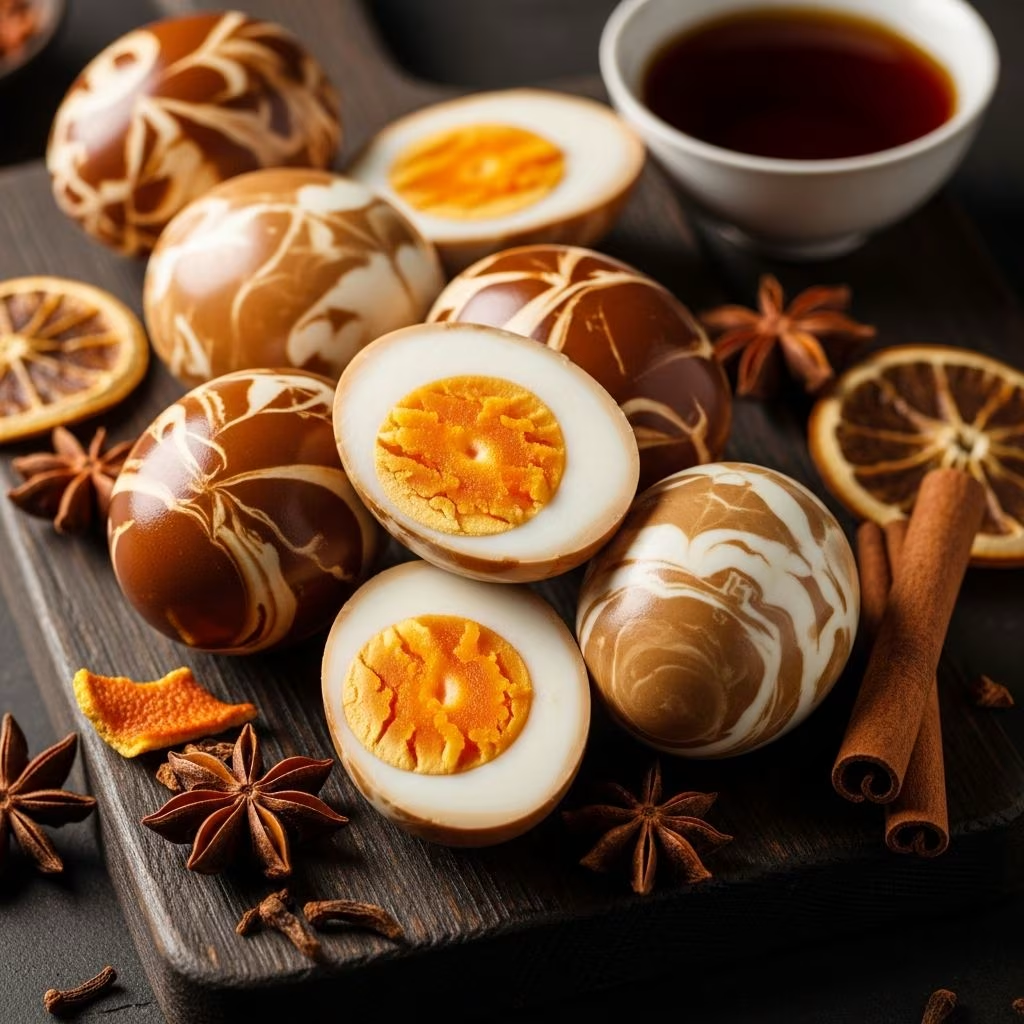
Marbled tea eggs offer a captivating blend of visual appeal and deep flavor, transforming ordinary eggs into a delicacy prized in Chinese cuisine. These eggs feature a distinctive cracked-shell pattern that allows a savory marinade of tea, soy sauce, and spices to seep in, creating intricate brown webs beneath the shell. Whether aiming for a creamy soft-boiled center or a firmer yolk, mastering this recipe elevates simple ingredients into an addictive snack.
Historical Roots and Cultural Appeal
Originating from street vendors in China, marbled tea eggs have become a staple convenience food across Asia. Their popularity stems from affordability, portability, and the unique infusion process that permeates the egg with earthy tea notes and warming spices. Traditionally prepared with hard-boiled eggs simmered for hours, modern adaptations allow for quicker methods while preserving authenticity.
The marbling effect, achieved by gently cracking cooked eggs before marinating, not only enhances aesthetics but also ensures even flavor distribution. This technique dates back centuries, symbolizing resourcefulness in using everyday pantry staples like black tea and soy for bold taste.
Essential Ingredients for Authentic Flavor
Building a robust marinade is key to success. Core components include black tea for its tannic depth, soy sauces for umami, and a spice bouquet for complexity.
- Black tea: 2 bags or 2 tablespoons loose leaves provide the signature hue and subtle bitterness.
- Soy sauces: Combine 4 tablespoons light soy with 2 tablespoons dark for balanced saltiness and color.
- Spices: Star anise, cinnamon stick, Sichuan peppercorns, and bay leaves infuse aromatic warmth; 1 teaspoon peppercorns, 1 star anise, 1 cinnamon stick, and 2 bay leaves suffice for 12 eggs.
- Eggs: 12 large eggs, preferably at room temperature to prevent cracking.
- Other additions: 2 teaspoons sugar, 1 teaspoon salt, and optional Shaoxing wine or ginger for extra layers.
For convenience, substitute with ½ teaspoon five-spice powder if whole spices are unavailable, yielding comparable results.
Step-by-Step Boiling Guide
Precision in boiling determines yolk texture: soft, medium, or hard. Start with eggs at room temperature to minimize shell cracks.
- Fill a pot with enough water to cover eggs; bring to a rolling boil over high heat.
- Gently lower eggs in using a ladle to avoid thermal shock.
- Adjust time based on preference:
- 5 minutes for soft-boiled (runny yolk).
- 7 minutes for medium (jammy yolk).
- 10 minutes for hard-boiled (firm yolk).
- Immediately transfer to an ice bath for 2-3 minutes to halt cooking and ease peeling.
This method ensures vibrant whites and prevents overcooking, crucial for soft-boiled versions where yolks remain creamy.
Creating the Perfect Marble Pattern
The magic lies in shell cracking. After cooling, tap each egg gently with a spoon’s back, creating fine fissures without fully breaking the shell. Rotate and tap multiple times for denser patterns. Avoid aggressive force, especially with soft-boiled eggs, to maintain integrity.
Pro tip: For intricate designs, roll eggs lightly on a hard surface post-tapping. The finer the cracks, the more detailed the marbling after marinating.
Marinade Preparation and Infusion
Combine marinade ingredients in a pot: soy sauces, spices, tea, sugar, salt, and 2½-5 cups water (scale to cover eggs).
- Bring to a boil over medium heat, then simmer 10 minutes to meld flavors.
- Cool completely; discard tea bags and large spices.
- Submerge cracked eggs in cooled marinade. Use a ziplock bag for efficiency or a container; ensure full coverage.
- Refrigerate 12-24 hours for standard flavor, or 2-3 days for deeper infusion where yolks absorb a light brown tint and richer taste.
Peeled marination halves time to 12 hours but skips marbling visuals.
Customization Options for Every Palate
| Variation | Key Additions | Marination Time | Best For |
|---|---|---|---|
| Spicy Kick | 1-2 dried chilies, extra Sichuan peppercorns | 24 hours | Heat lovers |
| Five-Spice Quick | ½ tsp five-spice powder | 12-18 hours | Beginners |
| Soft Yolk Deluxe | Shaoxing wine, ginger slices | 1-2 days | Creamy texture fans |
| Hard-Boiled Classic | Standard spices | 2-3 days | Street food authenticity |
Experiment with tea types like oolong for floral notes or green tea for lighter profiles, adjusting steep time to taste.
Storage, Serving, and Pairing Ideas
Stored submerged in marinade, tea eggs last up to a week in the fridge. For longer, drain and store airtight up to 5 days. Serve chilled as snacks, in ramen, or atop salads.
- Pair with congee for breakfast.
- Add to bento boxes for portable protein.
- Garnish with cilantro for appetizers.
Reheat gently in marinade if desired, but cold is traditional.
Troubleshooting Common Pitfalls
Encounter issues? Here’s how to fix:
- No marbling: Cracks too shallow; tap more firmly next time.
- Cracked eggs: Boil water too aggressively; lower gently.
- Bland flavor: Extend marination or boost soy.
- Green ring around yolk: Overboiling; stick to timed ice bath.
Nutritional Profile and Health Benefits
One tea egg delivers about 80 calories, 6g protein, and minimal carbs, making it a nutrient-dense snack. Tea’s antioxidants and spices’ anti-inflammatory properties add health perks. Opt for low-sodium soy for heart-friendly versions.
FAQ
Can I use quail eggs for tea eggs?
Yes, reduce boiling to 3-4 minutes and adjust marinade proportionally for bite-sized treats.
How do I achieve runny yolks safely?
Boil precisely 5 minutes and ice bath immediately to stop cooking.
Vegetarian-friendly?
Fully vegan if using plant-based alternatives, though eggs are animal-derived.
Can I reuse the marinade?
Yes, for another batch; reboil with fresh spices to refresh flavors.
Freezer-safe?
Best fresh; freezing alters texture, but possible peeled up to 1 month.
Advanced Techniques for Pros
For next-level results, pressure cook eggs 5 minutes for soft yolks, then marinate. Or infuse overnight in a sous-vide at 140°F for uniform flavor penetration without shell cracking risks. Experiment with lapsang souchong tea for smoky depth.
Scaling up? Double marinade for 24 eggs, maintaining ratios. Perfect for parties or meal prep.
References
- How to Make Soft-Boiled Chinese Tea Eggs (Recipe) 茶叶蛋 — Omnivore’s Cookbook (YouTube). Accessed 2026. https://www.youtube.com/watch?v=zFWMUx3vSQ4
- Chinese Tea Eggs (w/ Soft and Hard Boiled Eggs, 茶叶蛋) — Omnivore’s Cookbook. Accessed 2026. https://omnivorescookbook.com/chinese-tea-eggs/
- Tea Eggs Recipe — H.Y. Hanna. Accessed 2026. https://www.hyhanna.com/tea-eggs-recipe/
- Chinese Tea Eggs — The Woks of Life. Accessed 2026. https://thewoksoflife.com/chinese-tea-eggs/