Phyllo dough, known for its paper-thin layers that crisp up beautifully when baked, forms the foundation of many iconic Mediterranean and Middle Eastern pastries. Creating it from scratch allows bakers to achieve superior texture and flavor compared to commercial varieties, which often contain preservatives and lack the freshness of handmade versions. This guide explores the essentials of preparing phyllo dough, from ingredient selection to advanced rolling methods, empowering home cooks to produce professional results.
Understanding Phyllo: Origins and Qualities
Originating from Greek cuisine—where “phyllo” translates to “leaf”—this dough has been a staple in baking for centuries, used in dishes like baklava and tiropita. Its hallmark is extreme thinness, achieved through repeated stretching and layering, resulting in a flaky, airy quality when brushed with butter or oil and baked. Unlike puff pastry, which relies on steam for lift, phyllo depends on separation of layers for its signature crispness.
- Key characteristics: Translucent when raw, shatters when baked properly.
- Common uses: Savory pies, sweet desserts, appetizers.
- Storage advantage: Freezes well for up to three months if wrapped airtight.
Essential Ingredients for Success
The beauty of phyllo lies in its simplicity: just a handful of pantry staples yield impressive results. Flour provides structure, while liquids and fats ensure elasticity and tenderness.
| Ingredient | Role | Best Choices |
|---|---|---|
| Flour | Base structure | All-purpose or “00” flour for fineness |
| Water | Hydration | Warm (lukewarm) for better gluten development |
| Oil or Olive Oil | Tenderness | Extra virgin olive oil for flavor |
| Vinegar or Lemon Juice | Elasticity | Red wine vinegar to relax gluten |
| Salt | Flavor | Sea salt, about 1 tsp per 2 cups flour |
| Cornstarch | Prevent sticking | For dusting during rolling |
Proportions typically scale to 2 cups flour yielding 20-30 thin sheets. Warm water aids in activating gluten without overworking the dough.
Step-by-Step Dough Preparation
Begin by combining dry ingredients in a large bowl: sift flour and salt to ensure even distribution. Add oil and vinegar, rubbing them into the flour with fingertips until the mixture resembles coarse crumbs—this technique, common in traditional recipes, distributes fat evenly for flakiness.
- Mix wet and dry: Gradually incorporate warm water, kneading until a smooth, soft dough forms (5-10 minutes by hand or 2-3 minutes in a stand mixer with dough hook).
- Rest the dough: Cover with plastic wrap or a damp cloth and let it relax for 30-60 minutes at room temperature. This step is crucial for elasticity, allowing gluten strands to unwind.
- Divide: Portion into 8-30 equal balls, depending on desired sheet size. Dust lightly with cornstarch and cover to prevent drying.
For a basic recipe serving 12-15 sheets: 2 cups all-purpose flour, 3/4 cup warm water, 2 tbsp olive oil, 1 tsp salt, 1-2 tsp vinegar. Knead until satiny, not sticky.
Mastering the Rolling and Stretching Technique
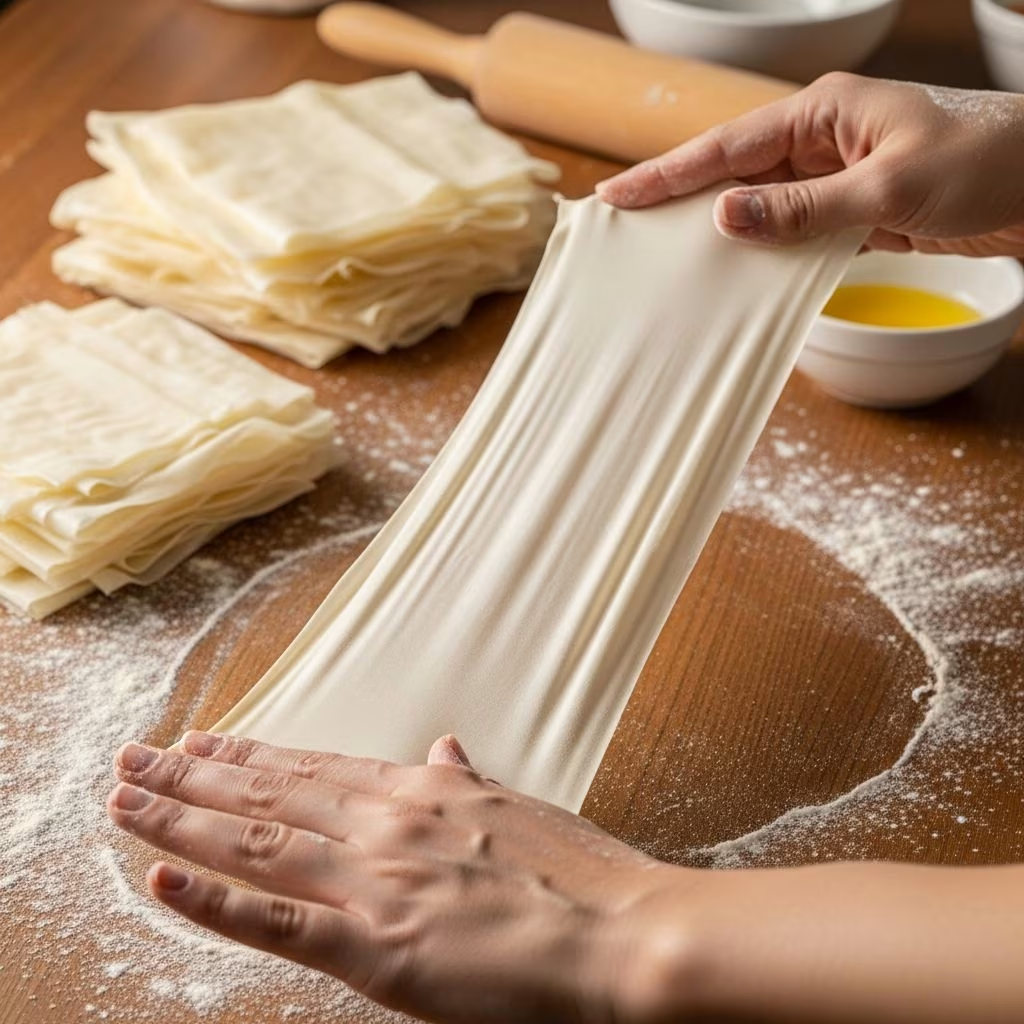
The true challenge—and reward—of phyllo making is achieving gossamer-thin sheets. Patience and a well-dusted surface are key.
Beginner Method (Stacked Rolling): Roll 4-5 small dough balls individually to palm-sized circles, dust generously with cornstarch, stack, and roll the stack together to 1/16-inch thickness. Gently peel layers apart. This mimics commercial processes and builds thinness progressively.
Advanced Stretching: On an oiled surface, roll a single ball to 6-8 inches, then use hands or a dowel to stretch outward from the center, rotating clockwise. Aim for 18-20 inches diameter, thin as tissue (about 0.01 inches). Cornstarch prevents tears.
- Tools needed: Rolling pin or thin dowel, large clean tablecloth or marble slab.
- Tips: Work in a warm, draft-free kitchen; keep unused dough covered.
Once stretched, sheets are ready for assembly or can be layered with butter, folded, and refrigerated before baking.
Perfecting the Bake: From Dough to Crispy Layers
Baking transforms raw phyllo into its flaky glory. Brush generously with melted butter or oil between layers to promote separation and browning.
- Preheat oven to 350-375°F (175-190°C).
- For plain sheets: Bake on parchment-lined trays 8-12 minutes until golden and puffed.
- In recipes: Layer with fillings, score tops, bake until crisp (40-50 minutes for pies).
Convection ovens yield even results; rotate trays midway. Cool completely before cutting to maintain structure.
Recipe Variations for Every Occasion
Adapt phyllo for diverse flavors and dietary needs.
- Savory Spinach Pie (Spanakopita): Layer 10 sheets phyllo with spinach-feta mix, butter-brushed; bake at 375°F for 45 minutes.
- Sweet Baklava: Stack 20+ sheets with nuts and syrup; cut before baking.
- Gluten-Free Option: Use rice flour blend with xanthan gum, add extra oil for binding.
- Quick Sweet Rolls: Spread with cinnamon-sugar, roll, slice, bake 20 minutes.
Experiment with whole wheat flour for nuttier taste or add herbs to dough for infused sheets.
Troubleshooting Common Issues
| Problem | Cause | Solution |
|---|---|---|
| Dough tears easily | Insufficient rest or dry environment | Rest longer; mist with water |
| Layers stick together | Too little dusting | Use more cornstarch between sheets |
| Not flaky after baking | Skipped butter brushing | Apply melted butter liberally |
| Dough too tough | Over-kneaded | Knead minimally; add vinegar next time |
Practice refines technique; start with thicker sheets to build confidence.
Storage and Make-Ahead Strategies
Fresh phyllo dries out quickly, so handle promptly. Trim to recipe size, layer with parchment, roll into logs, and freeze. Thaw overnight in fridge before use. Baked pastries store airtight up to 3 days or freeze for 1 month. Revive crisps by reheating at 300°F for 5-10 minutes.
Health Benefits and Nutritional Notes
Homemade phyllo controls ingredients: opt for olive oil for heart-healthy fats, reduce salt. A single sheet (unbaked) offers about 30 calories, mostly from flour. Paired with veggies or lean proteins, it fits balanced diets. Compared to store-bought, it avoids additives like TBHQ.
FAQs
Can I make phyllo without a pasta machine?
Yes, traditional methods use only hands and rolling pins for authentic thinness.
How thin should phyllo be?
Ideally, thin enough to read newsprint through it—about 0.01-0.02 inches.
Why add vinegar?
It tenderizes gluten, preventing tough dough and aiding stretchability.
Does phyllo work for vegan recipes?
Absolutely; use oil instead of butter between layers.
Can I reuse scraps?
Stack and re-roll scraps once; further rolling toughens them.
With practice, crafting phyllo becomes a rewarding skill, elevating everyday baking to artisanal levels. Its versatility invites endless creativity in both sweet and savory applications.
References
- Homemade Phyllo Dough Recipe — Yummy Tummy Aarthi. 2023. https://www.yummytummyaarthi.com/homemade-phyllo-pastry-recipe-how-to/
- Homemade Phyllo Dough — Caputo Flour. 2024. https://caputoflour.com/blogs/recipes/homemade-phyllo-dough
- Homemade Phyllo Pastry Recipe — Food.com. 2002 (updated 2023). https://www.food.com/recipe/homemade-phyllo-pastry-71214
- Easy recipe for phyllo dough sheets — YouTube (Video Transcript). 2023. https://www.youtube.com/watch?v=wBQfIFDGC3A
- How to make Homemade Phyllo — Kopiaste. 2007 (updated 2024). https://www.kopiaste.org/2007/11/how-to-make-dough-and-roll-out-phyllo/