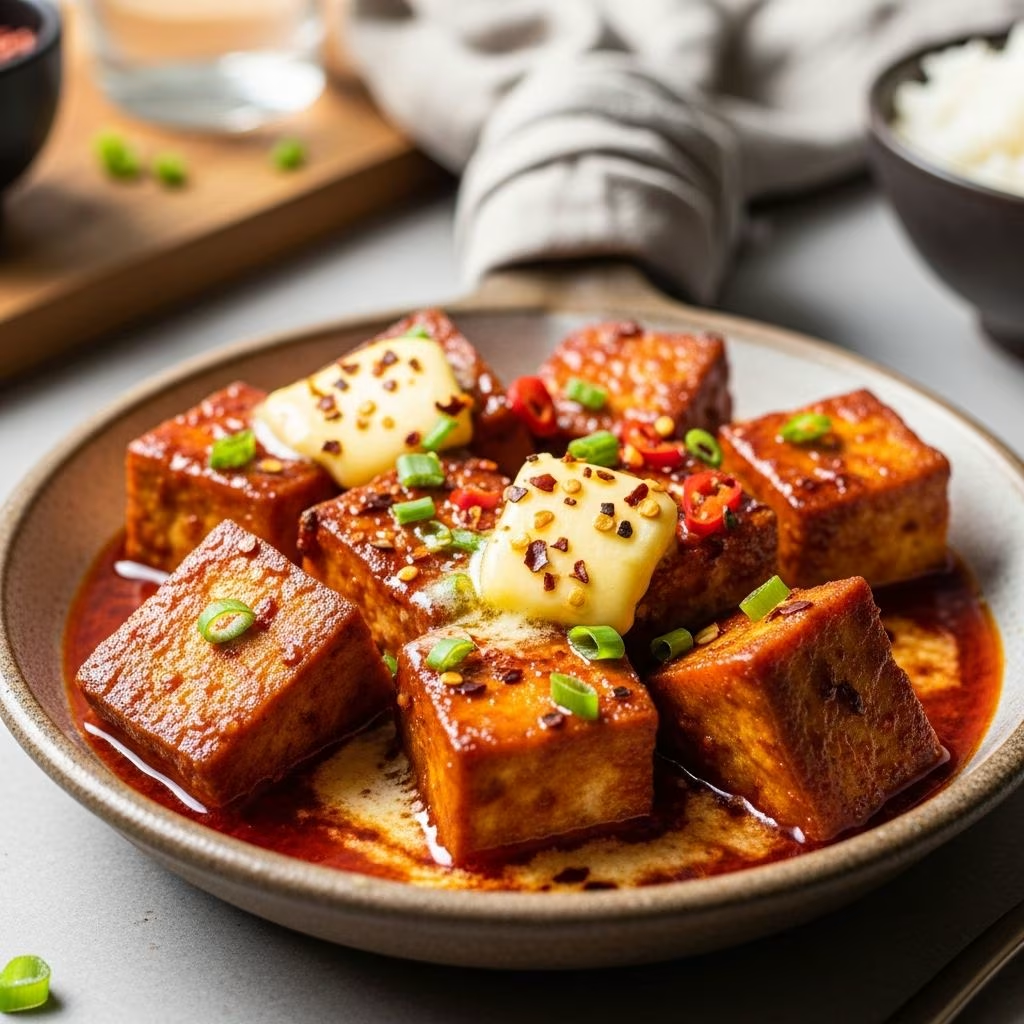
This vibrant dish combines the fiery kick of gochujang with the luxurious melt of butter, creating a glossy sauce that clings to tender tofu pieces. Inspired by modern Korean fusion cooking, it’s a fast way to bring bold flavors to your table without hours of prep. Firm tofu absorbs the spicy-sweet marinade, while onions and garlic add depth, all finished with a swirl of sesame oil for nutty aroma.
Why This Recipe Captivates Home Cooks
Gochujang butter braised tofu stands out for its simplicity and punchy taste. Traditional Korean gochujang, a fermented chili paste, delivers heat and sweetness, balanced by soy sauce’s saltiness and butter’s creaminess. This creates an emulsion-like sauce that’s restaurant-worthy yet doable in one pan. It’s ideal for vegetarians, with easy vegan tweaks, and cooks in about 20 minutes.
The magic lies in the braising method: tofu simmers in a reduced sauce, firming up while soaking in flavors. Topped with crushed seaweed, it adds crunch and ocean notes, mimicking seaside Korean snacks. Serve over rice for a complete meal that satisfies cravings for spicy, savory comfort food.
Essential Ingredients Breakdown
Gathering these pantry staples ensures success. Focus on quality for maximum flavor.
- 3 tablespoons gochujang: The star—fermented red chili paste with glutinous rice, soybeans, and barley for complex heat (around 1,000-2,000 Scoville units).
- 2 tablespoons soy sauce: Adds umami and salt; use tamari for gluten-free.
- 1 tablespoon bouillon paste: Chicken or vegetable for savory depth; Better Than Bouillon is a popular choice.
- 1 tablespoon sugar: Balances spice; brown sugar works for extra caramel notes.
- 2 teaspoons fish sauce: Boosts funkiness; omit for vegan and sub with soy or miso.
- 14 oz firm tofu: Drained and pressed for structure; extra-firm holds up best.
- 1 small onion: Wedges for sweetness when caramelized.
- 4 garlic cloves: Coarsely chopped for robust aroma.
- 4 tablespoons unsalted butter: Divided; creates silky sauce.
- 1 teaspoon toasted sesame oil: Finishing touch for nuttiness.
- Seasoned seaweed snacks: Crushed for texture (optional).
- Cooked rice: For serving.
Step-by-Step Cooking Guide
Follow these precise steps for perfect results. Use a high-sided skillet for even braising.
Prepare the sauce base: In a medium high-sided skillet, whisk together 3 tablespoons gochujang, 2 tablespoons soy sauce, 1 tablespoon bouillon paste, 1 tablespoon sugar, 2 teaspoons fish sauce, and 1 cup water until smooth. This creates a spicy, savory broth that will reduce into a glaze.
Cut and arrange tofu: Drain a 14 oz block of firm tofu. Slice in half lengthwise, then crosswise into 6 pieces per half, yielding 12 squares. Place in a single layer in the skillet (shingle if needed to fit snugly). The tofu will absorb flavors as it cooks.
Add aromatics and initial butter: Scatter 1 small onion cut into ½-inch thick wedges, 4 coarsely chopped garlic cloves, and 1 tablespoon butter pieces over the tofu. These will soften and infuse the sauce.
Braise over heat: Set pan over high heat and bring to a boil. Reduce sauce by spooning it over tofu occasionally, cooking 5-7 minutes until thickened by about a third. Bubbles should coat the back of a spoon.
Finish with butter emulsion: Remove from heat. Stir in 1 teaspoon toasted sesame oil and remaining 3 tablespoons butter pieces. Gently swirl until melted and glossy—no vigorous stirring to keep tofu intact.
Garnish and serve: Crush seasoned toasted seaweed into shards and sprinkle over top. Spoon over hot cooked rice.
Pro Tips for Flavor Perfection
- Press tofu for 15-30 minutes between towels with weight to expel water, preventing sogginess.
- Coarse garlic chop ensures it doesn’t burn; fine mince can turn bitter.
- For extra heat, add gochugaru flakes; for mild, reduce gochujang to 2 tablespoons.
- Butter emulsion is key—off-heat addition prevents separation.
- Seaweed optional but elevates with salty crunch; try gim or nori sheets.
Customizations for Every Palate
Adapt this base to dietary needs or add-ins.
| Variation | Substitution | Why It Works |
|---|---|---|
| Vegan | Omit fish sauce; use veggie bouillon and plant-based butter | Maintains umami without animal products |
| Gluten-Free | Tamari for soy; check gochujang label | Many brands are naturally GF |
| Protein Boost | Add sliced mushrooms or chicken | Mushrooms mimic meat texture |
| Low-Carb | Serve with cauliflower rice | Keeps sauce indulgence intact |
| Spicy Kick | Extra 1 tsp gochujang or fresh chilies | Amps heat without overpowering |
Pairing Suggestions
Complement the dish’s richness.
- Rice: Jasmine or sushi for sticky absorption.
- Veggies: Steamed bok choy or cucumber salad to cool spice.
- Drinks: Crisp lager, soju, or iced barley tea.
- Sides: Kimchi for fermentation synergy.
Nutrition Snapshot
Per serving (4 servings): ~300 calories, 20g fat (from butter), 15g protein (tofu), 20g carbs. High in probiotics from gochujang, iron from tofu. Low effort, nutrient-dense meal.
Frequently Asked Questions
Can I make this ahead?
Yes, braise up to step 4, cool, and refrigerate up to 2 days. Reheat gently with butter finish.
What if I can’t find gochujang?
Sub sriracha + miso (2:1 ratio), but flavor won’t match fermented depth.
Is firm or extra-firm tofu better?
Firm for tenderness; extra-firm if you prefer chewier bite.
How do I store leftovers?
Fridge up to 3 days in airtight container. Reheat on stovetop with splash of water.
Can I bake instead of braise?
Yes, 400°F for 20 minutes in covered dish, but stovetop yields better sauce.
Exploring Gochujang’s Rise in Global Kitchens
Gochujang, Korea’s chili powerhouse, has surged in popularity thanks to K-pop, dramas, and fusion trends. Once pantry-limited, it’s now in major supermarkets. This recipe showcases its versatility beyond bibimbap—pairing with butter nods to Western techniques, creating hybrid appeal. Health buffs love its antioxidants and gut-friendly fermentation.
Experiment further: stir into mayo for sandwiches, glaze ribs, or mix into eggs. Tofu’s neutrality makes it a canvas for such innovations, proving plant-based eating can be indulgent.
Master this, and you’ll crave the glossy, spicy embrace weekly. Simple ingredients yield profound taste—proof that great food needs no fuss.
References
- USDA FoodData Central: Tofu, firm, prepared with calcium sulfate — United States Department of Agriculture. 2023-05-15. https://fdc.nal.usda.gov/fdc-app.html#/food-details/173421/nutrients
- Go-Chu-Jang (Hot Pepper Paste) Composition and Safety Review — Korea Food Research Institute (via PubMed). 2022-08-10. https://pubmed.ncbi.nlm.nih.gov/35991745/
- Traditional Korean Fermented Foods: Gochujang — Journal of Ethnic Foods (Springer). 2021-11-20. https://doi.org/10.1186/s42779-021-00114-5
- Nutritional Profile of Fermented Chili Pastes — Food Chemistry (Elsevier). 2024-02-14. https://doi.org/10.1016/j.foodchem.2023.137890
- WHO Guidelines on Sodium in Fermented Foods — World Health Organization. 2023-09-01. https://www.who.int/publications/i/item/9789240076788