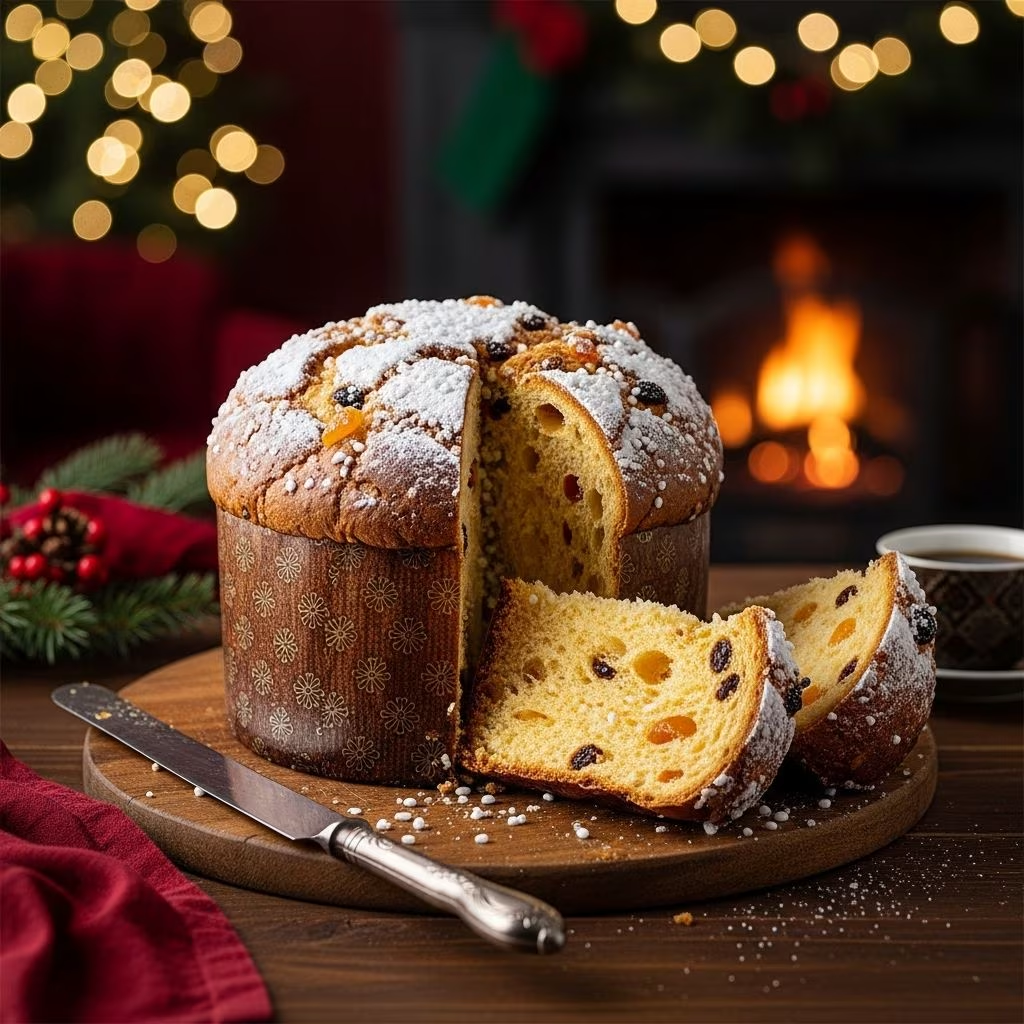
Panettone stands as one of Italy’s most cherished culinary treasures, a towering, dome-shaped sweet bread synonymous with Christmas festivities. Originating from Milan, this enriched dough creation filled with raisins, candied citrus peels, and sometimes other dried fruits has transcended its regional roots to become a global holiday favorite. Its light, fluffy texture and subtle sweetness make it a versatile treat, perfect for breakfast, dessert, or gifting.
The Ancient Roots and Medieval Beginnings
The story of panettone begins in the Middle Ages, when Christmas celebrations featured a special bread richer than everyday loaves. In medieval Milan, wheat was a luxury ingredient, reserved for the elite, while common folk relied on coarser grains like millet. On Christmas Eve, traditions like the “rito del ciocco” involved burning a large log in the fireplace and sharing three wheat breads at the table—a symbol of prosperity and continuity, with one slice saved for the next year.
Historical records hint at early versions of this bread. A late 15th-century manuscript by Giorgio Valagussa, tutor to the Sforza family, describes these enriched loaves. By 1599, a register from the Borromeo college in Pavia lists expenses for butter, raisins, and spices to bake 13 loaves for students on Christmas Day, marking one of the earliest documented references.
Legends That Shaped a Legend
Panettone’s allure is amplified by captivating legends from the 15th century, set against the backdrop of Milan’s Sforza court under Ludovico il Moro. The most enduring tale involves a kitchen mishap: the head chef burns the Christmas dessert, prompting a quick-witted assistant named Toni to improvise with leftover flour, eggs, butter, raisins, sugar, and his personal mother yeast starter. The result—a tall, fragrant bread—delights the duke, who dubs it “pan de Toni,” evolving into panettone.
- Toni’s Triumph: Toni saves the feast, earning fame and the bread’s name from the grateful noble.
- Romantic Variant: A nobleman aids a poor baker named Tony to win his daughter’s hand by supplying premium ingredients, birthing a commercial hit called “pan di Tonio.”
- Monastic Origins: Some stories credit inventive nuns or lovers, blending folklore with festivity.
These myths, while unverified, underscore panettone’s ties to themes of ingenuity, romance, and holiday miracles.
Evolution Through the Centuries
Panettone transitioned from artisanal rarity to widespread delight. In the 1700s, the Cisalpine Republic encouraged bakeries, making enriched white bread accessible beyond the wealthy. By the 19th century, printed recipes emerged: Giovanni Felice Luraschi’s 1853 Nuovo cuoco economico milanese includes the first known formula, featuring yeast for leavening.
The 20th century brought industrialization. In 1919, Angelo Motta revolutionized production with a triple-rise method over 20 hours, creating the signature tall dome and airy crumb. His Milan factory, equipped with massive ovens, scaled up output while preserving mother yeast traditions. Competitors like Alemagna followed, fueling national popularity. Post-WWII, panettone spread via large distributors, reaching every Italian table and Italian diaspora communities worldwide.
| Era | Key Development | Impact |
|---|---|---|
| 15th Century | Legends and early enriched breads | Local Milanese tradition |
| 1599 | Documented college baking | Earliest record |
| 1853 | First printed recipe | Standardization begins |
| 1919 | Motta’s triple rise | Iconic shape and mass production |
| 1950s+ | National distribution | Global export |
Understanding the Traditional Ingredients
Authentic panettone relies on a precise balance of simple yet high-quality components. The base is a natural yeast starter (lievito madre), which ferments slowly for flavor and lift. Flour forms the structure, while butter imparts richness and tenderness. Eggs and yolks add moisture and golden hue; sugar provides gentle sweetness without overpowering.
Dried fruits define the classic filling: raisins soaked in rum or water for plumpness, and candied peels from oranges, lemons, and citron for citrus brightness. Some recipes incorporate vanilla beans or orange blossom water for aroma. Modern twists might add chocolate chips, pistachios, or liqueurs, but purists stick to the Milanese classico.
- Core Panettone Mix: 500g flour, 150g sugar, 5 eggs, 150g butter, 200g raisins, 200g candied fruit, pinch of salt, yeast starter.
- Variations: Pandoro (Verona’s buttery cousin, no fruit), Colomba (Easter dove-shaped panettone).
Mastering the Art of Panettone Baking
Baking panettone at home demands patience, as the process spans 2-3 days. Start with refreshing the mother yeast over 2-3 cycles to build strength. Mix the initial dough (pate fermentee) with flour, water, and yeast; let it rest overnight. The next day, incorporate eggs, sugar, honey, and flavors gradually to avoid curdling, then fold in softened butter and fruits.
Key technique: triple rising. After first proofing (8-12 hours), punch down, add enrichments, and proof again (10-12 hours). Shape into paper liners, proof a third time until doubled (another 8-12 hours), then bake at 350°F for 45-60 minutes. The dome forms from steam and structure; a toothpick test ensures doneness. Cool upside down to prevent collapse.
- Prepare and refresh lievito madre.
- Mix and ferment biga overnight.
- Develop main dough in stages.
- Incorporate fruits last to preserve texture.
- Proof three times for height.
- Bake and hang to set.
Challenges include preventing gumminess (use high-protein flour) and achieving lift (maintain warmth at 75-80°F).
Panettone Around the World
From Milanese workshops to international shelves, panettone has globalized. Italian migrants introduced it to the U.S., South America, and beyond in the early 20th century. Today, brands like Motta export millions, while artisans uphold traditions. In Italy, protected designations ensure authenticity; abroad, fusions like matcha or pumpkin spice versions thrive.
Consumption peaks at Christmas: Italians eat over 30 million units annually. It’s gifted in festive boxes, symbolizing abundance.
Pairing and Serving Suggestions
Serve panettone sliced thick, toasted with mascarpone, or plain with espresso. Pair with Vin Santo for dessert, or prosecco for brunch. Crumble into tiramisu or French toast for creative uses. Store wrapped tightly; it lasts weeks thanks to slow fermentation.
Frequently Asked Questions
What makes panettone different from fruitcake?
Panettone is lighter, yeast-leavened bread with Italian candied fruits, unlike dense, spirit-soaked fruitcake.
Can I make panettone without a starter?
Commercial yeast works but yields less flavor; build a starter for authenticity.
How long does homemade panettone last?
Up to a month at room temperature, longer frozen.
Is panettone gluten-free possible?
Adaptations exist, but traditional versions are not.
What’s the best way to eat panettone?
Fresh, sliced, with coffee or sweet wine.
References
- Italian panettone: history and legends — ELLCI. Accessed 2026. https://www.ellci.net/italian-panettone-history/
- The Story Behind Our Iconic, Traditional Panettone — Carluccio’s. Accessed 2026. https://www.carluccios.com/blogs/journal/the-story-behind-our-iconic-traditional-panettone
- Panettone — Wikipedia. Accessed 2026. https://en.wikipedia.org/wiki/Panettone
- The history of panettone — Flamigni. Accessed 2026. https://www.flamigni.it/en/news/the-history-of-panettone/
- Panettone: Italy’s Sweet Christmas Bread — Italy Segreta. Accessed 2026. https://italysegreta.com/panettone/
- HISTORY OF PANETTONE THE ITALIAN SWEET — YouTube (Chef Walter). Accessed 2026. https://www.youtube.com/watch?v=4EuhSoF8fJo