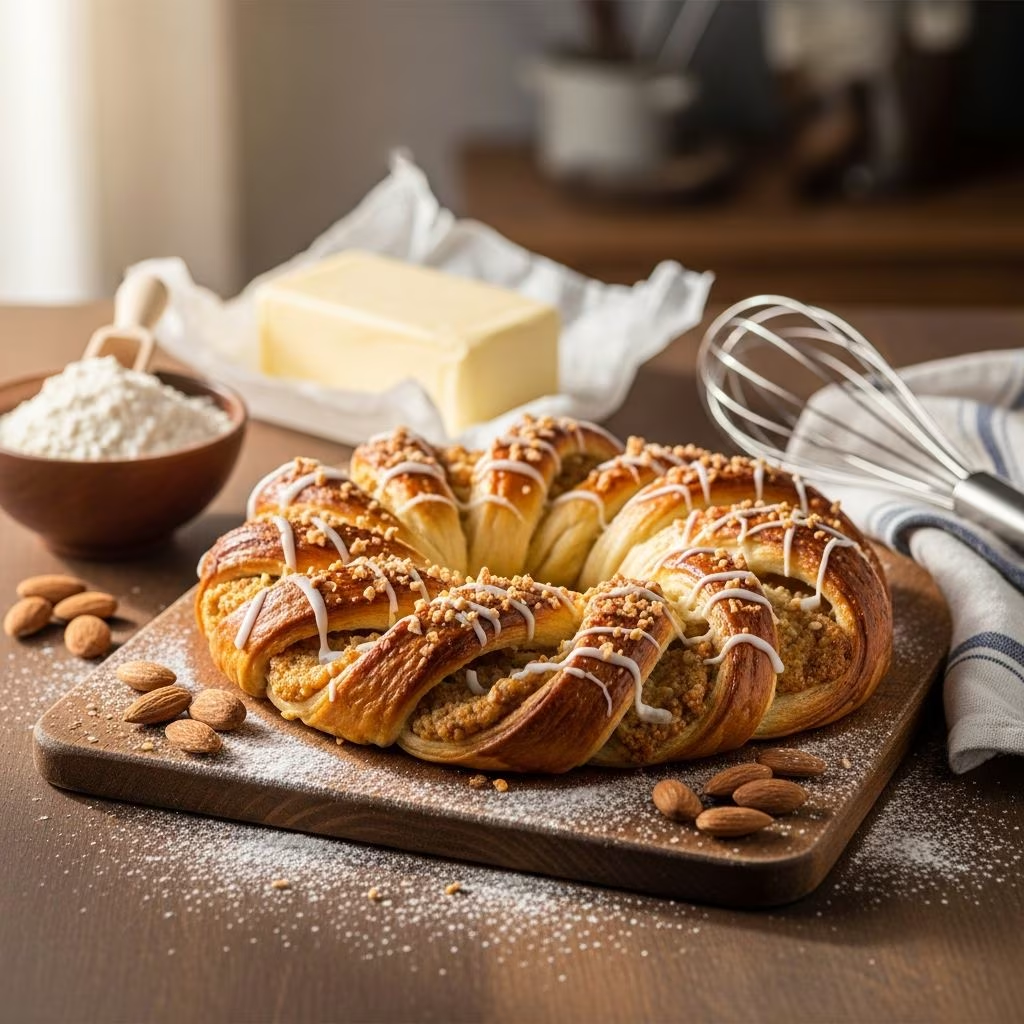
Kringle is a buttery, flaky pastry with deep roots in Northern European baking traditions, particularly Denmark, where it evolved into a beloved treat shaped like a pretzel and filled with sweet delights. This article guides you through its fascinating history, provides a reliable homemade recipe, explores variations, and shares techniques for bakery-quality results at home.
The Origins and Evolution of Kringle
Kringle traces its beginnings to the 13th century when Roman Catholic monks introduced pretzel shapes to Denmark, laying the foundation for what would become a staple in Scandinavian cuisine. Over centuries, this simple form transformed into an array of sweet and savory pastries, characterized by their distinctive twisted, oval, or ring shapes.
In Denmark, kringle—known locally as part of the broader Wienerbrød category—featured almond fillings and was crafted using laminated dough techniques borrowed from Austrian bakers during a labor strike in Copenhagen. Danish bakers adopted the method of layering butter between yeast dough, creating the signature flakiness that defines modern versions.
The pastry’s journey to America began in the late 19th century with Danish immigrants settling in Racine, Wisconsin. This city became the epicenter of kringle production, boasting more bakeries per capita than anywhere else due to its large Danish population. Immigrants like those who founded family-run shops preserved and adapted the recipe, turning it into an oval-shaped coffee cake often topped with icing and nuts.
Kringle’s Rise in American Baking Culture
Racine earned the nickname ‘Kringle Capital of the World’ as Danish bakers introduced their craft to the Midwest. By the early 20th century, kringles were a fixture in local bakeries, shipped nationwide and celebrated in community events. One legendary tale from Racine recounts a dying man named Lars Larson, who on his deathbed requested a taste of kringle, highlighting its emotional and cultural significance.
Swedish immigrants also influenced Midwestern versions, leading to hybrids like ‘Swedish kringle’—a choux pastry-based oval with almond glaze, distinct from the traditional Danish laminated style. These adaptations appeared in church cookbooks and family recipes across Minnesota and Wisconsin, blending Scandinavian emigration waves with American ingenuity.
Today, third-generation bakeries continue the tradition, innovating with flavors while honoring the butter-laminated dough that sets authentic kringle apart from puff pastry or croissant mimics.
Essential Ingredients for Authentic Kringle
Creating kringle at home requires high-quality ingredients and patience. The dough’s magic comes from laminating cold butter into yeast dough, similar to croissants but with a sweeter profile.
- Flour: Bread flour for structure, about 4 cups.
- Yeast: Active dry, 2 teaspoons for gentle rise.
- Butter: Unsalted, 1 pound, kept ice-cold for layering.
- Sugar and Salt: For balance, 1/4 cup sugar and 1 teaspoon salt.
- Milk and Eggs: Whole milk for richness, eggs for tenderness.
- Fillings: Almond paste, fruit preserves, or cheese for variety.
- Glaze: Powdered sugar, milk, almond extract.
These components ensure the pastry’s tender, flaky layers and moist interior.
Step-by-Step Guide to Homemade Kringle
Baking kringle spans 2-3 days due to resting periods, but the result is worth it. Yields two 12-inch kringles.
Day 1: Prepare the Dough
- Warm 1 cup milk to 110°F, dissolve 2 tsp yeast and 1/4 cup sugar. Let sit 5 minutes.
- Mix in 3.5 cups bread flour, 1 tsp salt, 1 egg, and 1/4 cup softened butter. Knead into a smooth dough (5-7 minutes).
- Roll into a 12×18-inch rectangle on floured surface. Chill 30 minutes.
Day 1: Laminate the Butter Block
- Place 3/4 lb cold butter between parchment, pound to 8×12-inch rectangle.
- Position dough over butter, fold edges to enclose like a letter. Roll to 8×24 inches, fold in thirds (first turn). Chill 1 hour.
- Repeat rolling and folding for 3 more turns, chilling 1 hour between each. Wrap and refrigerate overnight.
Day 2: Shape and Fill
- Roll chilled dough to 10×30 inches. Cut into two 5×30 strips.
- Spread 1/2 cup softened almond paste (or filling) down the center of each.
- Fold sides over filling, seal, and twist into an oval on parchment-lined sheet. Pinch ends.
- Cover loosely, proof 1-2 hours until puffy.
Day 2: Bake and Finish
- Preheat oven to 375°F. Brush with egg wash (1 egg + 1 tbsp water).
- Bake 25-30 minutes until golden. Cool completely.
- Whisk 1 cup powdered sugar, 2 tbsp milk, 1/2 tsp almond extract for glaze. Drizzle over, sprinkle sliced almonds.
Store airtight up to 3 days or freeze unbaked for later.
Popular Filling Variations
Experiment beyond almond for personalized kringles. Here’s a comparison:
| Filling | Ingredients | Flavor Profile | Best For |
|---|---|---|---|
| Almond Paste | Blanched almonds, sugar, egg white | Nutty, marzipan-like | Traditional Danish |
| Cheese | Farmer’s cheese, sugar, lemon zest | Creamy, tangy | Breakfast |
| Cherry | Preserves, pecans | Tart, fruity | Holidays |
| Pecan | Chopped pecans, brown sugar | Caramelized, crunchy | Fall baking |
| Raspberry Cream Cheese | Jam, cream cheese | Sweet-tart, smooth | Summer treats |
Swedish-style uses choux for lighter texture.
Troubleshooting Common Kringle Issues
- Flat Layers: Butter too warm during lamination—keep under 68°F.
- Dense Dough: Insufficient resting; allow full proofing time.
- Cracked Shape: Over-twist gently; use parchment for easy transfer.
- Soggy Bottom: Bake on preheated stone or double-pan.
- Uneven Rise: Proof in warm, draft-free spot (75-80°F).
Patience with chilling prevents these pitfalls.
Storage, Freezing, and Shipping Tips
Fresh kringle shines within 48 hours. Wrap tightly in foil for 3-5 days at room temp, or refrigerate up to a week. Freeze baked (up to 3 months) or unbaked logs (2 months). Thaw overnight, proof, and bake. For gifting like Racine bakeries, use insulated boxes with ice packs—kringle travels well due to sturdy shape.
Healthier Twists and Dietary Adaptations
Substitute half flour with whole wheat or almond flour for nuttier profile. Use plant-based butter and fillings for vegan versions. Reduce sugar by 25% in fillings—natural fruit sweetness suffices. Each slice (1/12 kringle) offers about 300 calories, balanced by protein from nuts.
Pairing Suggestions for Kringle
- Coffee or Tea: Black coffee cuts richness; chai enhances almond.
- Wines: Sparkling Riesling or Port for dessert pairing.
- Cheese: Mild Brie contrasts flakes.
- Fruits: Fresh berries temper sweetness.
Frequently Asked Questions (FAQs)
What makes kringle different from Danish or croissant?
Kringle uses sweeter yeast dough with more folds for oval shape and fillings, unlike plain croissants.
Can I make kringle without lamination?
Yes, Swedish-style choux is simpler but lacks flakiness.
How long does kringle keep?
3 days room temp, 1 week chilled, 3 months frozen.
Is Racine kringle the only authentic kind?
No, but it’s the American standard; Danish originals are pretzel-shaped.
Best tools for home bakers?
Rolling pin, bench scraper, digital scale for precision.
Why Kringle Endures as a Holiday Favorite
From monastic origins to Midwest icon, kringle embodies heritage and indulgence. Its labor-intensive process rewards bakers with a showstopper perfect for gatherings. Whether traditional almond or inventive pecan, mastering kringle connects you to centuries of culinary history.
References
- Danish Kringle History and Recipe — WhatsCookingAmerica.net. Accessed 2026. https://whatscookingamerica.net/bread/kringle.htm
- The Swedish kringle that wasn’t – The bakers’ cottage — Fanny Zanotti Substack. Accessed 2026. https://fannyzanotti.substack.com/p/the-swedish-kringle
- Kringle — Wikipedia. Accessed 2026. https://en.wikipedia.org/wiki/Kringle
- Exploring Racine’s Kringle Legacy and Danish-American — Oh Danish Bakery. Accessed 2026. https://www.ohdanishbakery.com/hygge-blog/danish-culture/history-of-danish-pastries-in-racine
- Our History — Kringle.com. Accessed 2026. https://www.kringle.com/about/our-history
- The Kringle Chronicles: The History of Our Famous Kringle — Uncle Mike’s Bake Shoppe. Accessed 2026. https://unclemikesbakeshoppe.com/blogs/knead-to-know/the-kringle-chronicles-the-history-of-our-famous-kringle-and-what-makes-ours-different