Delicate and nearly translucent, banh cuon wrappers form the heart of this beloved Vietnamese dish. These steamed rice sheets, rolled around savory fillings and topped with fresh herbs, offer a unique texture that’s chewy yet tender. Making them at home requires precision but rewards with fresh, customizable results far superior to store-bought versions.
Understanding the Essence of Banh Cuon
Banh cuon, or steamed rice rolls, trace their roots to northern Vietnam, where street vendors skillfully steam thin batter layers over cloth screens. The wrappers must be paper-thin to achieve their signature see-through quality, allowing the vibrant fillings and toppings to shine through. Home cooks can replicate this using common tools like nonstick pans or improvised steamers, adapting traditional methods for modern kitchens.
The magic lies in the batter’s simplicity: rice flour provides structure, while tapioca flour adds elasticity and translucency. Water hydrates the mix, and a touch of oil prevents sticking. Resting the batter allows starches to hydrate fully, ensuring even cooking without lumps.
Perfecting the Batter Recipe
A reliable batter sets the foundation for success. Start with high-quality rice flour and tapioca flour, sifted to remove clumps. Proportions vary slightly by recipe, but a common ratio balances chewiness and fragility.
| Ingredient | Quantity | Role |
|---|---|---|
| Rice flour | 1 cup (about 120-150g) | Main structure and mild flavor |
| Tapioca flour | 1 cup (about 120-140g) | Elasticity and transparency |
| Water (room temp) | 4 cups | Hydration for thin consistency |
| Vegetable oil | 1 tbsp | Prevents sticking |
| Salt | 1 tsp | Enhances flavor |
Mix dry ingredients in a large bowl, then gradually whisk in water and oil until smooth. Let rest for 30 minutes to 8 hours; longer rests improve texture by settling impurities, which can be poured off and replaced with fresh water. This step, noted in traditional preparations, cleans the flour naturally.
Essential Tools for Steaming Success
No fancy equipment is needed, though options abound:
- Nonstick pan method: An 8-inch pan with a lid mimics vendor setups. Ideal for beginners.
- Steamer cloth setup: Stretch muslin over a pot ring, secure tightly. Pour batter directly for authentic thinness.
- Plate steamer: Use a heatproof plate in a wok with boiling water below.
- Offset spatula or silicone brush for spreading.
- Chopping board or tray for rolling.
Practice flipping or peeling wrappers quickly to avoid tears. Initial attempts may fail, but rhythm develops fast.
Crafting the Savory Filling
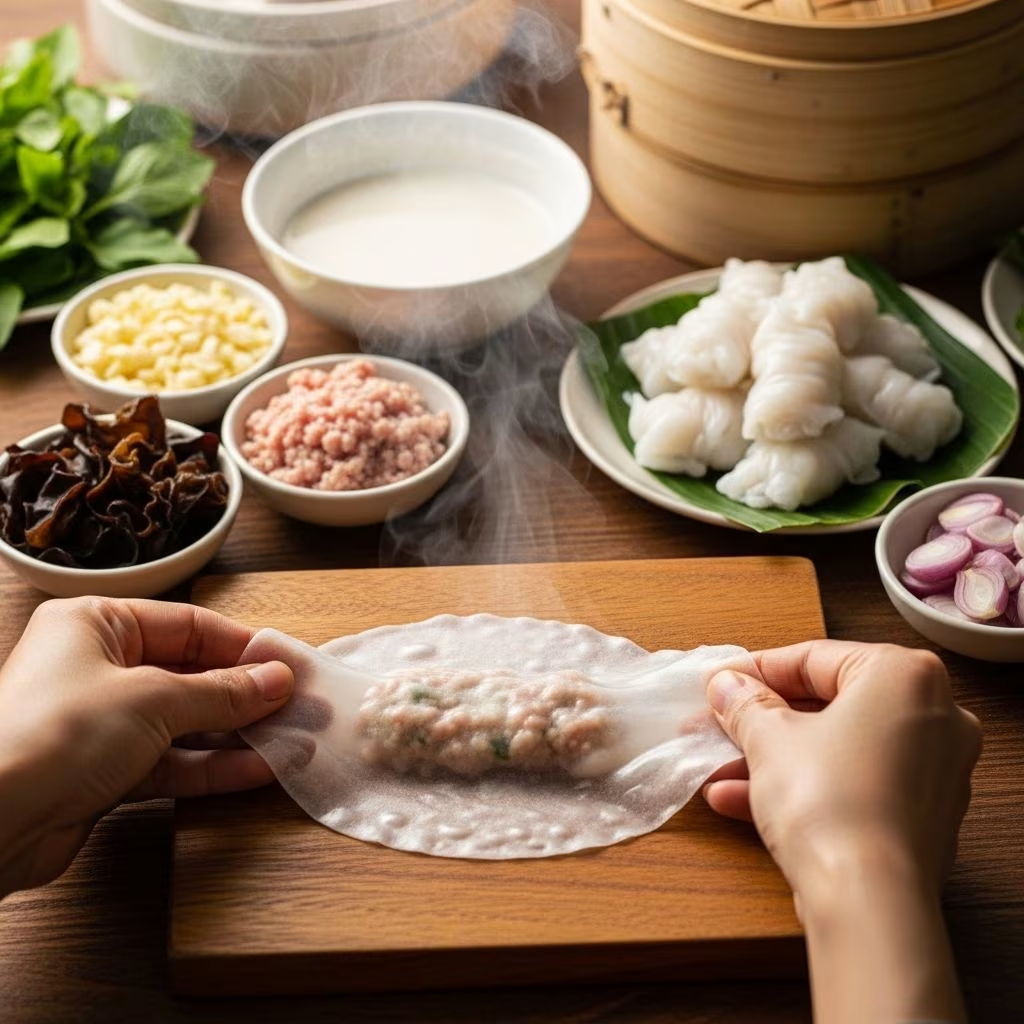
The contrast of silky wrappers and crunchy, umami-packed filling defines banh cuon. Ground pork is classic, enhanced by rehydrated wood ear mushrooms for texture and subtle earthiness.
Step-by-Step Filling Guide
- Soak ½ cup dried wood ear mushrooms in hot water for 20-30 minutes until plump. Drain, chop finely.
- Marinate 1 lb ground pork with 2 tsp fish sauce, 1 tsp sugar, 1 tsp pepper for 10 minutes.
- Sauté minced onion (½ yellow) in 1 tbsp oil until fragrant, add pork and mushrooms. Cook 2-3 minutes until browned. Cool completely.
Variations include jicama for crunch or shallots for aroma. Keep filling moist but not watery to prevent soggy rolls.
Steaming and Forming the Wrappers
Pan-Steam Technique
Heat pan over low-medium. Stir batter, ladle ⅛ cup (thin layer). Cover, steam 1-2 minutes until edges lift and center sets translucently. Invert onto oiled surface; wrapper should release cleanly. Cool 10 seconds, add 1 tbsp filling, roll tightly like a cigar. Repeat, greasing surfaces as needed.
Cloth Steamer Method
Boil water in steamer pot. Stir batter, ladle onto taut cloth, spread thinly with spatula. Steam 30-60 seconds until translucent. Scrape off gently. This yields the most authentic delicacy but requires taut fabric to prevent pooling.
Tips for perfection: Maintain low steam to avoid overcooking; stir batter each time; work in batches to keep rhythm.
Assembling and Serving with Flair
Plate rolls generously. Drizzle scallion oil (fried green onions in oil). Top with sliced cha lua (Vietnamese ham), julienned cucumber, bean sprouts, fried shallots, and mint. Serve with nuoc cham—a tangy fish sauce dip mixing lime, sugar, garlic, chili, and fish sauce.
- Nuoc cham base: ¼ cup fish sauce, ¼ cup lime juice, 2 tbsp sugar, ½ cup water, minced garlic/chili.
For variety, add sliced pork sausage or extra herbs like Thai basil. Enjoy warm for best texture.
Troubleshooting Common Challenges
Wrappers tearing? Batter too thick—add water incrementally. Sticky pans? More oil in batter or surface. Uneven steaming? Consistent low heat and quick spreading.
| Issue | Solution |
|---|---|
| Lumpy batter | Sift flours; rest and stir well |
| Thick wrappers | Thinner ladle; spread faster |
| Dry rolls | Drizzle oil; serve immediately |
| Bland filling | Adjust fish sauce/pepper |
Time-Saving Hacks for Busy Cooks
Premixed flours from Asian markets simplify prep. For ultra-quick versions, soften rice paper in water, fill, and mimic steaming effect—though less authentic. Batch-freeze fillings or wrappers for future meals.
Health Twists and Variations
Swap pork for ground chicken or tofu. Use less oil, more veggies like carrot or mung bean sprouts. Gluten-free by nature, these rolls suit many diets.
Frequently Asked Questions (FAQs)
What if I can’t find wood ear mushrooms?
Substitute shiitake or omit; they add crunch but aren’t essential.
Can I make batter ahead?
Yes, refrigerate up to 24 hours; whisk before use.
How do I store leftovers?
Layer with plastic wrap; refrigerate 2 days. Reheat by steaming.
Is tapioca flour necessary?
Vital for chewiness; potato starch works in pinch.
Vegetarian version?
Use mushrooms, tofu, onions; season with soy sauce.
Scaling for Crowds
Double batter for 8 servings. Prep filling in advance. Steam in assembly line for efficiency. Pairs well with pho or spring rolls at gatherings.
Mastering banh cuon transforms home cooking, blending patience with bold flavors. Experiment confidently for your signature twist.
References
- My Grandma’s Banh Cuon – Cooking Therapy — Becca Du. 2023 (approx.). https://www.cooking-therapy.com/banh-cuon-recipe/
- Bánh Cuốn (Steamed Rice Rolls) | Simple Vietnamese Food — Simple Vietnamese Food. 2023 (approx.). https://simplevietnamesefood.com/banh-cuon-steamed-rice-rolls/
- Bánh Cuốn / Bánh Ướt Recipe (Vietnamese Rice Rolls) – Hungry Huy — Hungry Huy. 2023 (approx.). https://www.hungryhuy.com/banh-cuon/
- Easy Shortcut for Rice Rolls Recipe (Bánh Cuốn) – FeedMi — FeedMi. 2023 (approx.). https://www.feedmi.org/easy-rice-rolls-recipe/