There is something deeply satisfying about simmering a pot of homemade chicken broth on the stovetop. Unlike commercially packaged broths that line supermarket shelves, a pot of broth you’ve made yourself carries a richness and depth of flavor that transforms everyday meals into something more meaningful. The process itself is remarkably straightforward, requiring minimal hands-on time while delivering results that far surpass anything produced in a factory setting.
Making chicken broth at home is an economical choice that also reduces waste. Rather than purchasing expensive containers of broth week after week, you can prepare large batches and freeze them for months. This guide walks you through the entire process, from selecting your ingredients to properly storing your finished broth for future use.
Understanding the Foundation: Quality Ingredients Matter
The foundation of excellent broth begins with thoughtful ingredient selection. The most critical component is the chicken itself. You’ll want to use whole roasting chickens rather than parts, as the bones and connective tissue contribute essential gelatin and minerals that create a silky mouthfeel in the finished broth. Roasting chickens typically weigh between four and five pounds each, providing substantial bone structure and meat.
Beyond chicken, your aromatics create the flavor profile. These supporting players—vegetables and herbs—shouldn’t be overlooked. Fresh, quality aromatics make an enormous difference in the final product’s taste and nutritional profile.
The Essential Vegetables
- Yellow onions — These should remain unpeeled; the papery skin adds color and subtle sweetness to the broth. Quartering them releases their natural juices during the long simmer.
- Carrots — Their natural sugars caramelize slightly during cooking, contributing a gentle sweetness and golden hue. Leave the skin on for additional nutrients and flavor compounds.
- Celery stalks — Often overlooked, celery provides an herbaceous backbone to your broth. The leaves contain concentrated flavor, so don’t discard them.
- Parsnips — These root vegetables add earthy undertones and subtle complexity. While optional, they elevate the broth to a more sophisticated level.
- Garlic — A whole head, unpeeled and halved, mellows considerably during the extended cooking time, imparting a gentle savory note rather than sharp garlic bite.
Fresh Herbs and Seasonings
Fresh herbs are non-negotiable in quality broth. Dried herbs often become bitter during extended cooking, while fresh herbs maintain their character and contribute aromatic complexity.
- Flat-leaf parsley — Provides subtle grassiness and freshness to balance richer flavors
- Fresh thyme — Adds earthy, almost minty notes that complement chicken beautifully
- Fresh dill — Contributes distinctive brightness and a faint anise character
- Whole black peppercorns — Ground pepper becomes dusty and bitter during long cooking; whole peppercorns maintain their integrity and flavor
- Kosher salt — Use quality kosher salt, not iodized table salt, which can impart metallic flavors
Ingredient Quantities and Proportions
Understanding proper proportions ensures balanced, flavorful broth rather than something too weak or overly concentrated.
| Ingredient | Quantity | Notes |
|---|---|---|
| Roasting chickens | 3 whole birds (5 lbs each) | Provides essential collagen and protein |
| Yellow onions | 3 large, quartered | Leave skin on for color and nutrients |
| Carrots | 6 whole, halved | Unpeeled; provides natural sweetness |
| Celery stalks with leaves | 4 stalks, cut in thirds | Essential for herbaceous backbone |
| Parsnips | 4 whole, halved (optional) | Adds earthy complexity |
| Fresh parsley sprigs | 20 sprigs | Use flat-leaf variety |
| Fresh thyme sprigs | 15 sprigs | Do not strip from stems |
| Fresh dill sprigs | 20 sprigs | Adds brightness and complexity |
| Garlic head | 1 head, halved crosswise | Unpeeled; mellows during cooking |
| Kosher salt | 2 tablespoons | Adjustable to taste preference |
| Whole black peppercorns | 2 teaspoons | Not ground; maintains integrity |
| Water | 7 quarts | Cold, filtered if possible |
Step-by-Step Preparation Process
Prep Work and Assembly
Begin by assembling all your ingredients near your cooking station. You’ll need a substantial stockpot—ideally 16 to 20 quarts in capacity. Prepare your vegetables by cutting them into manageable pieces; you’re not aiming for uniformity since they’ll cook down significantly and ultimately be discarded.
Cut onions into quarters, slice carrots in half lengthwise, divide celery into thirds, and halve your parsnips. Don’t peel any vegetables; the skins contribute valuable nutrients, color, and flavor compounds. Gather your fresh herb sprigs and leave them intact on their stems.
Combining and Cooking
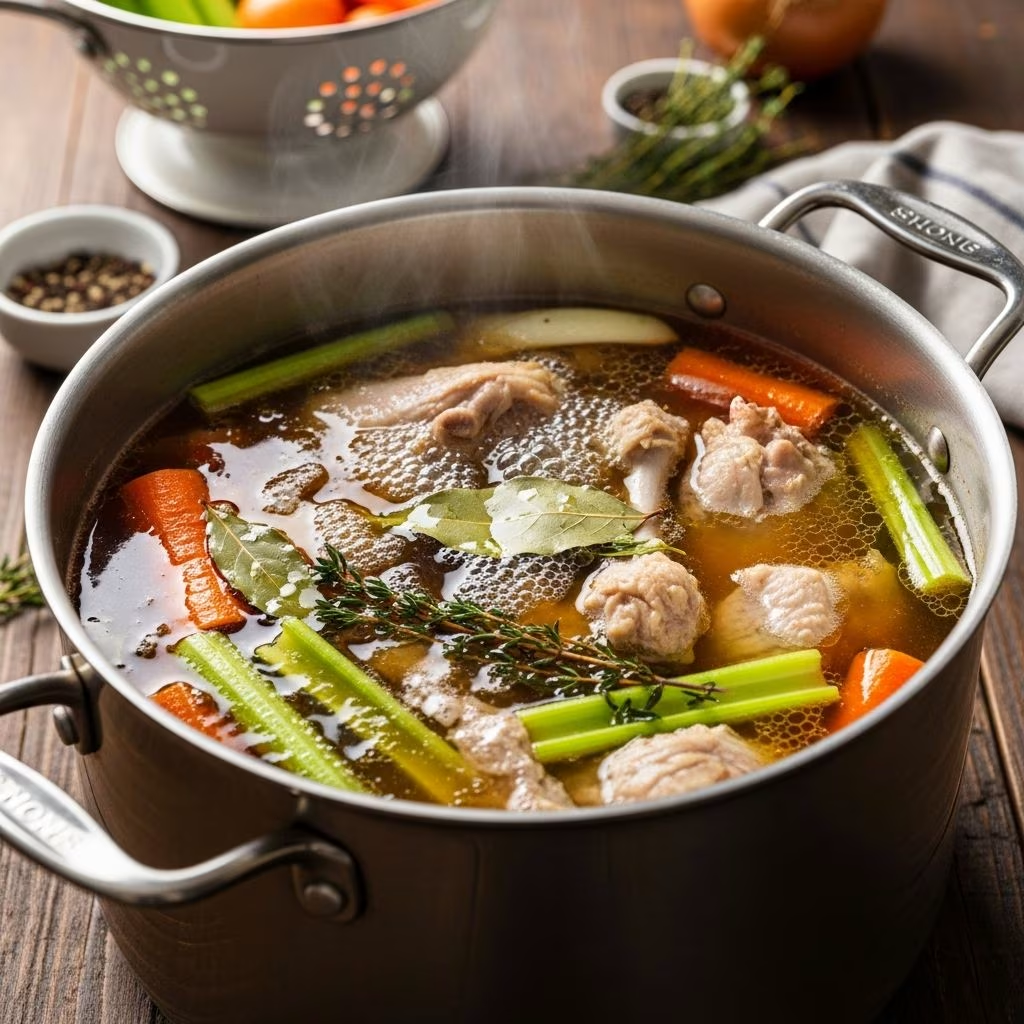
Place your three whole chickens directly into the stockpot. Add the prepared vegetables, fresh herbs, garlic, kosher salt, and whole peppercorns. Pour in seven quarts of cold water. The water should come up to cover all solids by a few inches but shouldn’t overfill your pot, as it will bubble up during cooking.
Place the pot over medium-high heat and bring the contents to a boil. This initial heating may take 20 to 30 minutes depending on your stove’s power and pot size. You’ll notice foam and impurities rising to the surface as the liquid heats—this is normal and will be handled during the simmering stage.
Once you achieve a rolling boil, reduce the heat to medium-low and settle into a gentle simmer. Remove any foam that accumulates on the surface using a spoon or small ladle. This skimming prevents cloudiness in your finished broth and removes impurities.
The Long Simmer
Maintain an uncovered simmer for four hours. This extended cooking time is crucial—it allows collagen from the chicken bones and connective tissue to break down into gelatin, creating body and silky texture in your broth. The long gentle heat also draws flavors from all vegetables and herbs into the liquid.
During cooking, you may notice a layer of fat rising to the surface. This is rendered chicken fat, which many cooks prefer to leave in place during cooking and remove after chilling, when it solidifies and can be lifted away cleanly. However, if you prefer to remove it during cooking, skim it away periodically with a spoon.
Cooling, Straining, and Storage Methods
Initial Cooling Phase
After four hours of simmering, turn off the heat and allow the pot to sit undisturbed for 15 to 20 minutes. This brief rest allows solids to settle slightly, making straining cleaner and easier. Never rush this step or attempt to strain boiling-hot broth, as you risk injury and compromise your results.
Proper Straining Technique
Set a large colander or fine-mesh strainer over a clean pot or large bowl. Carefully pour the broth through the strainer, allowing liquid to flow while solids collect in the colander. Work slowly and deliberately; don’t force the process. Once most liquid has drained through, you can discard all solids.
For the clearest broth, some cooks prefer straining through cheesecloth or a fine-mesh strainer a second time. This step is optional but produces a more refined appearance.
Fat Management
After straining, allow the broth to cool to room temperature. Once cooled, refrigerate overnight. The fat will solidify on the surface as it chills, creating a protective layer that you can simply lift off and discard if desired. Some cooks prefer to leave this fat in place, as it contains flavor and nutrients.
Freezing and Long-Term Storage
This recipe yields approximately seven to nine quarts of finished broth—far more than most households use at one time. Proper storage extends usability for months.
- Pour cooled broth into freezer-safe containers, leaving one inch of headspace to allow for expansion during freezing
- Label containers with contents and date
- Frozen broth maintains quality for up to three months
- Refrigerated broth (without freezing) lasts approximately four to five days
- Individual ice cube trays provide convenient portion-sized frozen broth for recipes requiring small quantities
Frequently Asked Questions
Can I Use Chicken Bones or Rotisserie Chicken Instead of Whole Roasting Chickens?
Yes, absolutely. Freezing bones from rotisserie chickens or other poultry creates an economical alternative. Simply accumulate bones from several meals, freeze them until you have a collection, then use them in place of whole birds. The cooking time may be reduced to three to four hours since bones release their essence faster than whole chickens. Using rotisserie chicken bones also eliminates any qualms about “wasting” meat, as the bird has already been consumed.
What If I Don’t Have Fresh Herbs Available?
Fresh herbs genuinely matter in broth-making, but if they’re unavailable, frozen herbs work better than dried alternatives. Avoid dried herbs if possible, as they can develop bitter, dusty flavors during extended cooking. If you must use dried herbs, reduce quantities by two-thirds, as dried herbs are more concentrated than fresh.
How Can I Reduce Cooking Time?
Higher heat produces faster results, but at a cost to flavor development and broth clarity. If you need broth more quickly, increase heat slightly to maintain a more vigorous simmer rather than gentle one. This may reduce cooking time to three hours but may result in a cloudier broth. Alternatively, using bones instead of whole chickens reduces cooking time to approximately three hours.
Should I Cover the Pot During Cooking?
No. An uncovered pot allows steam to escape and encourages gentle evaporation, which concentrates flavors. Covering the pot traps steam, potentially creating a cloudy broth and diluting flavors.
Why Is My Finished Broth Cloudy Rather Than Clear?
Cloudiness results from impurities boiling vigorously rather than simmering gently, or from insufficient skimming at the beginning. Maintain a gentle simmer throughout cooking and skim foam regularly during the first 30 minutes. If broth is already cloudy, straining it through cheesecloth lined into a fine-mesh strainer often clears it substantially.
Culinary Applications and Beyond
Homemade broth transforms countless dishes. Use it as a base for soups, risotto, rice pilaf, or sauces. Its rich, subtle flavor enhances gravies and adds depth to braised dishes. Even simple preparations benefit from homemade broth—plain rice cooked in broth instead of water becomes infinitely more interesting.
The investment of time in making broth pays dividends across weeks or months of cooking. Each time you use a container of your homemade broth, you’re using something you’ve created with care and quality ingredients, something far superior to commercial alternatives.
References
- Barefoot Contessa Homemade Chicken Stock Recipe — Ina Garten / Food Network. Accessed April 2026. https://barefootcontessa.com/recipes/homemade-chicken-stock
- How to Make Ina Garten’s Homemade Chicken Stock for Delicious Cooking — Business Insider. https://www.businessinsider.com/ina-garten-homemade-chicken-stock-soup-recipe-review
- Ina Garten’s Chicken Stock Recipe — Foolproof Living by Aysegul Sanford. https://foolproofliving.com/homemade-chicken-stock/
- Ina Garten’s Homemade Chicken Stock — A Hint of Rosemary. https://ahintofrosemary.com/recipes/homemade-chicken-stock/