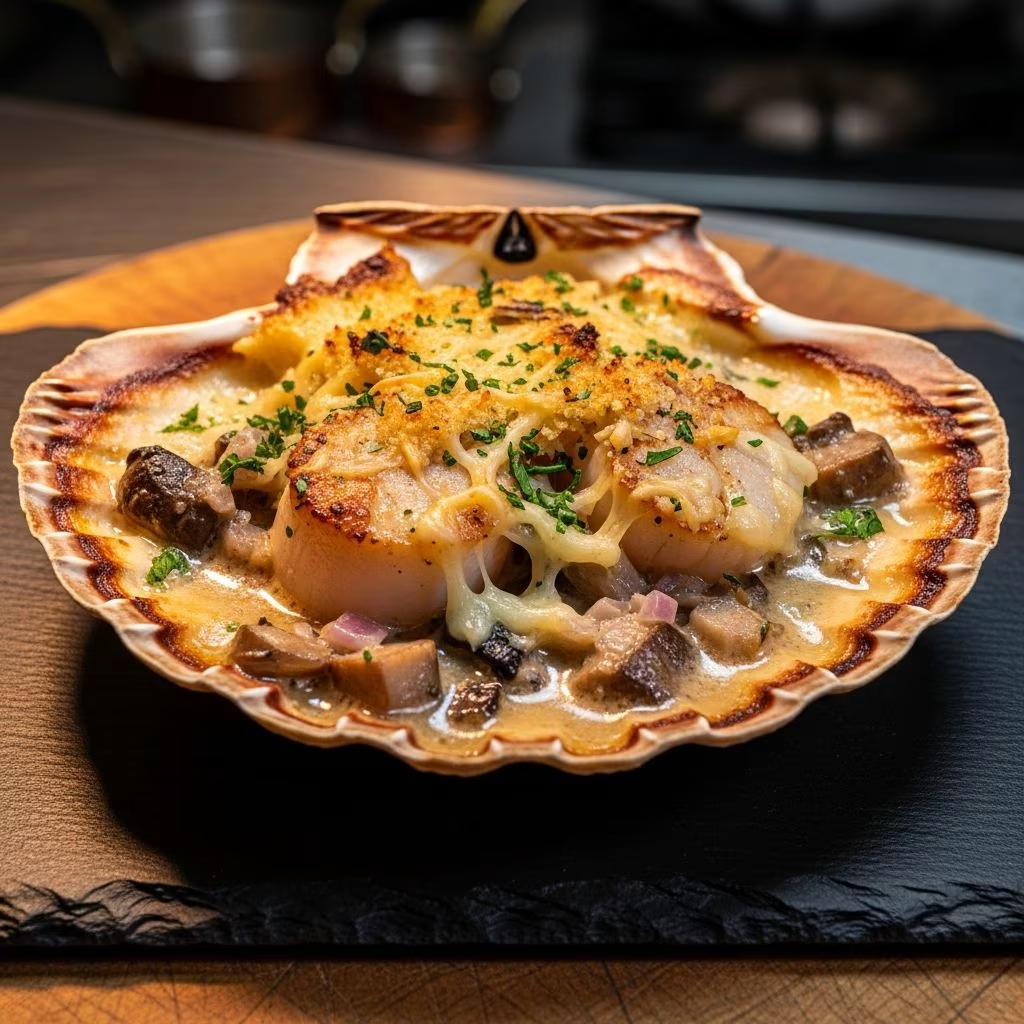
Coquilles Saint-Jacques stands as one of the most refined dishes in French gastronomy, representing elegance and sophistication on the dining table. This classical preparation combines tender scallops with a velvety mushroom cream sauce, topped with a golden breadcrumb and cheese crust that shatters delightfully with each spoonful. Once considered an exclusive restaurant offering, this dish is entirely achievable in a home kitchen with proper understanding of technique and ingredient quality.
Understanding the Dish’s Heritage and Significance
The name Coquilles Saint-Jacques translates to “Saint James shells,” referencing both the scallop shells traditionally used for presentation and the spiritual connection to Santiago de Compostela. This dish embodies the French culinary philosophy of transforming simple ingredients into something transcendent through careful preparation and classical technique. The combination of seafood, cream, and a gratinéed topping represents the height of French comfort food, suitable for both intimate dinners and formal entertaining.
The beauty of this preparation lies in its balance—the delicate sweetness of scallops against the earthy mushrooms, the richness of the cream sauce tempered by the crispy topping, and the interplay of textures that make each bite interesting. Understanding these flavor and texture relationships helps home cooks appreciate why this dish has maintained its status for generations.
Selecting Quality Scallops and Other Essential Ingredients
The foundation of any successful Coquilles Saint-Jacques begins with scallop selection. Bay scallops, smaller and sweeter, work beautifully in this dish, though sea scallops can be used if quartered appropriately. When purchasing scallops, look for those that are firm, translucent, and free from any ammonia smell—signs of freshness that will translate directly into the final dish. Avoid scallops stored in excessive liquid, as this indicates they have been treated with sodium tripolyphosphate, which compromises their ability to brown properly.
Fresh mushrooms form the aromatic base of the sauce. Button mushrooms and cremini varieties both contribute earthy undertones that complement the oceanic quality of the scallops. Cremini mushrooms offer slightly deeper flavor and better browning characteristics due to their lower water content. Shallots replace onions in this preparation, providing a refined sweetness without the assertive bite of regular onions.
The sauce itself relies on quality butter, fresh cream, and properly thickened milk to achieve the correct consistency. Gruyère cheese, specified over generic cheddar or Swiss varieties, adds complexity to the topping with its nutty, crystalline character. Breadcrumbs made from day-old white bread offer superior texture compared to panko, creating a fine, cohesive crust when combined with cheese and butter.
Foundational Techniques for Perfect Preparation
Preparing Scallops for Cooking
Proper scallop preparation determines the success of the entire dish. Each scallop contains a small side muscle, colloquially called the “foot,” which becomes rubbery during cooking and should be removed before preparation. This muscle, typically located on the side of the scallop, can be identified by its slightly different appearance and is easily removed with a gentle pull or the edge of a knife.
Pat scallops thoroughly dry with paper towels—moisture on the surface prevents proper browning and creates steam that compromises texture. Moisture is the enemy of the Maillard reaction necessary for developing flavor. Some preparations call for slicing scallops into rounds or halves, distributing them more evenly throughout the ramekin while creating more surface area for flavor development. This approach also allows the scallops to cook more uniformly when distributed in a single layer.
Creating the Mushroom Béchamel Foundation
The sauce represents the heart of Coquilles Saint-Jacques, requiring precision in technique and timing. Begin by sautéing minced shallots and mushrooms in butter over medium heat. This initial step, lasting four to five minutes, coaxes out the mushrooms’ natural moisture, concentrating their umami-rich flavors. Proper heat management prevents mushrooms from steaming rather than browning; maintain medium rather than high heat to allow the moisture to evaporate naturally.
After mushrooms achieve a light golden color, add flour to create a roux—the thickening agent that will hold the sauce together. Cook this flour-butter mixture for thirty seconds to one minute, stirring constantly, to eliminate the raw flour taste while maintaining a smooth consistency. The mixture may appear slightly pasty at this point; this is the correct appearance indicating proper roux development.
Slowly pour hot milk and cream into the roux, whisking continuously to prevent lumps from forming. The combination of milk and cream provides both body and richness; using only one or the other compromises the sauce’s character. Once fully incorporated, season with salt, white pepper, and a whisper of nutmeg—the nutmeg adds depth without becoming identifiable as a distinct flavor, a hallmark of classical French sauce preparation.
Allow the sauce to simmer briefly, just until small bubbles appear at the surface, then remove from heat. Overcooking the sauce causes it to break or separate, compromising its silky texture. The sauce should coat the back of a spoon smoothly, indicating proper thickness for coating the scallops and filling the ramekins.
Assembling the Topping Mixture
The gratinéed topping combines breadcrumbs, grated Gruyère cheese, minced parsley, and butter to create textural contrast against the creamy sauce. Combine these elements in a bowl, mixing gently to distribute cheese and herbs evenly through the breadcrumbs. If the mixture appears dry, drizzle lightly with melted butter or olive oil to achieve a texture that holds together without becoming damp or compacted.
This topping mixture can be prepared ahead of time, stored covered in the refrigerator for several hours, then brought to room temperature before final assembly. Preparing components in advance reduces last-minute stress and ensures precise timing when ready to bake.
Assembly and Baking Process
The assembly process determines whether the finished dish achieves the desired balance of components. Divide seasoned scallops among four shallow ramekins, arranging them in a single even layer. Shallow, wide ramekins prove superior to standard gratin dishes because the flat profile ensures scallops cook uniformly while maximizing the surface area for the desired golden crust.
Pour the mushroom béchamel over the scallops, ensuring the sauce fills all gaps and surrounds each piece. Use the back of a spoon to gently press and smooth the sauce surface, creating an even, tidy appearance. Reserve no sauce—the creamy mixture provides essential moisture for cooking scallops through while adding flavor and richness.
Distribute the breadcrumb topping evenly across each ramekin, covering from center to edges with no bare spots. This even distribution ensures consistent browning and prevents some portions of the crust from burning while others remain pale. Press the topping very gently onto the sauce to ensure adhesion without compacting it into a dense layer; the topping should remain somewhat loose to achieve crispness during baking.
Arrange filled ramekins on a baking tray and place in a preheated oven at 400°F (200°C), or 350°F (180°C) for fan-forced ovens, for approximately twenty minutes. The baking time may require adjustment based on individual oven characteristics; begin checking at eighteen minutes to prevent overcooking. The dish is perfectly finished when the topping turns golden brown with slight bubbling visible at the edges, and the sauce beneath shows minimal movement when the ramekin is gently shaken.
Allow the finished dish to rest for two minutes on the counter before serving. This brief resting period allows the sauce to set slightly, preventing excessive runiness while the topping maintains its crispy texture. Serve immediately while the contrast between the hot, creamy sauce and the crispy topping is most pronounced.
Ingredient Variations and Adaptations
While the classical preparation remains the standard, thoughtful variations can personalize the dish while maintaining its essential character. Some preparations incorporate a splash of brandy or Cognac added to the mushroom mixture, which burns off most alcohol while contributing subtle depth. Others include fresh tarragon or thyme in the cream sauce, adding herbal complexity to the overall flavor profile.
For textural variety, some cooks substitute panko breadcrumbs for traditional breadcrumbs, creating a coarser, more distinct crust. Emmental or Swiss cheese can replace Gruyère, though the dish loses some of the characteristic nutty complexity. A small amount of minced garlic added to the mushroom sauté provides additional aromatic depth for those who appreciate it.
The scallops themselves can be adapted based on availability and preference. Sea scallops work well when cut into quarters, creating consistent pieces that cook uniformly. For a lighter interpretation, some cooks reduce the cream portion slightly, replacing it with additional stock, though this diminishes the characteristic richness.
Serving Suggestions and Complementary Accompaniments
Coquilles Saint-Jacques, being a rich and substantial dish, requires thoughtful accompaniment. Serve as a first course with a simple green salad dressed in vinaigrette, allowing the acidity to cleanse the palate between bites. A crisp white wine—Sauvignon Blanc, Albariño, or Chablis—complements the dish’s richness while highlighting the scallop’s delicate sweetness.
For a more elaborate presentation, precede the gratinéed scallops with a light soup or additional oysters, establishing a seafood theme throughout the meal. Follow with a lighter main course such as roasted chicken or fish rather than another rich preparation. Crusty bread serves an essential function, allowing diners to capture every drop of the precious sauce remaining in the ramekin.
At the table, present each ramekin in its baking dish, allowing the visual appeal of the golden crust to make an impression before tasting. The presentation itself signals the care and attention devoted to preparation, enhancing the overall dining experience.
Storage and Make-Ahead Strategies
Coquilles Saint-Jacques can be fully assembled several hours in advance, covered with plastic wrap, and refrigerated until ready to bake. This advance preparation proves invaluable when entertaining, as the final cooking step requires only twenty minutes. Remove the ramekins from the refrigerator fifteen minutes before baking to allow them to reach closer to room temperature, ensuring more even cooking.
The finished dish does not reheat successfully, as the scallops toughen and the sauce separates. Consume the dish immediately after removing from the oven for optimal texture and flavor. Store any leftovers in an airtight container in the refrigerator for up to two days, though reheating will compromise the carefully developed textures and flavors.
Troubleshooting Common Challenges
Watery sauce results from overcooking scallops that release excess liquid, or from insufficient flour in the initial roux. Ensure proper roux development before adding liquids, and monitor baking time carefully to prevent overcooking. If sauce appears too thin, strain the finished dish carefully and thicken the liquid with a small amount of cornstarch slurry before reassembling.
Rubbery scallops indicate either overcooking during baking or scallops that were too small for the preparation time. Use appropriately sized scallops and begin checking for doneness at eighteen minutes rather than waiting the full twenty. Pale topping suggests an oven that is not hot enough; ensure proper preheating and verify oven temperature with a thermometer for accuracy.
Bitter or off flavors in the finished dish suggest aged or improperly stored scallops. Always purchase from reputable sources on the same day as preparation, and store in the coldest portion of the refrigerator until ready to cook.
Frequently Asked Questions
Can I prepare Coquilles Saint-Jacques without cream? Classical preparations require cream for the characteristic richness and mouthfeel. Substituting entirely with milk or stock results in a significantly different, less luxurious dish. A compromise approach uses half cream and half stock, reducing richness while maintaining some of the essential character.
How do I know when the scallops are properly cooked? Properly cooked scallops are opaque throughout and firm but not rubbery. Perform a visual check through the ramekin sides if possible; the scallops should have changed from translucent to solid white. Avoid cutting into the dish to test, which compromises presentation.
Can frozen scallops be used for this preparation? Fresh scallops produce superior results due to their texture and flavor. If using frozen scallops, thaw them completely in the refrigerator and pat very dry to remove excess liquid before proceeding with the recipe.
What wine pairs best with Coquilles Saint-Jacques? Dry white wines work best, particularly those with good acidity to cut through the sauce’s richness. Burgundian whites, Loire Valley varieties, or Alsatian options all complement the dish beautifully.
References
- Coquilles Saint-Jacques Recipe — RecipeTin Eats. Accessed April 2026. https://www.recipetineats.com/coquilles-saint-jacques/
- Scallop Selection and Storage Guidelines — United States Department of Agriculture, Food Safety and Inspection Service. https://www.fsis.usda.gov/wps/wcm/connect/government/site/topics/safe-food-handling/seafood-and-shellfish-safety
- Classical French Sauce Techniques — Escoffier School of Culinary Arts. https://www.escoffier.edu/
- Maillard Reaction in Cooking — McGee, Harold. On Food and Cooking: The Science and Lore of the Kitchen. Scribner, 2004.
- Wine Pairing with French Seafood Dishes — Court of Master Sommeliers. https://www.mastersommeliers.org/