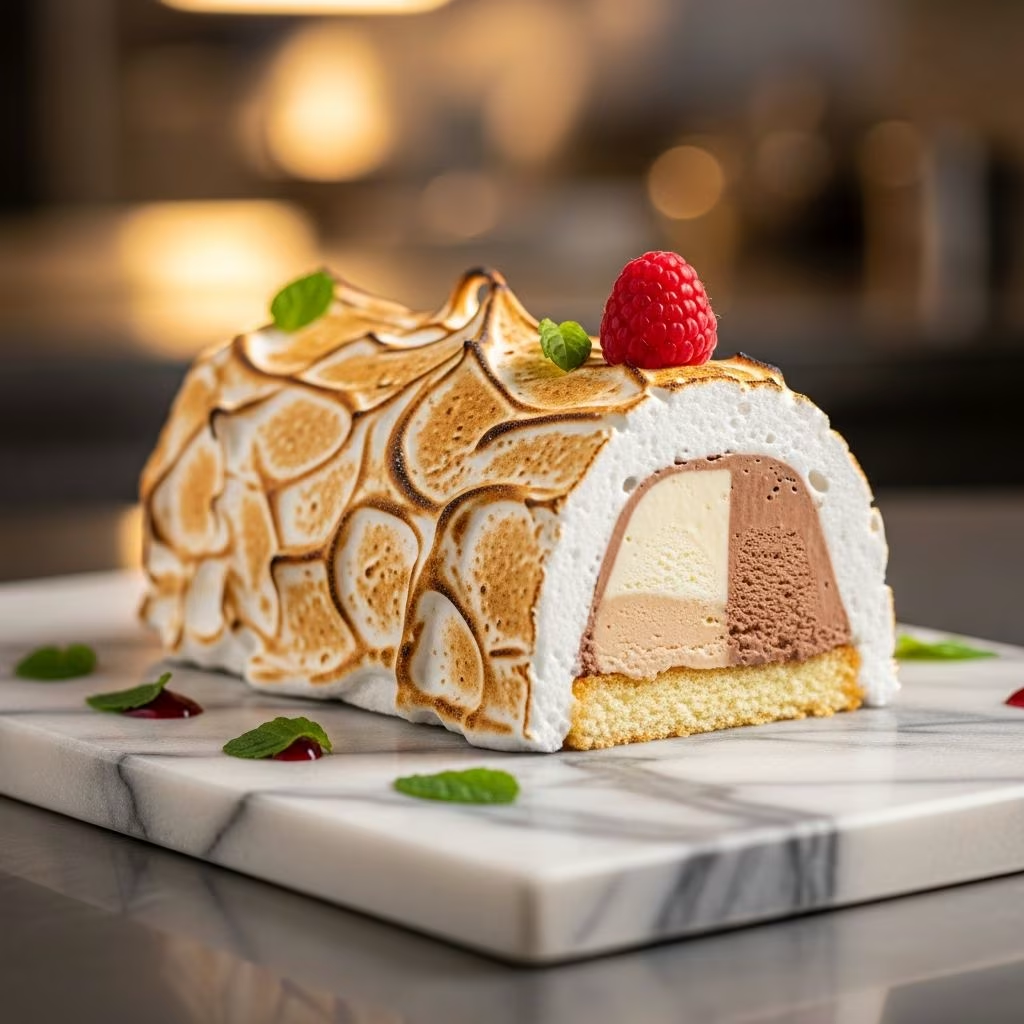
The allure of Baked Alaska lies in its dramatic contrast: a cold ice cream core encased in warm, golden meringue. This timeless dessert combines simple ingredients into a spectacle that’s equal parts science and showmanship. Whether you’re hosting a dinner party or celebrating a special occasion, mastering Baked Alaska elevates your baking repertoire. In this guide, we’ll explore its origins, break down the components, provide detailed recipes, and share expert techniques to ensure success every time.
Tracing the Roots of a Frozen Classic
Baked Alaska emerged in the late 19th century amid culinary innovation. Legend credits Thomas Jefferson with introducing ice cream to America, but the dessert’s modern form took shape later. In 1867, after the U.S. purchased Alaska, Delmonico’s Restaurant in New York celebrated with a creation called ‘Alaska Florida,’ featuring ice cream insulated by cake and meringue, then briefly baked.
Its popularity soared in the early 20th century, appearing in cookbooks and high-society menus. The key science? Meringue’s air pockets and proteins shield the ice cream from melting during the high-heat torching or broiling. This thermal magic makes it a favorite for entertainers seeking ‘wow’ factor.
Core Ingredients and Their Roles
Success hinges on quality components. Here’s what you need:
- Ice Cream: Use high-quality, dense varieties like vanilla, chocolate, or strawberry. Avoid airy soft-serve types that melt too fast.
- Cake Base: Pound cake, sponge, or brownies provide structure. Opt for sturdy, day-old cake to absorb minimal moisture.
- Meringue: Fresh egg whites whipped with sugar create the insulating shell. Italian meringue offers superior stability.
- Flavor Boosters: Liqueurs, fruits, or nuts add depth.
Proportions matter: Aim for equal parts ice cream and cake by volume, with meringue twice the height for full coverage.
Essential Tools for Perfect Assembly
Gathering the right equipment simplifies the process:
| Tool | Purpose | Why It Matters |
|---|---|---|
| Metal bowl (for ice cream mold) | Shapes the ice cream dome | Conducts cold evenly; easy release |
| Kitchen torch or broiler | Browns the meringue | Precise control prevents melting |
| Stand mixer or whisk | Whips meringue | Ensures stiff peaks |
| Plastic wrap | Lines mold | Prevents sticking |
| Offset spatula | Spreads layers | Smooth, even application |
Invest in a culinary torch for best results—broilers can be unpredictable.
Step-by-Step: Building Your First Baked Alaska
Prep time: 45 minutes. Freeze time: 4+ hours. Bake time: 5 minutes. Serves 8.
- Mold the Ice Cream: Line a 6-cup metal bowl with plastic wrap. Pack softened ice cream firmly, alternating flavors for stripes. Smooth the top, cover, and freeze 4 hours until solid.
- Bake the Cake: Prepare a simple sponge: Beat 4 eggs with 3/4 cup sugar until tripled in volume. Fold in 3/4 cup flour and 1 tsp vanilla. Bake in an 8-inch pan at 350°F for 20 minutes. Cool and trim to fit bowl base.
- Assemble: Unmold ice cream onto cake round on a parchment-lined tray. Refreeze 30 minutes.
- Make Meringue: Whip 6 egg whites to soft peaks. Gradually add 1.5 cups sugar and 1/4 tsp cream of tartar. Beat to glossy stiff peaks. Spread over ice cream, sealing edges completely. Create swirls for texture.
- Torch or Broil: Use a torch for even browning, or broil 3-4 inches from heat for 2-3 minutes, rotating tray.
- Serve Immediately: Slice with a hot knife for clean cuts.
Flavor Innovations to Elevate the Dessert
Customize for any palate:
- Tropical Twist: Mango sorbet, coconut cake, meringue spiked with rum.
- Chocolate Indulgence: Triple chocolate ice cream, brownie base, cocoa-dusted meringue.
- Berry Blast: Raspberry ripple ice cream, almond genoise cake, Chambord flambé.
- Nutty Delight: Pistachio gelato, hazelnut cake, torched with Frangelico drizzle.
- Seasonal: Pumpkin ice cream over gingerbread for fall.
For mini versions, use muffin tins for individual portions—perfect for parties.
Advanced Techniques for Flawless Results
Timing is crucial. Assemble no more than 2 hours before serving to avoid sogginess. For extra stability, brush cake with simple syrup or liqueur.
Humidity challenges meringue? Add cornstarch to the mix or use Italian meringue (hot sugar syrup beaten into whites). Test doneness: Meringue should be crisp outside, soft inside.
Flambé option: After torching, warm 1/4 cup liquor (Grand Marnier or brandy), ignite, and pour over for flames. Safety first—do this away from flammables.
Common Pitfalls and Fixes
Even pros slip up. Here’s how to troubleshoot:
- Melting Ice Cream: Insufficient meringue thickness or over-broiling. Fix: Double meringue layer, use torch.
- Weepy Meringue: Fat contamination. Fix: Clean bowl with vinegar; use copper bowl if available.
- Soggy Cake: Fresh cake absorbs melt. Fix: Freeze cake first; use dense pound cake.
- Uneven Browning: Broiler hotspots. Fix: Rotate frequently; prefer torch.
Store leftovers wrapped tightly; refreeze and re-torch before serving.
Pairing Suggestions for Maximum Impact
Complement with bold wines: Sparkling rosé cuts richness, or coffee liqueur amplifies chocolate versions. Fresh berries or coulis add tartness.
For dietary tweaks: Dairy-free ice cream and aquafaba meringue make it vegan-friendly.
Frequently Asked Questions
Can I make Baked Alaska ahead?
Yes, assemble up to 24 hours ahead, tightly wrapped. Torch just before serving.
Is a torch necessary?
No, but recommended. Oven broiling works if monitored closely.
How do I cut clean slices?
Dip knife in hot water, wipe dry between cuts.
Gluten-free version?
Use almond flour cake or meringue-only bombe.
Why does meringue sometimes crack?
Overbeating or rapid temp changes. Whip slowly; let rest 30 minutes post-assembly.
Scaling Up for Crowds
For 12+ servings, use a 1.5-quart bowl. Multiply ingredients by 1.5. Individual Alaskas in ramekins serve effortlessly.
Experiment with themes: Halloween with orange ice cream and black meringue spikes, or holiday red-green layers.
References
- The Oxford Companion to Food — Alan Davidson, Oxford University Press. 1999-12-15. https://global.oup.com/academic/product/the-oxford-companion-to-food-9780199677337
- On Food and Cooking: The Science and Lore of the Kitchen — Harold McGee, Scribner. 2004-11-23. https://www.simonandschuster.com/books/On-Food-and-Cooking/Harold-McGee/9781416556374
- USDA Food Safety Guidelines for Egg Products — United States Department of Agriculture. 2023-08-10. https://www.fsis.usda.gov/food-safety/safe-food-handling-and-preparation/eggs/eggs-and-food-safety
- Merengue Science: Proteins and Thermal Insulation — Institute of Food Technologists Journal. 2022-05-01. https://ift.onlinelibrary.wiley.com/doi/full/10.1111/1750-3841.16123
- Historical American Cookbooks: Baked Alaska Origins — Library of Congress. 2021-03-17. https://www.loc.gov/collections/cookbooks/about-this-collection/