The **Ragù Bolognese** stands as one of Italy’s most iconic culinary creations, a sauce that represents centuries of gastronomic tradition and careful preparation. Despite its widespread international popularity, this sauce remains widely misunderstood outside of Italy, with countless variations and shortcuts obscuring the authentic recipe. The true Ragù Bolognese demands time, patience, and respect for traditional methods that have been refined over generations in the Emilia-Romagna region.
Understanding the Historical Significance of Bolognese Sauce
The history of Ragù Bolognese stretches back centuries, with documentation of the recipe appearing in Emilian cookbooks as far back as the seventeenth century, though the origins likely extend even further into antiquity. What makes this sauce particularly special is not merely its age, but the way it has remained relatively unchanged despite globalization and modern culinary innovations. In Bologna, the preparation of ragù is treated with utmost seriousness—locals understand that this sauce represents their cultural heritage and culinary identity.
Traditionally, ragù was not always paired with pasta as it is today. Historical records indicate that this rich meat sauce was initially served alongside bread slices or polenta, adding substance and flavor to simple starches. The evolution of Bolognese sauce demonstrates how regional Italian cuisine has adapted while maintaining core principles that define its authenticity.
The Critical Importance of Ingredient Selection
The foundation of an authentic Ragù Bolognese rests entirely on selecting the proper ingredients. Unlike many modern recipes that incorporate numerous herbs and spices, traditional Bolognese sauce maintains remarkable simplicity in its ingredient list, allowing each component to shine while creating a harmonious whole.
Selecting the Right Meats
The meat selection forms the backbone of this sauce. **Ground beef** serves as the primary protein, typically using meat that is approximately 80-85% lean. This fat content is essential, as it provides flavor and richness while preventing the sauce from becoming too dry during the extended cooking process. Many authentic recipes also incorporate **ground pork**, which adds sweetness and complexity to the final product.
**Pancetta**, the Italian cured pork belly, is another crucial meat component. Unlike raw pork belly, pancetta has been cured and aged, developing distinctive flavors that transform the entire sauce. When diced finely and rendered at the beginning of cooking, pancetta contributes fat, salt, and umami depth that anchors all other flavors. The amount should be carefully balanced—typically between 2 to 10 ounces depending on recipe scale—to provide influence without overwhelming the dish.
The Sacred Vegetable Trinity
Three vegetables form the aromatic foundation in Italian cooking: onion, carrot, and celery, collectively known as the **soffritto** or **battuto** base. These must be finely diced to nearly uniform sizes, ensuring even cooking and proper integration into the sauce. The key principle involves chopping vegetables finely through a food processor, but avoiding over-processing, which would create a wet pulp rather than discrete pieces.
Each vegetable contributes specific qualities: onions provide sweetness and body, carrots add natural sugars and earthiness, and celery brings subtle herbal notes. Importantly, authentic Bolognese does not include garlic, a common misconception in many modern interpretations. This absence allows the other flavors to remain pure and clear, creating the characteristic taste that distinguishes Bolognese from other Italian sauces.
Tomato and Liquid Components
While tomato appears in traditional Bolognese sauce, it plays a supporting role rather than dominating as in many contemporary versions. **Tomato paste**, typically added in concentrated form (about 2-4 tablespoons depending on recipe size), provides umami depth and acidity rather than vegetable flavor. Some recipes incorporate a small quantity of pureed tomatoes or passata for additional complexity, but these remain minimal compared to the meat and liquid components.
The liquid elements—specifically **whole milk**, **white wine**, and **beef broth**—create the sauce’s luxurious texture and flavor profile. Milk, added early in the cooking process, serves the critical function of tenderizing the meat while adding creaminess and mild sweetness. White wine, preferred over red in many traditional recipes, provides acidity that brightens the sauce without overpowering it. Rich beef broth, preferably made from bones, contributes depth and body. Bay leaves and occasionally a pinch of nutmeg round out the aromatics, adding subtle sophistication.
Essential Cooking Techniques for Authentic Results
Preparing Ragù Bolognese requires understanding and respecting several critical cooking techniques. The process cannot be rushed; authentic recipes demand between two to three hours of gentle simmering to achieve the proper texture and flavor integration.
The Initial Meat Rendering Phase
Begin by sautéing the diced pancetta in a heavy-bottomed pot over medium heat for approximately 8-10 minutes, allowing the fat to render completely while the meat browns. This pancetta fat becomes the cooking medium for subsequent steps, eliminating the need for additional oil or butter. Transfer the cooked pancetta to a separate bowl, leaving approximately 2 tablespoons of the rendered fat in the pot.
Building the Aromatic Foundation
Lower the heat and gently sauté the finely diced onion, carrot, celery, and minced garlic (if using) for approximately 10 minutes. The goal is softening without browning—gentle cooking at lower temperatures releases the vegetable’s natural liquids and flavors while maintaining their delicate texture. This step establishes the aromatic base that will flavor the entire sauce.
The Meat Integration Process
Add the ground beef and pork mixture to the softened vegetables, breaking up any large chunks as the meat browns. However, a critical distinction exists between browning and over-browning: the meat should lose its raw appearance without developing a hard, crusty exterior that would result from high-heat cooking. This gentle approach maintains the meat’s tender quality, essential for achieving the sauce’s characteristic melt-in-your-mouth texture.
Sequential Liquid Additions
The order of liquid additions profoundly affects the final result. Begin by adding the whole milk, cooking gently until it is nearly completely absorbed by the meat—a process that typically requires 30-45 minutes. This early milk addition tenderizes the meat fibers while infusing them with creaminess. Following the milk absorption, add white wine and bring the sauce to a boil before reducing heat and cooking for approximately 10 minutes.
Finally, introduce the tomato paste, pureed tomatoes (if using), beef broth, bay leaves, and any additional seasonings. Bring the mixture back to a boil, then reduce to a gentle simmer. This final phase continues for 2-2.5 hours, during which the sauce develops complexity, thickens substantially, and the flavors meld into a unified whole.
Achieving the Perfect Sauce Consistency
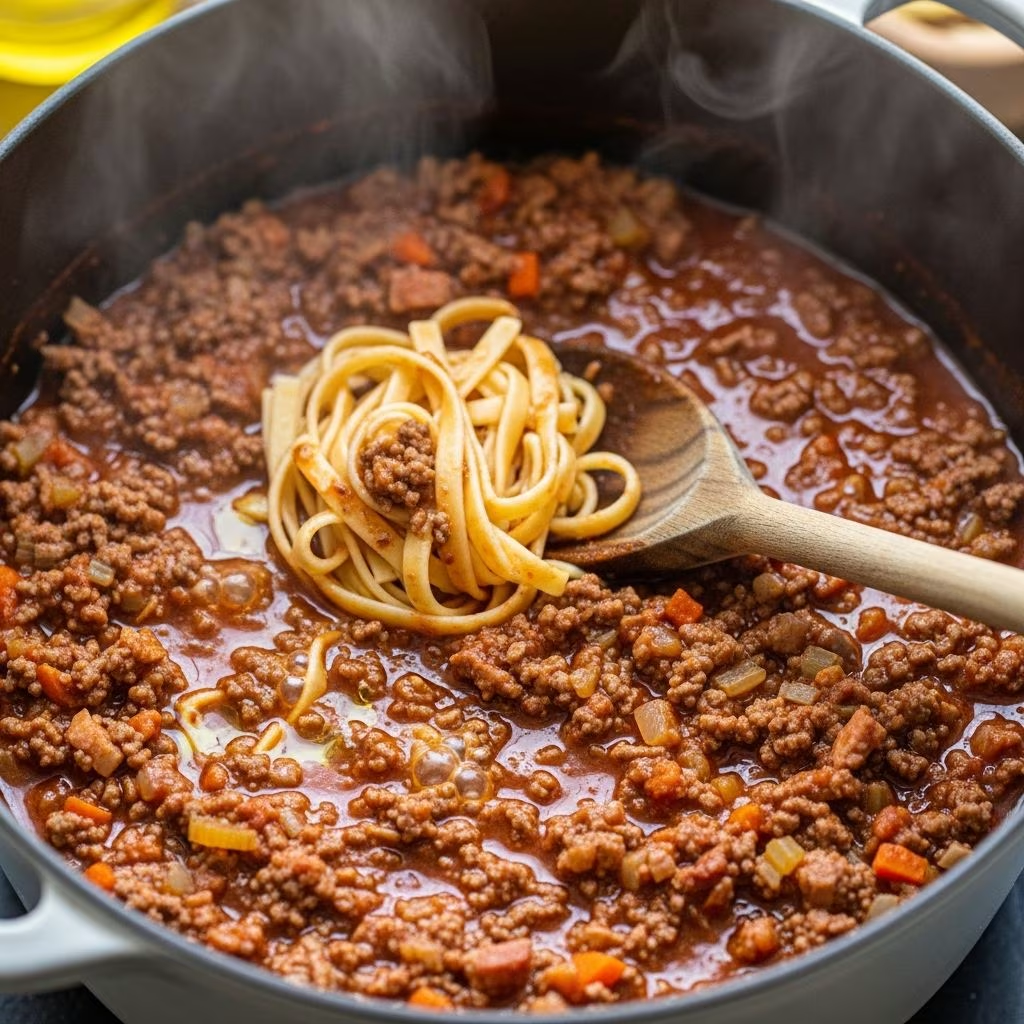
The texture of finished Ragù Bolognese should be thick and rich, clinging to pasta rather than pooling at the bottom of a bowl. This consistency develops through patient simmering that allows excess liquid to evaporate while the meat breaks down further, incorporating its collagen and creating a silky texture. The sauce should coat a spoon completely, leaving a thick residue rather than running off immediately. If the sauce remains too thin after 2.5 hours, increase the heat slightly to encourage faster evaporation. Conversely, if it threatens to stick to the pot’s bottom, reduce heat immediately and add small amounts of additional broth.
Traditional Pasta Pairings and Service
A common misconception persists that Ragù Bolognese should be served over spaghetti; in reality, the mayor of Bologna has confirmed that true Ragù Bolognese never appears with spaghetti. The authentic pairing demands **wider, flat pasta ribbons** that can properly catch and hold the thick, rich sauce. The preferred choices are **tagliatelle al uovo** (fresh egg tagliatelle) and **pappardelle**, both of which have sufficient width and surface area to embrace the sauce properly.
When serving with fresh pasta, always reserve some pasta cooking water to adjust the sauce’s consistency if needed. The starch in pasta water helps bind the sauce to the noodles, creating a more cohesive dish. Freshly grated Parmigiano-Reggiano should be offered at the table, allowing diners to customize their portion.
Variations and Adaptations
While the base recipe remains consistent across traditional Bolognese preparations, minor variations exist between families and restaurants within Bologna itself. Some preparations incorporate chicken livers for additional richness, while others use silky tomato passata instead of chunky pureed tomatoes. A few recipes include cream or additional butter, though purists consider these departures from tradition.
For lasagna Bolognese preparation, the sauce should be slightly saucier than when served with fresh pasta, as the noodles absorb considerable liquid during baking. Adding a can of whole peeled plum tomatoes, passed through a food mill for smoothness, provides the necessary additional moisture while maintaining texture consistency.
Storage and Make-Ahead Preparation
One advantage of Ragù Bolognese is its exceptional freezability. The sauce actually develops improved flavor after a day or two of refrigeration as flavors continue melding. Divide cooled sauce into portions and freeze in airtight containers for up to three months. When ready to serve, thaw in the refrigerator overnight and gently reheat over low heat, adding a splash of broth or water if necessary to restore proper consistency.
Common Mistakes to Avoid
Understanding frequent errors helps ensure success on your first attempt:
- Adding garlic: Traditional recipes exclude garlic entirely, allowing other flavors to remain pure
- High-heat cooking: Aggressive heat toughens the meat and causes the sauce to scorch; maintain a gentle simmer throughout
- Over-processing vegetables: While finely chopped vegetables integrate better, a wet pulp creates undesirable texture
- Skipping the milk step: This undermines the meat’s tenderness and the sauce’s creamy quality
- Using red wine instead of white: While not prohibited, white wine provides superior brightness
- Serving with thin pasta: Spaghetti or thin noodles cannot properly support the sauce’s weight
- Rushing the cooking time: The minimum 2-hour simmer cannot be shortened without compromising results
Frequently Asked Questions
Can I prepare Ragù Bolognese in a slow cooker?
While slow cookers can cook the sauce adequately, they don’t achieve the same flavor development as stovetop simmering. If using a slow cooker, complete the initial browning and vegetable-sautéing steps on the stovetop, then transfer to the slow cooker on low heat for 4-6 hours.
What if I cannot find pancetta?
While pancetta specifically contributes its cured flavor, guanciale (cured pork jowl) or even high-quality bacon can substitute in a pinch, though the result will differ slightly from the traditional preparation.
How much sauce does this recipe yield?
Most traditional Ragù Bolognese recipes, which serve 6-8 people, create approximately 3-4 cups of finished sauce, sufficient for about 1.5 pounds of pasta.
Can I freeze leftover sauce?
Absolutely. Properly stored in airtight containers, Ragù Bolognese freezes excellently for up to three months, often improving in flavor upon thawing.
Is there a vegetarian version?
Creating an authentic vegetarian Ragù Bolognese presents challenges, as the meat provides essential umami and body. Mushroom-based versions exist but constitute a different dish rather than a true Bolognese adaptation.
References
- Authentic Italian Ragu Bolognese — Just a Little Bit of Bacon. Accessed April 2026. https://www.justalittlebitofbacon.com/authentic-italian-bolognese/
- Ragù Bolognese Sauce — The Clever Carrot. 2022-01-15. https://www.theclevercarrot.com/2022/01/ragu-bolognese-sauce/
- Authentic Ragù Bolognese — Tina’s Table. Accessed April 2026. https://www.tinastable.com/authentic-ragu-bolognese/
- Authentic Ragù alla Bolognese: Recipe and History — PhilosoKitchen. Accessed April 2026. https://philosokitchen.com/authentic-ragu-alla-bolognese/
- Authentic Bolognese Sauce Recipe — An Italian in my Kitchen. Accessed April 2026. https://anitalianinmykitchen.com/bolognese-sauce/
- Traditional Bolognese From Italy — Chef Jean-Pierre (YouTube). Accessed April 2026. https://www.youtube.com/watch?v=LEZOwA_Qb-Q
- In Search of Ragù Bolognese — 177 Milk Street. Accessed April 2026. https://www.177milkstreet.com/stories/ragu-bolognese-bolgna