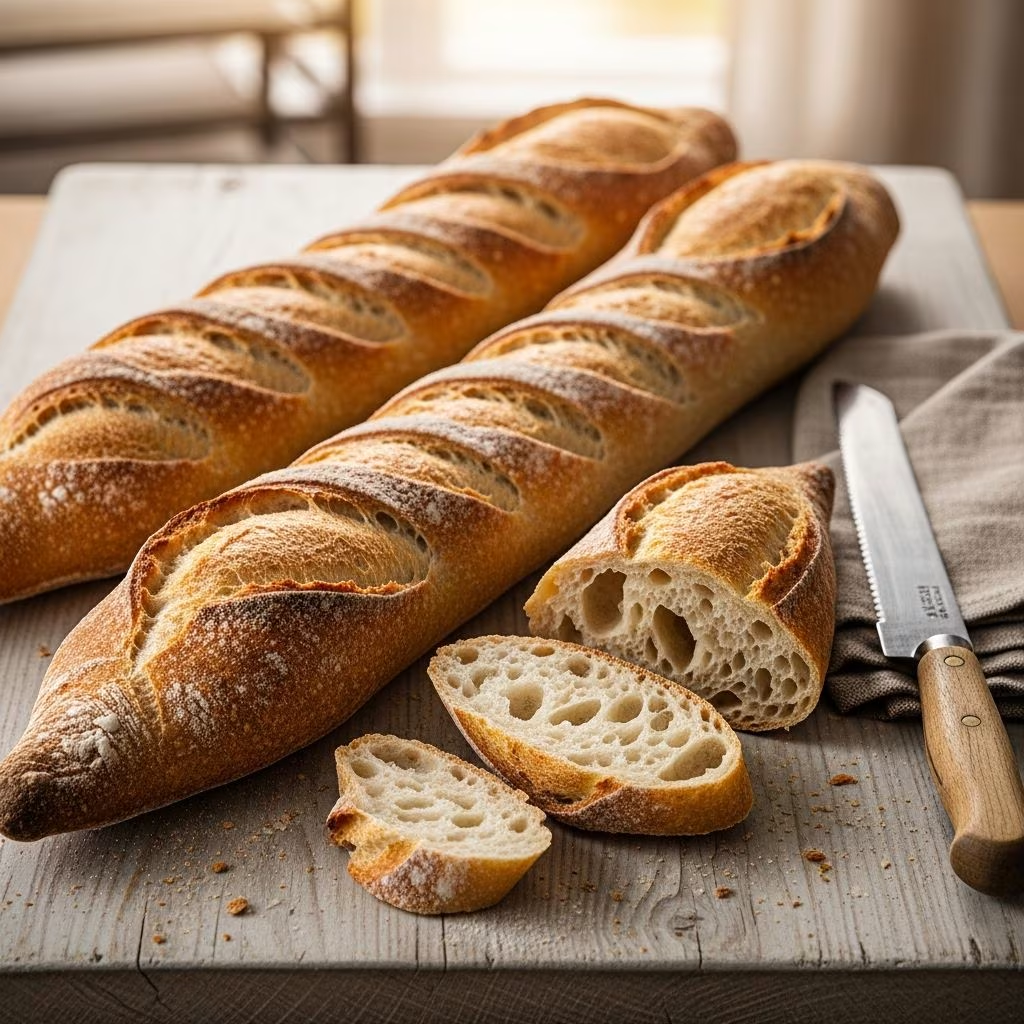
Creating authentic French baguettes in your own kitchen brings the essence of Parisian bakeries right to your table. These iconic loaves feature a crisp, golden crust encasing a chewy, open crumb that pairs perfectly with cheese, soups, or simply enjoyed on its own. With just a handful of ingredients—flour, water, yeast, and salt—you can produce bakery-quality results without advanced equipment. This guide draws from time-tested methods to help beginners and experienced bakers alike achieve professional outcomes through precise techniques, hydration control, and oven steaming.
The Science Behind the Perfect Baguette
The magic of a baguette lies in its high hydration dough, typically 65-75% water to flour ratio, which develops gluten for structure while allowing steam to create large air pockets during baking. Yeast ferments the dough, producing carbon dioxide for rise, while salt strengthens gluten and enhances flavor. High-heat baking (around 450-480°F) gelatinizes starches on the surface for that signature crust, and steam prevents the crust from setting too early, promoting oven spring—a dramatic expansion in the first minutes of baking.
Understanding these elements allows home bakers to troubleshoot issues like dense crumb (often from over-kneading) or pale crusts (insufficient steam). Poolish or biga preferments, used in advanced recipes, add nutty flavors through slow fermentation but are optional for quick versions.
Essential Ingredients for Success
Quality starts with simple, fresh components:
- Bread flour: High-protein (12%+) for strong gluten networks; all-purpose works but yields denser results.
- Water: Lukewarm (about 100°F) to activate yeast without killing it.
- Yeast: Instant or active dry; fresh yeast for authenticity in some traditions.
- Salt: Sea or fleur de sel for flavor; measure precisely as it slows fermentation.
- Optional sweeteners: Honey or sugar feeds yeast in faster recipes.
A standard formula yields three 14-inch loaves: 500g flour, 360g water (72% hydration), 10g salt, 3g instant yeast. Scale up for larger batches, maintaining ratios for consistency.
Tools You’ll Need for Baguette Baking
No fancy gadgets required, but these elevate results:
| Tool | Purpose | Alternatives |
|---|---|---|
| Baguette pan or couche | Supports even shaping and rise | Clean tea towel on a board |
| Baking stone or steel | Retains heat for crisp crust | Upside-down baking sheet |
| Lame or sharp knife | Scoring for controlled expansion | Razor blade |
| Digital scale | Precise measurements by weight | Measuring cups (less accurate) |
| Cast-iron skillet | Steam generation | Metal pan with ice cubes |
Weigh ingredients for pro-level accuracy, as volume measures vary by flour brand.
Step-by-Step Recipe: Quick No-Knead Baguettes
This beginner-friendly method takes about 2-3 hours total, yielding three crusty loaves.
Prepare the Dough (20 minutes)
- Mix 500g bread flour, 10g salt, and 3g instant yeast in a large bowl.
- Stir in 360g lukewarm water until a shaggy dough forms—no kneading needed. Cover and rest 30 minutes.
Ferment and Fold (1-1.5 hours)
- Perform three stretch-and-folds: Wet hands, pull one edge of dough up and fold over center. Rotate bowl 90 degrees, repeat four times. Rest 30-45 minutes between folds. Dough will gain strength and elasticity.
- Cover and let bulk ferment until doubled, about 1 hour.
Shape the Loaves (15 minutes)
- Turn dough onto lightly floured surface. Divide into three 300g pieces.
- Gently shape each into a loose rectangle, fold edges to center, then roll into a tight cylinder starting from the long side. Seal seams with thumbs.
- Roll gently to elongate to 14 inches, tapering ends. Place seam-side up on a floured couche or towel between pleats.
Final Proof and Bake (45 minutes)
- Cover and proof 45-60 minutes until puffy and a gentle poke leaves a slow indent.
- Preheat oven to 475°F with baking stone on middle rack and skillet on bottom. Score loaves with 1/4-inch deep slashes at 45-degree angles.
- Transfer to stone, add 1 cup hot water to skillet for steam. Bake 15 minutes, rotate, reduce to 450°F, bake 15 more until deep golden and hollow-sounding (internal 205-210°F).
- Cool on wire rack 1 hour before slicing.
Yield: 3 baguettes (12 servings). Per slice: ~158 calories.
Advanced Techniques for Artisan Results
For superior flavor and texture, try a poolish preferment: Mix equal parts flour and water with a pinch of yeast, ferment 12-16 hours before main dough. This mimics professional methods, yielding tangy depth.
High-hydration (75%) doughs, like those from baguette champion Anis Bouabsa, require fridge retardation (21 hours) for slow flavor development. Fold minimally to preserve airiness, bake at 480°F for maximum volume.
Experiment with flour blends: 10-20% whole wheat or rye adds nutty notes without heaviness.
Troubleshooting Common Baguette Problems
- Flat loaves: Under-proofed or weak dough—extend fermentation, ensure high protein flour.
- Gummy crumb: Insufficient baking—use thermometer, bake to 210°F internal.
- Thick crust: No steam—always preheat pan and add boiling water.
- Uneven scoring: Use lame at 45 degrees; practice on parchment first.
- Dense interior: Overworked dough—stick to stretch-folds, avoid punching down.
Creative Variations and Pairings
Customize your baguettes:
- Herbed: Add 2 tbsp minced rosemary or olives to dough.
- Seeded: Brush with water, roll in sesame or poppy seeds pre-bake.
- Whole grain: Substitute 100g flour with whole wheat.
Pair with butter and jam for breakfast, Camembert and wine for appetizers, or hearty stews. Slice diagonally for crostini topped with tapenade.
Storing and Freezing for Freshness
Baguettes are best eaten same-day. Store in a paper bag at room temp up to 24 hours. For longer: Wrap tightly in foil, freeze up to 3 months. Thaw at room temp, refresh in 400°F oven 5-10 minutes with steam for crisp revival.
Avoid plastic bags to prevent sogginess; slice and freeze individually for toast convenience.
Frequently Asked Questions (FAQs)
Can I use all-purpose flour?
Yes, but bread flour yields better structure. Adjust water if dough is sticky.
How do I create steam without a skillet?
Spray oven walls with water or use ice cubes in a hot pan.
Why measure by weight?
Precision ensures consistent hydration and results; cups pack differently.
Can I make this vegan?
Absolutely—ingredients are naturally vegan.
How long does poolish take?
12-16 hours at room temp for optimal flavor.
What’s French law on baguette weight?
Minimum 350g per traditional baguette, though home versions vary.
References
- Quick Easy French Baguettes (Baking Baguettes for Beginners) — Le Chef’s Wife. 2023. https://lechefswife.com/baking-baguettes-for-beginners/
- Authentic French baguette recipe — Zestuous. 2022. https://www.zestuous.com/french-baguettes/
- Crusty French Baguette Recipe — Baking A Moment. 2021. https://bakingamoment.com/crusty-french-baguette-recipe/
- How to Make the Best Authentic French Baguettes at Home — Culinary Exploration. 2023. https://www.culinaryexploration.eu/blog/Authentic-French-Baguettes
- How to Make French Baguettes — Taste of Artisan. 2022. https://tasteofartisan.com/french-baguette-recipe/