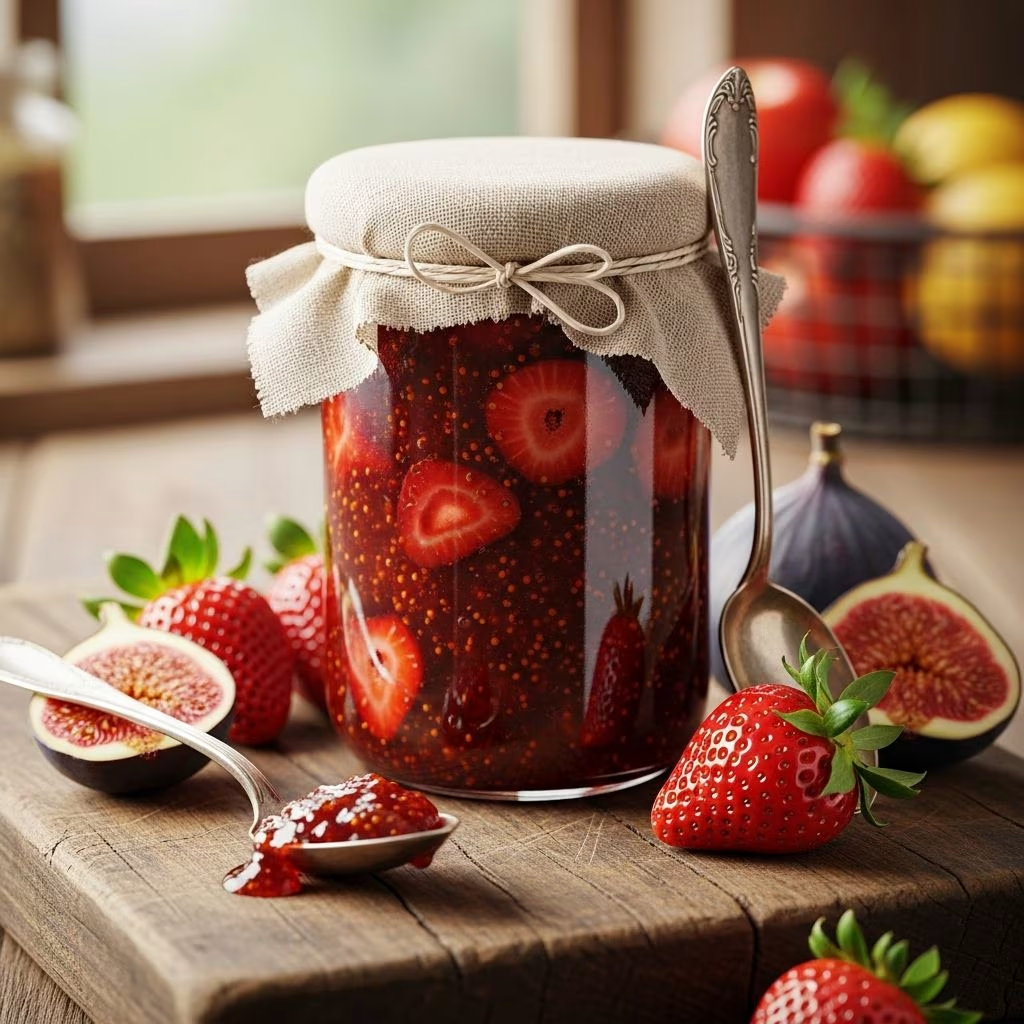
Strawberry fig preserves combine the earthy sweetness of figs with the bright tang of strawberries, creating a versatile condiment perfect for toast, cheese boards, or desserts. This guide explores recipes, techniques, and storage methods drawn from traditional Southern cooking practices.
Why Make Strawberry Fig Preserves?
These preserves capture peak summer flavors in a jar, extending the season’s bounty. Figs provide natural pectin for thickening, while strawberry elements add vibrant color and taste. Home preservers appreciate the simplicity, often using just a few ingredients for reliable results.
Benefits include cost savings over store-bought jams and customization of sweetness or texture. They’re ideal for gifting or stocking pantries, with a shelf life of up to a year when properly canned.
Essential Ingredients for Success
Core components vary slightly by recipe but focus on fresh produce and minimal additives. Here’s a breakdown:
- Fresh Figs: About 3 cups mashed (roughly 40 small figs), washed and stemmed. Choose ripe but firm ones for best texture.
- Strawberries or Strawberry Gelatin: Fresh berries (3 cups chopped) for authentic fruitiness, or 6 ounces strawberry-flavored gelatin (two 3-oz boxes) for color and flavor without real strawberries.
- Sugar: 2-4 cups granulated white sugar to sweeten and preserve. Adjust based on fig ripeness.
- Lemon Juice: 2 tablespoons bottled for acidity, aiding gelling and safety in canning.
- Optional Pectin: 3 tablespoons for quicker set in fresh fruit versions.
Pro Tip: Use bottled lemon juice for consistent pH levels in preserved goods.
Basic Recipe: Gelatin-Based Strawberry Fig Preserves
This no-pectin method yields about 4 half-pint jars in under 40 minutes.
Ingredients (Yields 4 jars)
| Ingredient | Quantity |
|---|---|
| Mashed figs | 3 cups (about 40 figs) |
| Granulated sugar | 2-3 cups |
| Strawberry gelatin | 6 oz (2 boxes) |
| Lemon juice | 2 tbsp |
Step-by-Step Instructions
Prepare Figs: Wash figs thoroughly, remove stems, and mash with a potato masher or fork for a chunky texture.
Combine and Heat: In a large pot, mix mashed figs, sugar, lemon juice, and gelatin. Stir over medium-high heat until boiling.
Simmer: Reduce heat and boil gently for 15-18 minutes, stirring to prevent sticking. The mixture thickens and turns deep red.
Jar and Seal: Ladle into sterilized 8-oz jars, leaving 1/4-inch headspace. Wipe rims, apply lids finger-tight, and process in a boiling water bath for 10 minutes if canning.
Cool: Turn jars upside down for 5 minutes, then right side up. Check seals (indented lids).
Total time: 33 minutes. Store in a cool, dark place.
Fresh Fruit Variation: Strawberry Fig Jam with Pectin
For a chunkier, real-fruit version, incorporate fresh strawberries.
Ingredients (Yields 4-6 half-pints)
- 3 cups hulled, sliced strawberries
- 3 cups chopped figs
- 1/4 cup bottled lemon juice
- 4 cups sugar
- 3 tbsp pectin
- 1 tbsp butter (to reduce foam)
Instructions
- Pulse strawberries and figs in a food processor for desired chunkiness.
- In a large saucepan, combine fruit, lemon juice, and pectin. Bring to a rolling boil.
- Add sugar, stir to dissolve, top with butter, and boil 1 minute.
- Skim foam, pour into jars, and process 10 minutes in boiling water.
This method highlights natural flavors but requires precise boiling times.
Equipment You’ll Need
Gather these for safe, efficient preserving:
- Large heavy-bottomed pot
- Food processor or masher
- 8-oz mason jars, new lids, bands
- Jar lifter, funnel, bubble remover
- Water bath canner or large stockpot with rack
- Potato masher, ladle, clean towels
Sterilize jars by boiling 10 minutes.
Canning Safety Essentials
Proper technique prevents spoilage. Always use tested recipes like those from university extensions.
- Acidity: Lemon juice ensures pH below 4.6.
- Headspace: 1/4 inch to allow expansion.
- Processing: 10 minutes in boiling water at sea level (adjust for altitude).
- Storage: Cool, dark pantry; refrigerate after opening.
Test seals: Lids should not flex. Discard if bulging, leaking, or off-smelling.
Troubleshooting Common Issues
| Problem | Cause | Solution |
|---|---|---|
| Runny preserves | Undercooked or low sugar | Reboil with more sugar/pectin |
| Crystallized sugar | Too much sugar or slow cool | Use right ratios; cool undisturbed |
| Foam formation | Normal in boiling | Skim or add butter |
| Seal failure | Dirty rims or faulty lids | Refrigerate and use promptly |
Flavor Variations and Twists
- Raspberry Fig: Swap strawberry gelatin for raspberry.
- No-Gelatin Version: Use extra figs/strawberries, cook 30-40 minutes.
- Spiced: Add cinnamon or vanilla during simmer.
- Low-Sugar: Use pectin for less sugar, but test gelling.
Creative Ways to Use Your Preserves
Beyond toast:
- Glaze for grilled chicken or pork.
- Filling for thumbprint cookies or tarts.
- Topping for cheesecake or ice cream.
- Pairing with brie on crackers.
- Mix into yogurt or oatmeal.
Nutrition and Storage Facts
A 1-tablespoon serving offers about 50-70 calories, mostly from sugar. Figs contribute fiber and potassium.
- Shelf Life: 12-18 months canned; 1 month refrigerated.
- Freezer Option: Up to 1 year in freezer-safe jars.
Frequently Asked Questions
Can I use frozen figs or strawberries?
Yes, thaw and drain excess liquid first to avoid watery results.
Do I need a canner?
For shelf-stable, yes. Otherwise, refrigerate up to 3 weeks.
Why gelatin instead of pectin?
Gelatin simplifies for beginners, providing set without precise fruit pectin levels.
How do I know it’s set?
Spoon test: Drop sheets off spoon or wrinkles when pushed.
Are these safe for water bath canning?
Yes, high acidity allows it. Follow USDA guidelines.
Seasonal Sourcing Tips
Harvest figs in late summer; strawberries peak early. Buy local for ripest fruit. Store unripe figs at room temp to ripen.
Scaling up? Make one batch at a time for best consistency.
References
- The Best Strawberry Fig Preserves Recipe (2026) — First Day of Home. 2026. https://www.firstdayofhome.com/fresh-fig-preserves-recipe/
- Strawberry Fig Preserves — The Cooking Bride. N/A. https://cookingbride.com/jam-and-jelly-recipes/strawberry-fig-jam/
- Mock Strawberry Preserves Made with Figs — Bayou Woman. N/A. https://bayouwoman.com/mock-strawberry-preserves-made-with-figs/
- Fig-Strawberry Preserves with Gelatin — National Center for Home Food Preservation (University of Georgia). N/A. https://nchfp.uga.edu/how/make-jam-jelly/jams/strawberry-fig-preserves-with-gelatin/