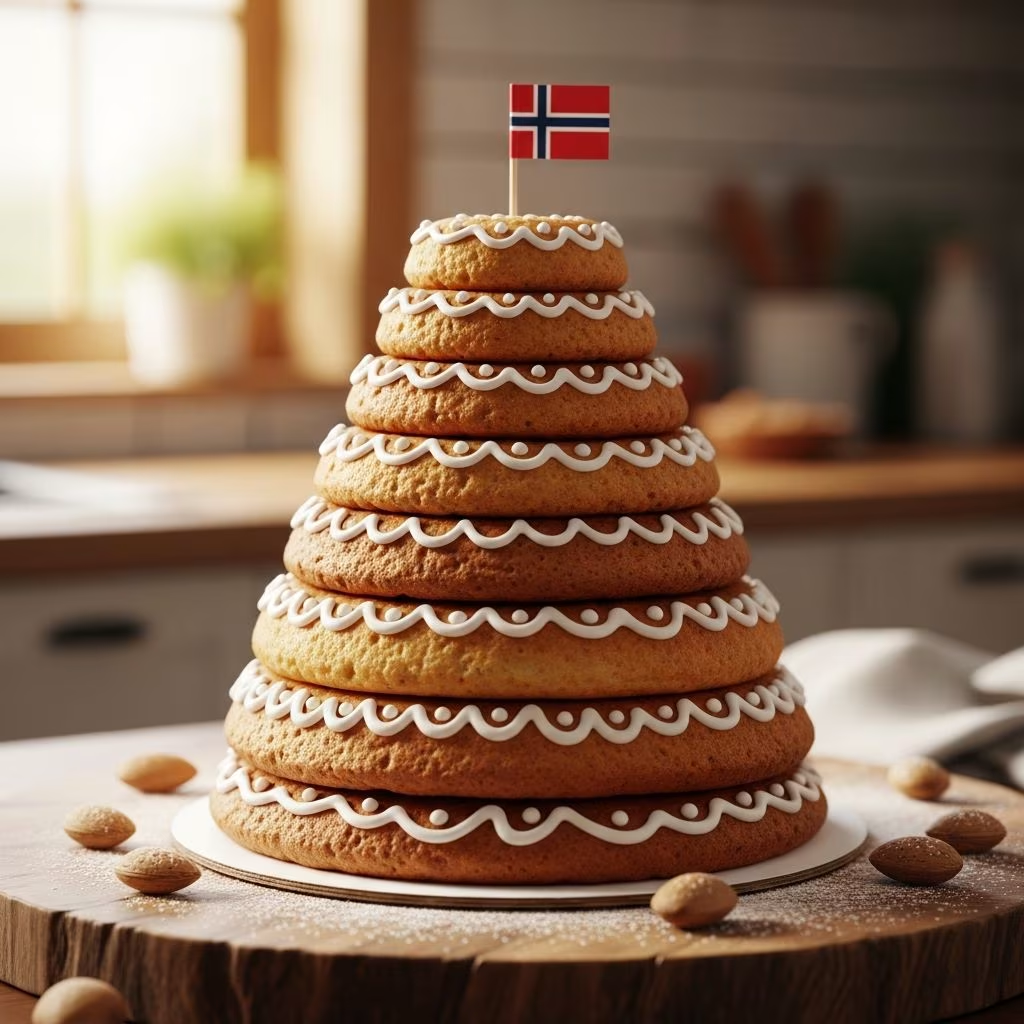
Norwegian kransekake stands as a symbol of celebration, featuring a dramatic tower of graduated almond rings stacked into an elegant centerpiece. This chewy, nutty treat, translating to “wreath cake,” captivates with its simplicity—relying on just ground almonds, powdered sugar, and egg whites—yet delivers profound flavor and visual impact at weddings, Christmas gatherings, and other joyous events.
Origins and Cultural Significance
Kransekake traces its roots deep into Scandinavian tradition, particularly Norway, where it has graced festive tables for generations. The cake’s name evokes its ring-like layers, resembling a festive wreath that signifies unity and prosperity. Families pass down recipes orally, adapting them slightly across regions, but the core remains unchanged: a labor of love baked in specialized molds.
At Norwegian weddings, the kransekake often towers up to 18 rings high, adorned with intricate icing patterns. Guests traditionally pull apart the rings by hand, starting from the top, symbolizing the breaking of bread in communal joy. During Christmas, smaller versions appear, sometimes with a bottle of aquavit nestled in the center for added festivity. This dessert transcends mere sweetness; it embodies heritage, with modern bakers worldwide embracing it for its gluten-free appeal and nut-forward taste.
Essential Ingredients for Authentic Kransekake
The beauty of kransekake lies in its minimalist ingredient list, allowing the pure almond essence to shine. Core components include finely ground almonds (or almond flour), sifted powdered sugar for binding and chewiness, and egg whites as the sole leavener and moistener.
| Ingredient | Quantity (for 18 rings) | Role |
|---|---|---|
| Ground almonds or almond flour | 1 lb (about 3.5-4 cups) | Provides nutty base and structure |
| Powdered sugar (confectioners’ sugar) | 1 lb (about 4 cups) | Sweetens and creates chewiness |
| Egg whites (unbeaten) | 3-4 large | Binds dough without adding flour |
| Optional: Almond extract or cardamom | 1 tsp | Enhances flavor depth |
Variations appear across recipes: some incorporate a touch of flour or semolina for easier handling, while purists stick to three ingredients. Almond skins can remain for rustic texture, or blanched nuts ensure a smoother finish. For the icing that cements the tower, royal icing made from egg whites, powdered sugar, and extracts holds the rings securely.
Tools and Equipment You’ll Need
Specialized kransekake ring molds—typically 18 graduated sizes from 2 to 6 inches in diameter—are essential for the authentic shape. These metal pans, available online or at baking specialty stores, ensure even baking and easy release.
- Ring molds: Full set of 18 nonstick or traditional tins.
- Food processor or grinder: To pulverize whole almonds into fine meal.
- Stand mixer or sturdy spoon: For kneading the stiff dough.
- Piping bags: For precise icing application.
- Baking sheets and parchment: If flattening tops during bake.
Nonstick sprays are discouraged; opt for generous greasing with butter or shortening plus a dusting of breadcrumbs or semolina to prevent sticking.
Mastering the Dough: Step-by-Step Guide
Creating the dough demands patience, as it starts crumbly but transforms with kneading. Begin by processing almonds to a fine, almost buttery consistency—avoid over-grinding to prevent oiliness.
- Combine dry ingredients: Mix ground almonds and powdered sugar thoroughly to distribute evenly.
- Incorporate egg whites: Add 3 egg whites gradually, kneading by hand or mixer until a smooth ball forms. If too dry, introduce a fourth white sparingly. The texture should be firm yet pliable, like marzipan.
- Chill thoroughly: Wrap in plastic and refrigerate overnight (or at least 1-2 hours). This rest hydrates the almonds, eases rolling, and intensifies flavor.
Pro tip: Divide dough into thirds before rolling to match ring sizes perfectly—pair largest with smallest for balanced thickness.
Shaping, Baking, and Assembly
Preheat oven to 400-410°F (200-210°C). Grease molds liberally and dust with semolina or flour.
Shaping: Divide chilled dough into portions. Roll each into finger-thick ropes (about 1/2-inch diameter) on a lightly sugared surface. Press into molds, joining ends seamlessly without overfilling. For smallest rings, work slowly to maintain evenness. Flatten tops gently with parchment and a weighted sheet for uniform height.
Baking: Bake 10-15 minutes until pale golden—no deep browning desired, as the chew endures. Cool in pans briefly, then unmold onto racks. Rings firm up as they cool.
Assembly: Pipe royal icing in zigzags on the largest ring’s top. Stack the next size atop, repeating upward. For separation ease, dry icing fully before stacking; otherwise, assemble wet for a bonded tower.
Perfect Royal Icing Recipe
Royal icing glues and decorates. Whisk 2 egg whites (or meringue powder equivalent) until frothy, then beat in 3-4 cups powdered sugar, 1-2 tsp almond extract or lemon juice, until pipeable.
- Use a fine tip for zigzags.
- Avoid runny consistency to prevent slippage.
- Store covered to evade crusting.
Troubleshooting Common Issues
| Problem | Cause | Solution |
|---|---|---|
| Rings stick to molds | Insufficient greasing | Double-grease and dust generously with semolina |
| Dough too crumbly | Not enough egg whites | Add whites one at a time during kneading |
| Tower unstable | Uneven icing or ring sizes | Measure ropes precisely; chill before stacking |
| Rings too hard | Overbaked | Check at 10 minutes; aim for pale edges |
Creative Variations and Flavor Twists
While classic kransekake shines plain, experiment mindfully. Add ground cardamom (1 tsp) for warmth or almond extract for intensity. Dip cooled rings in dark chocolate for decadence, or infuse icing with rosewater for floral notes. Gluten-free by nature, it’s ideal for inclusive events—swap almonds for hazelnuts cautiously to preserve tradition.
For mini versions, bake fewer rings or individual stacks. Pair with coffee, fruit, or sparkling wine to complement the dense sweetness.
Serving, Storage, and Make-Ahead Tips
Serve at room temperature for peak chewiness. Break apart tableside for interactive fun—rings stay fresh 2-3 days airtight, or freeze unbaked dough up to a month. Bake-ahead: Store cooled rings airtight for weeks, assembling day-of.
Yield: One 18-ring tower serves 20-30 generously.
Frequently Asked Questions (FAQs)
Can I make kransekake without ring molds?
Yes, pipe ropes onto parchment-lined sheets in circles, but molds ensure uniformity.
Is kransekake gluten-free?
Traditional recipes are, using no flour. Additions like semolina may alter this.
How far in advance can I prepare it?
Dough chills overnight ideally; baked rings store weeks. Assemble fresh.
Why is my dough oily?
Over-processed almonds release oils—pulse briefly.
Vegetarian or vegan options?
Egg whites are key; aquafaba substitutes work experimentally.
Nutritional Snapshot (Per Ring, Approx.)
| Nutrient | Amount |
|---|---|
| Calories | 150-200 |
| Protein | 4g |
| Fat | 10g |
| Carbs | 15g |
Rich in healthy fats from almonds, it’s a satisfying treat in moderation.
References
- Classic Norwegian Kransekake — Scandinavian Cookbook. 2023. https://scandinaviancookbook.com/classic-norwegian-kransekake-recipe/
- Kransekake (Norwegian Wedding Cake) — A Simple Homestead. 2022. https://asimplehomestead.com/kransekake-norwegian-wedding-cake/
- Kransekake — That Bread Lady. 2023. https://thatbreadlady.com/kransekake/
- Gift This: Kransekake — Sprinkle Bakes. 2015-12-01. https://www.sprinklebakes.com/2015/12/gift-this-kransekake.html
- Classic Norwegian Kransekake Recipe — YouTube (Scandinavian Cookbook). 2023. https://www.youtube.com/watch?v=fE85ioKQ7ew
- Paul Hollywood’s Christmas Kransekake — The Great British Bake Off. 2023. https://thegreatbritishbakeoff.co.uk/recipes/all/paul-hollywood-christmas-kransekake/