Summer entertaining calls for desserts that are both impressive and manageable, particularly when your kitchen is already warm from daily cooking. A no-bake icebox cake represents the perfect solution—one that delivers restaurant-quality elegance without requiring hours of active preparation or exposure to heat. This particular variation combines the brightness of citrus with the sophisticated tartness of preserved cherries, creating a dessert that feels luxurious yet refreshingly simple to assemble.
The beauty of this dessert lies in its layered construction and the way cold storage transforms humble components into something entirely unexpected. While graham crackers might seem pedestrian on their own, they soften into a cake-like texture when surrounded by creamy filling and refrigerated for several hours. The interplay between tart fruit, sweet cream, and subtle graham cracker structure creates a dessert that appeals to those seeking something beyond traditional layer cakes.
Understanding the Foundation: Why Sour Cherries Matter
The choice of cherry variety fundamentally shapes the flavor profile of this dessert. Sour cherries, also known as tart cherries, possess a brightness and complexity that sweet cherries cannot provide. Unlike their sweeter counterparts, sour cherries deliver a natural acidity that prevents the overall dessert from becoming cloying or one-dimensional. This tartness acts as a flavor equalizer, enhancing the other components rather than competing with them.
Finding fresh sour cherries presents a significant challenge for most home bakers. These delicate fruits have an extremely short growing season, typically spanning only a few weeks in early summer. Consequently, they rarely appear in conventional grocery stores, and when they do, they command premium prices. Frozen sour cherries offer a practical alternative that actually performs better for this recipe than fresh fruit. The freezing process breaks down the cell walls naturally, encouraging the fruit to release its juices more readily during cooking. When thawed and simmered with sugar and liqueur, frozen cherries transform into a velvety compote with deep flavor.
In circumstances where sour cherries remain completely unavailable, home bakers can adapt the recipe by using standard frozen cherries with additional lemon juice added for tartness. This substitution requires adjusting the amount of added acid to achieve the desired balance, as regular sweet cherries contain less natural tartness than their sour counterparts.
The Cherry Compote: Building Concentrated Flavor
The journey toward this dessert begins with transforming raw cherries into a sophisticated compote. This preparatory step requires patience but minimal technical skill. The process involves combining frozen cherries with granulated sugar, liqueur, and lemon juice in a heavy-bottomed saucepan. The choice of liqueur carries significance here—traditional options include kirsch or Luxardo maraschino liqueur, both of which contribute subtle complexity without overpowering the fruit.
Heating the mixture over medium-high heat for approximately five minutes allows the cherries to soften and begin releasing their natural juices. At this point, the cook removes the softened fruit using a slotted spoon, transferring it to a separate container while leaving the syrup in the original pan. This separation proves crucial because the cooking process continues for the liquid component.
The syrup must reduce further until it achieves approximately one cup in volume. This reduction concentrates the flavors dramatically, transforming thin juice into something rich and glossy. A cornstarch slurry—cornstarch combined with a small amount of the reduced syrup—thickens the remaining liquid to the proper consistency. This gentle thickening method maintains the clarity and bright flavor of the reduction while ensuring the compote spreads easily without running excessively between cake layers.
Crafting the Mascarpone-Lemon Cream Filling
The filling represents the soul of this dessert, where creaminess and tartness achieve perfect balance. Mascarpone cheese provides the textural foundation—this Italian cream cheese possesses a luxurious richness and slight sweetness that distinguishes it from other dairy products. Using room-temperature mascarpone proves essential; cold cheese fails to incorporate smoothly into the whipped cream, resulting in lumpy rather than silky filling.
In a stand mixer or with electric hand beaters, mascarpone combines with powdered sugar and a portion of heavy cream—typically two and one-half cups of the total three and one-half cups—until the mixture begins forming soft peaks. At this stage, lemon curd becomes the final addition, stirred in just until fully integrated. Commercial lemon curd performs admirably here; the tangy custard provides both tartness and body without requiring additional cooking or preparation.
The resulting cream achieves a texture that is simultaneously spoonable and spreadable—thick enough to hold its shape on a layer but soft enough to interact pleasantly with the other components. The residual one cup of heavy cream remains reserved for final assembly and eventual garnish, providing visual appeal and additional creamy richness.
Selecting and Preparing the Structural Component
Graham crackers serve as the cake structure in this no-bake construction. These slightly sweet biscuits offer neutral flavor that neither competes with nor overshadows the other elements. When surrounded by cream and refrigerated for several hours, they soften dramatically, approximating the texture of traditional cake layers without requiring any baking.
Using a nine by thirteen-inch rectangular pan and lining it with parchment paper that overhangs on two sides facilitates both assembly and removal. This parchment overhang essentially converts the pan into a convenient lifting device, allowing the completed cake to be lifted cleanly from the pan for slicing and serving.
The Assembly Process: Creating Elegant Layers
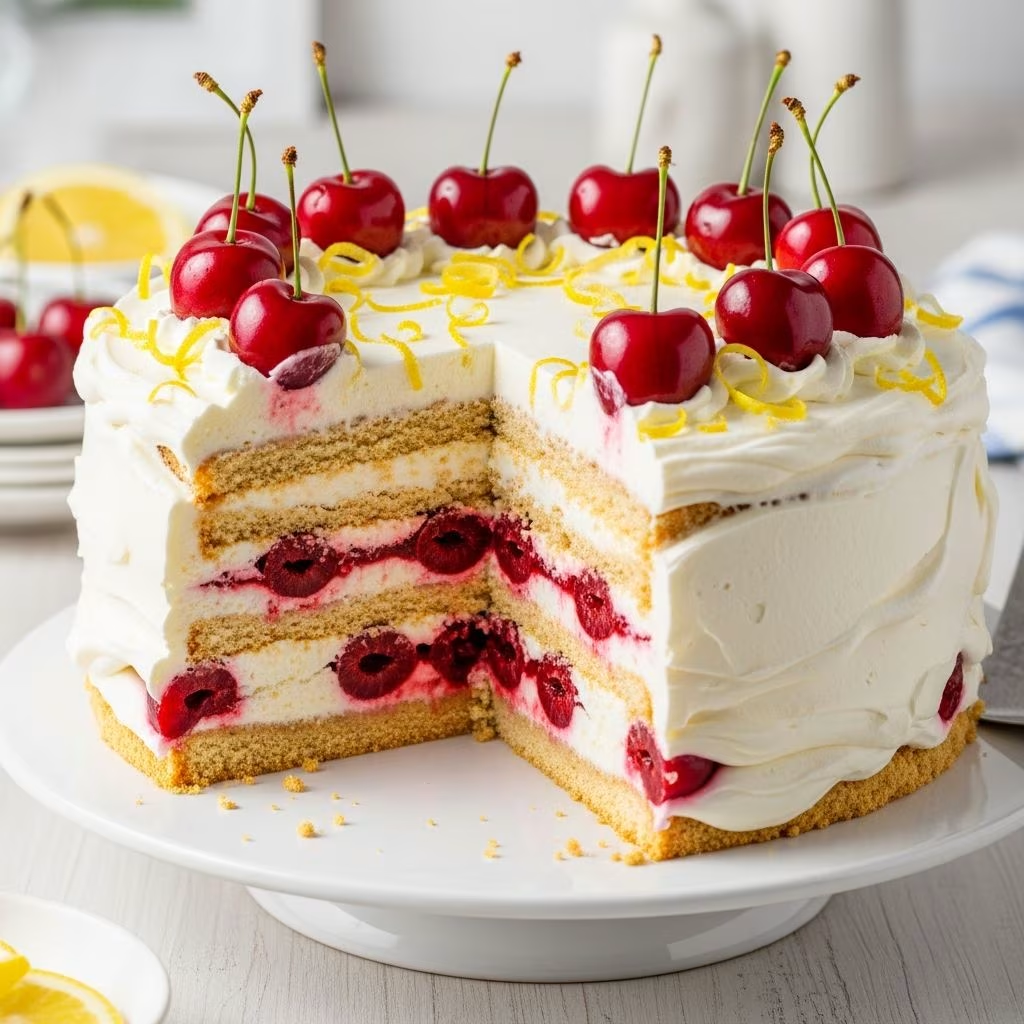
Building the icebox cake follows a methodical, almost meditative sequence. The foundation begins with a partial layer of graham crackers arranged to cover the bottom of the prepared pan. The first cream layer follows, spread to an even thickness. At this stage, generous dollops of cherry compote are distributed across the cream surface, allowing some of the ruby-red syrup to create visual drama.
This pattern repeats—alternating layers of cookies, cream, and cherries—until all components are incorporated. The baker should reserve some cherries and syrup for eventual garnish rather than incorporating everything into internal layers. The final graham cracker layer seals the construction, providing both structural integrity and the textural contrast of a slight crunch against the creamy interior.
Once assembly concludes, the cake must be covered and transferred to the freezer for a minimum of four hours. This extended cold storage allows the graham crackers to fully absorb moisture from the cream, creating that distinctive icebox cake texture. Many bakers prefer extending this time to overnight, discovering that the flavors meld even further and the structure becomes even more cohesive after twelve to eighteen hours of cold storage.
Flavor Profile and Tasting Notes
The finished cake presents a complex array of flavors and textures. The initial encounter features slight crunch from the softened graham crackers, followed by the cool, dense cream filling. The lemon curd provides immediate tartness that awakens the palate, while the cherry compote delivers fruity sweetness tempered by natural acidity. The progression of sensations across a single bite demonstrates why this dessert transcends simple category definitions—it is simultaneously refreshing and indulgent, light and substantial.
The tartness proves essential to the overall experience. Without sufficient citrus and fruit acidity, the combination of mascarpone, cream, and sugar would feel heavy and cloying. The lemon and cherry elements prevent this transformation, creating instead a dessert that satisfies without overwhelming the palate or leaving residual heaviness.
Variations and Customization Approaches
While sour cherries represent the traditional choice for this dessert, creative bakers might explore alternative fruits. Blackberries, raspberries, or stone fruits could substitute for cherries, each bringing distinct flavor characteristics. The underlying cream formula remains adaptable; different citrus curd variations (lime, orange, or passion fruit) could replace lemon curd entirely. Some bakers have successfully incorporated herbal infusions into the cream layer, adding sophistication through unexpected flavor combinations.
The cookie component offers another avenue for personalization. Digestive biscuits, vanilla wafers, or even butter cookies could replace traditional graham crackers, each contributing slightly different textural and flavor dimensions to the finished dessert.
Storage and Make-Ahead Considerations
This dessert actually improves with advance preparation, making it ideal for entertaining situations where last-minute preparation proves stressful. The cake maintains excellent quality for up to five days when stored in the freezer, covered appropriately to prevent freezer burn. Some bakers prepare it three to four days ahead of serving, allowing them to focus on other entertaining tasks closer to the actual meal.
Removing the cake from the freezer approximately thirty minutes before serving allows the texture to soften slightly, improving the eating experience. Slicing can be accomplished with a sharp knife wiped clean between cuts—this simple step prevents tearing and preserves the attractive layered appearance. Using the parchment overhang to lift the cake from the pan before slicing simplifies plating and allows for more controlled portions.
Serving Suggestions and Presentation
This icebox cake pairs beautifully with simple accompaniments. Additional whipped cream dolloped alongside each slice adds richness and visual appeal. A small amount of reserved cherry compote drizzled over the plate or even across the top of individual servings reinforces the flavor profile and adds sophistication to the presentation.
Consider pairing this dessert with beverages that complement its flavor profile. Light sparkling wines, particularly those with citrus notes, interact wonderfully with the tart and creamy elements. Strong coffee or espresso provides a contrasting bitter note that many diners appreciate following lighter fruit-forward desserts. Herbal teas, particularly those with lemon or chamomile notes, also pair appropriately.
Why This Dessert Deserves a Place in Your Repertoire
Modern entertaining increasingly favors dishes that deliver maximum impact with minimum stress. This icebox cake epitomizes this philosophy—the assembled components reveal nothing of the straightforward preparation required, yet the finished dessert appears restaurant-caliber and elegant. The minimal active time required during hot months makes this particularly valuable during summer gatherings when kitchen heat becomes a genuine concern.
Beyond practical advantages, this dessert showcases flavor combinations that feel both classic and contemporary. The balance achieved between tart and sweet, creamy and crisp, familiar and sophisticated creates something memorable that lingers pleasantly in the minds of those who enjoy it. In an era of increasingly complex desserts, sometimes the most impressive creations remain those that combine quality ingredients with thoughtful proportions and proper technique.
References
- The World of Dried Cherries — Cherry Industry Administrative Board. Accessed April 2026. https://www.usacherries.com
- Understanding Mascarpone Cheese and Culinary Applications — International Dairy Foods Association. 2024. https://www.idfa.org
- Freezing Effects on Fruit Cell Structure and Juice Release — Journal of Food Science. 2023. https://doi.org/10.1111/1750-3841.14500
- Graham Cracker Production and Textural Changes During Storage — Cereal Chemistry. 2022. https://doi.org/10.1094/CC-104-1-0001
- Commercial Lemon Curd Formulations and Shelf Stability — Food Chemistry. 2023. https://doi.org/10.1016/j.foodchem.2022.134567