Marzipan stands as one of Europe’s most beloved confections, yet its story is far more complex and geographically dispersed than most people realize. This delicate paste of ground almonds and sugar represents a fascinating convergence of trade routes, cultural exchange, and culinary innovation that spans more than a millennium. From its enigmatic origins in the Orient to its establishment as a prized specialty in Northern European cities, marzipan embodies the dynamic relationship between East and West through the lens of food.
Tracing the Mysterious Beginnings
The true birthplace of marzipan remains shrouded in historical debate, with multiple regions and time periods claiming its invention. What scholars do agree upon is that this confection emerged from the intersection of two critical ingredients: almonds and sugar, both crops that flourished in Mediterranean and Middle Eastern climates. The earliest documented references to almond paste mixtures appear in the literary tradition of the Arabian Nights, a collection of Middle Eastern folk stories spanning the 8th to 14th centuries. These ancient tales reference almond paste not merely as a delicacy but as a substance believed to possess medicinal and aphrodisiac properties, suggesting that the preparation held cultural significance beyond simple nourishment.
One compelling theory suggests that marzipan’s lineage traces back to China, from where the recipe traveled westward through trade networks, passing through the Middle East before ultimately reaching Europe via Al-Andalus and the Mediterranean. This trans-continental trajectory reflects the broader historical movement of culinary techniques and ingredients that characterized medieval commerce.
The Persian physician Rhazes, who lived from 850 to 923, documented the almond and sugar mixture in his medical writings, describing it as a remedy for various illnesses. This medical framing suggests that early iterations of marzipan occupied a liminal space between food and pharmaceutical, a categorization common to many luxury items in medieval times when the boundaries between apothecary and kitchen remained permeable.
The Arab Influence and European Introduction
The Arab culture played a foundational role in establishing marzipan’s presence in the Mediterranean world, particularly during the Islamic domination of Sicily around the year 1000. The term itself likely derives from the Arabic “maw-thabán,” referring to a silver coin that represented a specific quantity of this sweet preparation made with sugar, almonds, and rose water. This etymological connection underscores how deeply embedded the confection was in Arab commercial and culinary systems.
When the Crusades concluded and European warriors returned from the Orient, they brought with them not only spices and exotic ingredients but also knowledge of preparation techniques and cultural practices. These returning crusaders served as vectors for culinary innovation, introducing their societies to the sophisticated candy-making methods of the Islamic world. The knowledge transfer proved transformative, as European trading cities possessed both the economic capacity and geographic positioning to access the rare and expensive ingredients necessary for marzipan production.
Venice emerged as a particularly crucial player in this narrative, securing its position as a center of marzipan refinement during the medieval period. The maritime republic held near-monopolies on several critical spice and ingredient trades, making it one of the few European entities capable of consistently sourcing the almonds and sugar required for quality marzipan production. By the year 1300, Venice had codified the first formal recipe, combining its merchant expertise with culinary sophistication.
The Etymology and Evolution of the Name
The name “marzipan” itself represents layers of linguistic and cultural evolution. In Italian, the term “marzapane” emerged relatively early and derived from the Latin “martius panis,” translating literally to “bread of March.” This nomenclature hints at seasonal availability or perhaps spring harvesting patterns of almonds, though the exact motivation behind the designation remains uncertain.
Alternative etymologies propose different origins for the name. Some scholars suggest the term evolved from Venetian references to “Mark’s bread,” honoring the city’s patron saint Mark and reflecting Venice’s central role in popularizing the confection. The journey from “Mark’s bread” to the German “marzipan” and other European variations demonstrates how a single product generated multiple linguistic interpretations as it spread across different cultures and trading networks.
In Spanish contexts, particularly in Toledo, the confection was historically known as “Postre Regio,” or royal dessert, a designation reflecting its status as a luxury item reserved for nobility and wealthy merchants. This regional terminology persisted well into later centuries, showing how different cultures maintained distinct names for essentially the same preparation.
Regional Claims and Specialization
By the medieval and early modern periods, several European cities had cultivated distinctive marzipan traditions and were actively competing for recognition as the confection’s true home. This geographical competition reflects both genuine historical contributions to the craft and the economic and cultural prestige associated with claims of culinary mastery.
Sicily and the Frutta Martorana Tradition
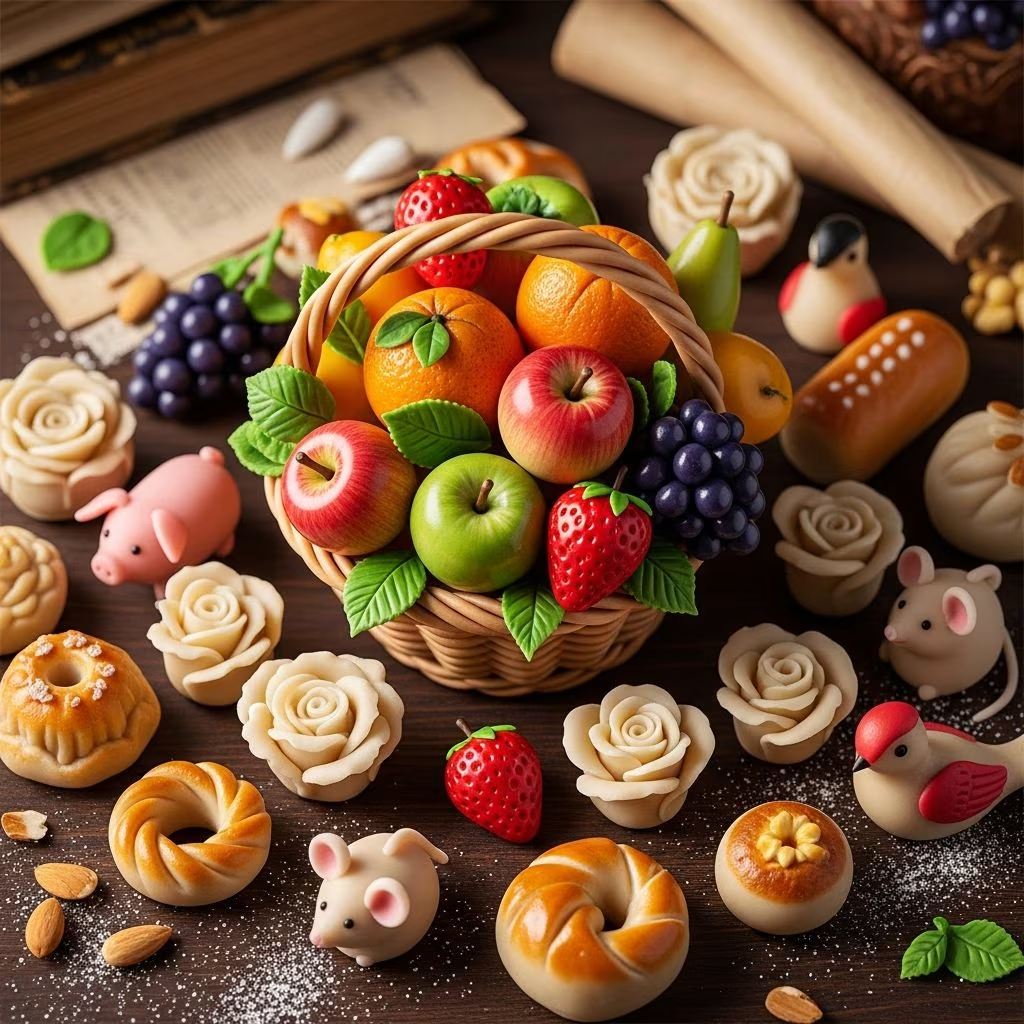
Sicily holds an unquestionably prominent position in marzipan lore, particularly through the creation of “frutta martorana,” decorative confections shaped and colored to resemble miniature fruits. According to historical records, these elaborate creations were invented in 1143 by nuns residing in the convent of Santa Maria dell’Ammiraglio, located in Palermo and also known as La Martorana. The nuns became renowned throughout the city for maintaining one of Palermo’s most beautiful gardens, and legend holds that they crafted their marzipan sculptures to so precisely resemble actual fruit that even visiting bishops were fooled by their artistry. This narrative captures the transformative power of skilled confectionery work during the medieval period, when the ability to create convincing illusions through food preparation was regarded as almost magical.
German Excellence and Northern Expansion
Germany, particularly the Hanseatic League port cities, emerged as another epicenter of marzipan production and refinement. The city of Lübeck became especially famous for its marzipan, with local legends attributing the craft’s flourishing to various figures including a baker named Marcus and an imaginative chef named Franz Marcip who allegedly returned to his hometown to establish a marzipan production facility.
By the 16th century, marzipan had become so established in Northern Europe that dictionaries formally recognized the term, with a 1521 publication documenting “marzipan” as “panis Marcius.” The Danish city of Odense also developed a strong marzipan tradition, with the confection thought to have been introduced to Denmark approximately 500 years ago by tradesmen traveling across the Alps. Lübeck maintained its reputation for producing particularly high-quality marzipan and became synonymous with the confection throughout the German-speaking world.
Spanish Toledo and Protected Heritage
Toledo, Spain represents yet another competing claim to marzipan heritage, with documented references to almond paste preparations dating to at least 1150 during the reign of Alfonso VII. Toledo’s marzipan production gained such prominence that the city eventually secured protected designation of origin status for its product, a modern legal recognition of centuries-old culinary tradition. During the 15th century, when famine threatened grain supplies, Toledoan bakers ingeniously substituted almonds, eggs, and sugar for scarce flour, creating marzipan as a practical survival food that subsequently became an enduring specialty.
The Culinary Transformation by Italian Masters
While multiple regions contributed to marzipan’s development, the Milanese and broader Italian confectioners elevated the craft to extraordinary artistic heights. Italian artisans developed refined techniques that allowed marzipan to be sculpted into elaborate, anatomically detailed creations that transcended simple candy to become edible sculpture.
The refinement reached such sophistication that the renowned polymath Leonardo da Vinci created intricate marzipan sculptures for the Milanese court. According to historical accounts, Leonardo expressed considerable frustration when court members consumed his edible artworks, lamenting that they “gobble up all the sculptures I give them, right down to the last morsel.” This anecdote captures the tension between marzipan as art object and marzipan as food, a duality that has characterized the confection throughout its history.
Compositional Consistency Across Cultures
Despite regional variations in production techniques, presentation styles, and cultural significance, marzipan has maintained consistent foundational ingredients throughout its documented history. The basic preparation remains elegantly simple: ground almonds combined with sugar, sometimes with the addition of egg white, water, or rose water to achieve the desired consistency and texture. This simplicity has paradoxically allowed for tremendous variation, as different artisans have experimented with proportions, additional ingredients, and molding techniques.
The Niederegger confectionery in Lübeck, which maintained family records spanning generations, documented a recipe comprising “as many almonds as possible, as much sugar as necessary plus a secret ingredient,” suggesting that even established producers maintained proprietary variations within the traditional framework.
The Journey from Luxury to Widespread Availability
Initially, marzipan existed as an extreme luxury item, accessible only to nobility, wealthy merchants, and the ecclesiastical elite due to the high cost of sugar and almonds during medieval and early modern periods. The confection’s rarity and expense contributed significantly to its cultural prestige and status as a marker of sophistication and refined taste.
As agricultural production expanded, trade routes became more efficient, and European production capabilities increased, marzipan gradually transitioned from exclusive luxury to a more widely consumed specialty. By the 18th and 19th centuries, established confectioneries in major European cities had begun formal commercial production, making marzipan available to broader segments of society, though it remained more expensive than common sweets.
Global Distribution and Modern Recognition
Today, marzipan maintains a presence across Europe, the Middle East, and Latin America, with notable concentrations in regions with historical ties to medieval Mediterranean trade. The confection also appears in parts of Southern and Southeast Asia where European colonial influence introduced the candy, including former Portuguese territories such as Goa and the Philippines.
Several European cities and regions have formalized their marzipan heritage through protected designations and maintained brand identity. Spain’s Toledo holds protected designation of origin status, while Italy’s Palermo, Portugal’s Algarve, and Germany’s Lübeck have cultivated international recognition as premier marzipan producers. These regional distinctions maintain cultural memory of marzipan’s complex history while supporting local economies through culinary tourism and specialty product sales.
Frequently Asked Questions
What are the primary ingredients in marzipan?
Marzipan consists fundamentally of ground almonds and sugar, with variations sometimes including egg white, water, or rose water to achieve particular textures and consistency levels. The basic ratio and proportions vary according to regional traditions and individual producer preferences.
Which country can claim authentic invention of marzipan?
No single country can definitively claim marzipan’s invention due to its complex origins spanning multiple continents and centuries. However, Arab culture played a foundational role in developing and popularizing the confection, while Italian, Spanish, and German traditions significantly shaped its evolution into the product recognized today.
Why did different regions claim marzipan as their own creation?
Multiple regions developed distinctive marzipan traditions through geographic access to key ingredients, merchant trade networks, and local culinary innovations. Cities like Toledo, Palermo, and Lübeck invested significant cultural capital in perfecting the craft, leading to legitimate historical claims and competitive regional pride.
When did marzipan first appear in written records?
References to almond paste appear in literary sources as early as the 8th-14th centuries, particularly in the Arabian Nights collection. The earliest formal written references to the term “marzipan” specifically appear in Italian and Spanish documents from the 16th century, though the confection existed considerably earlier.
What is frutta martorana and where did it originate?
Frutta martorana refers to decorative marzipan sculptures shaped and colored to resemble miniature fruits and other objects. This distinctive tradition was developed by nuns in the Palermo convent of Santa Maria dell’Ammiraglio in 1143 and remains a signature representation of Sicilian culinary artistry.
The Enduring Legacy of a Medieval Confection
Marzipan’s persistence across more than a thousand years demonstrates the profound impact of culinary traditions in preserving cultural memory and facilitating cross-cultural exchange. What began as an Oriental medicine and luxury commodity evolved through medieval trade networks into a distinctly European specialty, with each region imprinting its own artistic and technical signature upon the basic preparation.
The confection’s simplicity—mere ground almonds and sugar—belies its historical complexity. Each regional iteration reflects particular historical circumstances, ingredient availability, merchant networks, and artistic sensibilities. From Sicilian nuns creating fruit-like sculptures to Milanese artisans producing edible masterpieces to German confectioners establishing commercial production standards, marzipan’s history is fundamentally a history of human creativity working within specific material and cultural constraints.
As contemporary consumers encounter marzipan in European Christmas markets, specialty confectionery shops, or artisanal candy stores, they participate in a tradition spanning continents and centuries. Each piece represents not merely sugar and almonds, but rather a tangible connection to medieval Venice, Islamic medical theory, Sicilian convent gardens, and the patient refinement of countless artisans dedicated to transforming simple ingredients into objects of aesthetic and culinary excellence.
References
- Marzipan: history, recipes and variations of the typical sweet pastry of Sicily — Gambero Rosso International. Accessed April 2026. https://www.gamberorossointernational.com/news/food-news/marzipan-history-recipes-and-variations-of-the-typical-sweet-pastry-of-sicily/
- History of marzipan — Niederegger Lübeck. Accessed April 2026. https://www.niederegger.de/en/marzipan/history-of-marzipan/
- Marzipan — Encyclopædia Britannica Online. Accessed April 2026. https://en.wikipedia.org/wiki/Marzipan
- The Origin & History of Marzipan in Toledo, Spain — Toledo Lockers. Accessed April 2026. https://www.toledolockers.com/en/the-origin-history-of-marzipan-in-toledo-spain/
- The Long History and Timeless Appeal of Marzipan — Wockenfuss Candies. Accessed April 2026. https://wockenfusscandies.com/sweet-treats/the-long-history-and-timeless-appeal-of-marzipan/
- Marzipan in My Veins: A History of the Almond Candy — Institute of Culinary Education. Accessed April 2026. https://www.ice.edu/blog/marzipan-candy
- Marzipan: A History — British Food: A History. Accessed April 2026. https://britishfoodhistory.com/tag/marzipan/