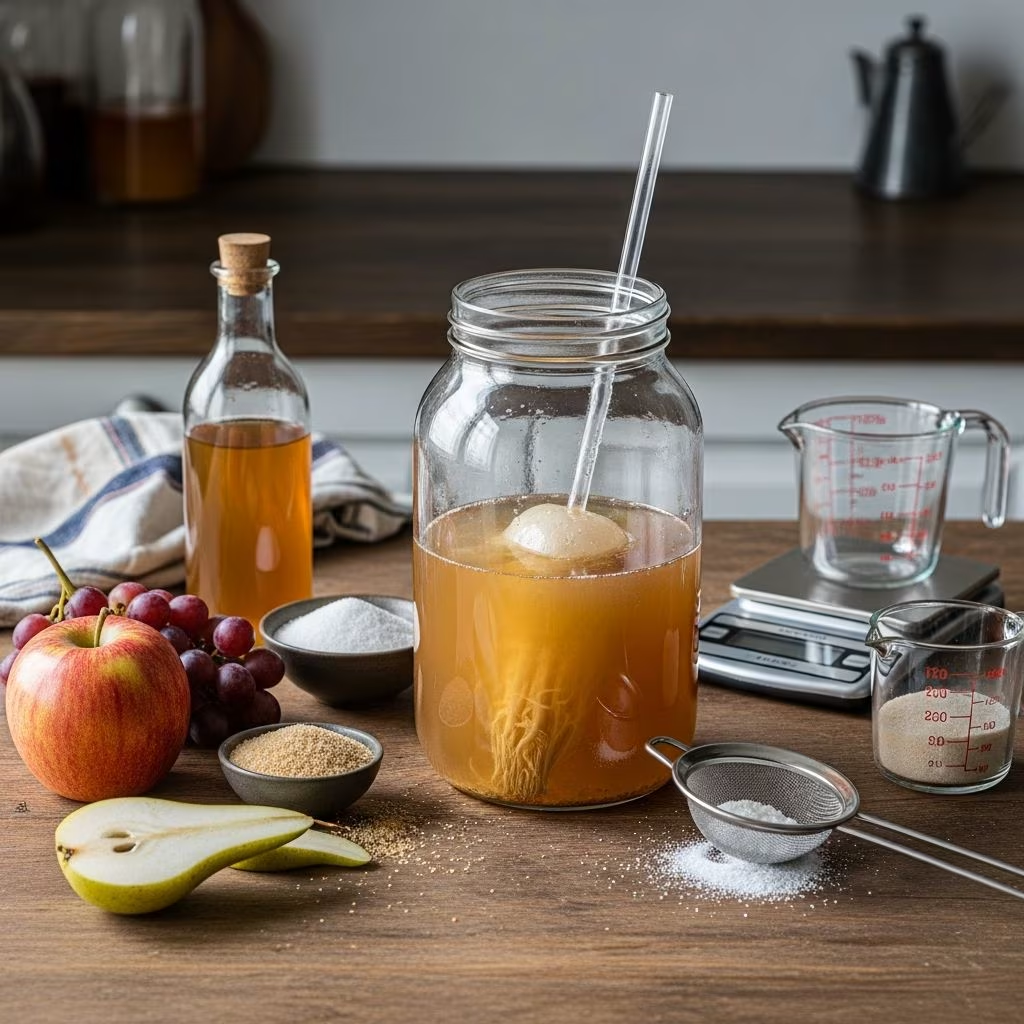
Transform everyday fruit scraps and basic ingredients into tangy, versatile vinegar through natural fermentation. This process yields customizable flavors perfect for dressings, marinades, and pickling, often surpassing store-bought options in freshness and depth.
Understanding the Fermentation Process
Vinegar production involves two key stages: alcoholic fermentation, where yeasts convert sugars to alcohol, followed by acetic acid fermentation, where bacteria turn alcohol into acetic acid. Wild yeasts and acetobacter bacteria, present in air and on fruit skins, drive this transformation when provided sugar, water, and oxygen.
Maintain temperatures between 60-80°F for optimal activity, as higher heat speeds fermentation but risks off-flavors, while cooler conditions slow it down. Oxygen is essential during the acetic phase, hence breathable covers on jars prevent anaerobic issues like unwanted yeasts.
Essential Equipment and Ingredients
Gather these basics for success:
- Glass jars: 1-quart to 1-gallon sizes; avoid metal as acid corrodes it.
- Breathable covers: Cheesecloth or tight-weave fabric secured with rubber bands for air exchange.
- Weights: Fermentation weights or small plates to submerge fruit.
- Sanitizer: Star San, iodophor, or dilute bleach, rinsed thoroughly.
- Starter: Unpasteurized vinegar with mother (sediment) to introduce beneficial bacteria.
Key ingredients include fresh or overripe fruit (high-fructose varieties like apples, berries), cane sugar (1 tbsp per cup water), and filtered water. Avoid chlorinated tap water, which inhibits microbes.
Recipe: Apple-Based Vinegar from Scratch
This method uses whole apples or scraps for a classic cider vinegar yielding about 1 liter.
Ingredients
| Ingredient | Quantity |
|---|---|
| Apples or scraps (Honeycrisp, Gala, etc.) | 1-1.5 lbs (fills jar 3/4) |
| Cane sugar | 4 tbsp |
| Filtered water | 1 liter |
| Raw ACV with mother (optional starter) | 2-3 tbsp |
Step-by-Step Instructions
- Sanitize jar, lid, and tools; rinse well.
- Chop apples into chunks, removing stems; rinse scraps.
- Fill jar 3/4 with apples; dissolve sugar in 1 cup water, add to jar.
- Top with remaining water, leaving 1/2-inch headspace; weight down fruit.
- Cover with cheesecloth; store in dark, 60-80°F spot.
- Stir daily for 2-3 weeks until bubbling slows (alcoholic phase).
- Strain liquid into clean jar; add starter if used.
- Re-cover; ferment 3-4 more weeks, tasting weekly via straw (avoid mother).
- Bottle when tangy; dilute if too strong.
Expect a cloudy “mother”—a cellulose pellicle of bacteria and yeast—forming on top, signaling healthy progress.
Quick Method: From Store-Bought Cider
Accelerate with ready alcohol: Mix equal parts unpasteurized apple cider and raw vinegar in a jar. Cover with cheesecloth, swirl daily for 3-4 weeks at room temp until sour. Filter and bottle. Ideal for beginners, ready in under a month.
Versatile Fruit Vinegar Variations
Adapt for other flavors:
- Berry Vinegar: 6 cups berries, 255g sugar, water to fill gallon jar, 3 tbsp starter. Ferment 3 weeks, stirring daily.
- Pineapple or Scrap Vinegar: Peels/cores from 1 fruit, 1 cup water, 1 tbsp sugar/honey, 1-2 tbsp starter per batch. Scale up.
- Wine Vinegar: Leftover red/white wine + raw vinegar mother. Aerate daily; ready in 4-6 weeks.
High-sorbitol fruits (e.g., pears) may develop kahm yeast—skim white film if appears, but discard if fuzzy mold forms.
Troubleshooting Common Issues
| Problem | Cause | Solution |
|---|---|---|
| No bubbling | Cold temps, chlorinated water | Warm to 70°F, use filtered water, add starter |
| Mold growth | Exposed fruit, contamination | Discard; sanitize better, ensure submersion |
| Off smells (rotten) | Anaerobic bacteria | Increase stirring/aeration |
| Too weak | Short fermentation | Continue tasting, extend time |
Patience is key; full strength takes 6-8 weeks total.
Storing and Pasteurizing Your Vinegar
Transfer to swing-top bottles or jars; store cool/dark up to a year. Refrigerate mothers for future batches. Optional pasteurization: Heat to 155°F for 30 min in stainless pot, then jar hot—kills bacteria for clarity, but raw retains probiotics.
Culinary Uses for Homemade Vinegar
Elevate dishes with your creation:
- Salad dressings: 3:1 oil to vinegar, herbs.
- Pickles: Quick brine with spices.
- Marinades: For meats/veggies.
- Drinking tonics: Diluted with water/honey for digestion.
Custom flavors infuse personality—experiment with herbs post-fermentation.
Health and Safety Considerations
Homemade vinegar may contain live cultures beneficial for gut health, akin to kombucha. Test pH below 4.0 with strips for safety (vinegar’s acidity preserves). Avoid if immunocompromised without pasteurizing. Use clean practices to prevent pathogens.
Scaling Up Production
Start small (pint jars) to learn, then fill gallons for bulk. Chain batches: Reserve 10% finished vinegar as starter. Warmer climates speed process; cooler ones extend to months.
FAQs
Can I make vinegar without a starter?
Yes, wild yeasts suffice, but starters shorten time and reduce failure risk.
How do I know it’s ready?
Taste: Sharp, vinegary tang without alcohol notes. Smell like store vinegar.
What if fruit floats?
Use sanitized weights; uncovered fruit molds.
Is the mother edible?
Yes, probiotic-rich; strain for clear vinegar or blend in.
Can I use honey instead of sugar?
Yes, but expect milder flavor; dissolve fully.
References
- How to Make Apple Cider Vinegar at Home — American Homebrewers Association. 2023. https://homebrewersassociation.org/beer-food/how-to-make-apple-cider-vinegar-at-home/
- How to Make Vinegar from Scratch — Cultured Guru. 2023. https://cultured.guru/blog/how-to-make-vinegar-from-scratch
- Homemade Vinegar — Ferment Pittsburgh. 2021-01-03. https://fermentpittsburgh.com/2021/01/03/homemade-vinegar/
- Making Cider Vinegar at Home — UC Davis Food Safety. N/A. https://ucfoodsafety.ucdavis.edu/sites/g/files/dgvnsk7366/files/inline-files/192135.pdf
- How To Make Your Own Vinegar — 5 Different Recipes — Cultured Food Life. 2023. https://www.culturedfoodlife.com/how-to-make-your-own-vinegar-5-different-recipes/