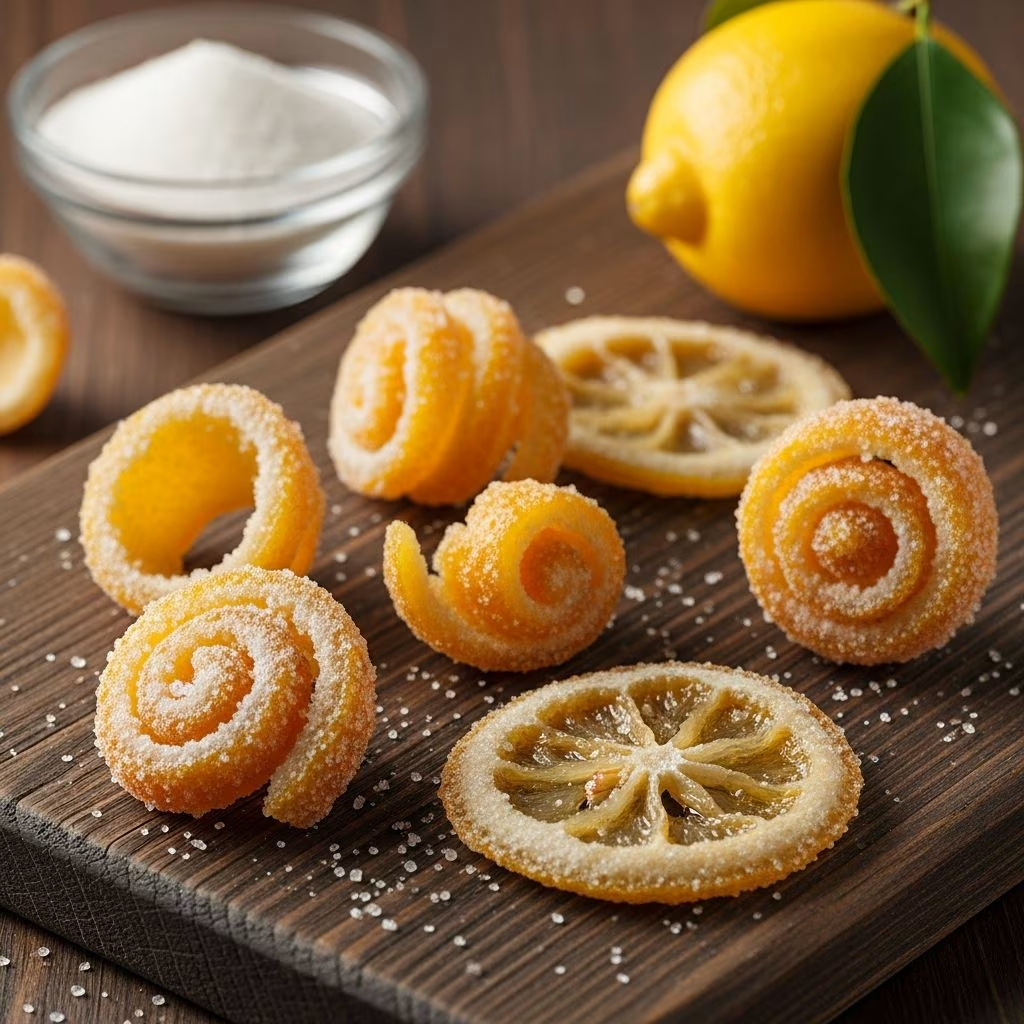
Homemade **candied lemon peel** offers a burst of sunny flavor that elevates everything from baked goods to cocktails. This versatile confection captures the essence of citrus in a chewy, sugar-glazed form, far superior to store-bought versions. With basic pantry staples like lemons, sugar, and water, anyone can master this craft. Our guide dives deep into the process, troubleshooting, and innovative applications to help you create professional-quality results.
Why Make Your Own Candied Lemon Peel?
Candied lemon peel isn’t just a nostalgic treat; it’s a kitchen powerhouse. The process removes bitterness from the rind while infusing it with sweetness, resulting in a product that’s tender yet holds its shape. Home versions allow control over quality—using organic lemons ensures cleaner peels without pesticides. Economically, it’s a smart move: a few dollars’ worth of ingredients yields pounds of peel, perfect for holiday gifting or stocking your pantry.
Beyond taste, this candy boasts nutritional perks. Lemon peels are rich in vitamin C, fiber, and antioxidants like flavonoids, which support immune health and digestion when consumed in moderation. Unlike processed candies, yours avoids artificial colors and preservatives. Bakers prize it for adding moisture and zing to fruitcakes, while mixologists chop it into syrups for bright cocktails.
Selecting the Best Lemons for Candying
Start with quality lemons to guarantee success. Opt for **thick-skinned varieties** like Eureka, Lisbon, or Sorrento lemons, as they provide more peel relative to flesh. Meyer lemons work wonderfully too, offering a milder, sweeter profile ideal for snacking. Avoid thin-skinned or overripe fruits, which can become mushy during cooking.
- Organic preferred: Reduces exposure to waxes and chemicals.
- Firm and heavy: Indicates juicy, vibrant peels.
- Bright yellow: Signals freshness; steer clear of green-tinged or spotted ones.
Plan for 4-6 large lemons per batch, yielding about 2 cups of finished peel. Wash thoroughly under warm water, scrubbing gently to remove any residue.
Essential Tools and Ingredients
Gather these basics before starting:
| Item | Purpose | Notes |
|---|---|---|
| 4-6 large lemons | Main ingredient | Thick-skinned for best texture |
| 2 cups granulated sugar | Sweetening and glazing | White sugar for clarity; can sub cane sugar |
| 2 cups water (plus extra for blanching) | Blanching and syrup base | Use filtered for purity |
| Sharp knife or peeler | Precise cutting | Paring knife excels for thin strips |
| Medium saucepan | Cooking vessel | Non-reactive like stainless steel |
| Wire rack or parchment-lined tray | Drying surface | Prevents sticking |
| Candy thermometer (optional) | Temperature monitoring | Ideal for syrup stage |
These yield approximately 2 cups of candied peel, enough for multiple recipes.
Step-by-Step Guide to Perfection
Follow these precise steps for flawless results. Total time: about 2 hours active, plus overnight drying.
1. Prepare the Peels
Trim ends from each lemon to create flat bases. Quarter lengthwise, then gently loosen the peel from the flesh using a spoon or knife, keeping the white pith intact—it’s crucial for chewiness. Scrape excess pith if overly thick, aiming for 1/4 to 3/8-inch wide strips. This yields uniform pieces that candy evenly.
2. Blanch to Banish Bitterness
Bitterness resides in the pith, so blanching is non-negotiable. Cover strips with cold water in a saucepan, bring to a rolling boil for 3-5 minutes, then drain. Repeat 3-5 times with fresh water each round. Taste a strip after the final blanch; it should be mildly citrusy without harshness. This step, repeated across recipes, transforms raw peels into candy-ready bases.
3. Craft the Sugar Syrup
In the same saucepan, combine 2 cups sugar and 2 cups water. Heat gently, stirring until dissolved into a clear syrup. Avoid boiling too soon to prevent crystallization. For aromatic twists, add cloves, a cinnamon stick, or reserved lemon juice now. Target 230-235°F if using a thermometer for soft-ball stage.
4. Simmer to Translucency
Add blanched peels to the syrup. Simmer on low for 45-60 minutes, stirring occasionally. Peels are ready when translucent, tender to the bite, and syrup has thickened slightly. Patience here prevents tough results—thinner lemon rinds finish faster.
5. Drain, Dry, and Dust
Remove peels with a slotted spoon to a wire rack over a tray. Let drip-dry for 1-2 hours, then air-dry 12-24 hours until no longer sticky. Toss in granulated sugar for a sparkling finish, or dip half in melted chocolate for luxury.
Common Pitfalls and Pro Tips
Achieve consistency with these insights:
- Too bitter? Extend blanching to 6 rounds.
- Syrup crystallizing? Add a glucose syrup pinch or avoid stirring post-dissolve.
- Peels too soft? Use thicker strips and shorter simmer.
- Pro tip: Save syrup for lemon simple syrup in drinks or glazes.
Scale up for gifts: double ingredients for pint jars, lined with parchment.
Creative Ways to Enjoy Candied Lemon Peel
This candy shines in diverse roles:
- Baking star: Chop into fruitcakes, panettone, or shortbread for citrus pop.
- Snack supreme: Eat plain or chocolate-dipped as trail mix alternative.
- Cocktail enhancer: Muddle into gin fizz or rim glasses.
- Dessert decorator: Garnish cheesecakes, tarts, or ice cream sundaes.
- Pantry staple: Blend into marmalade or infuse vodkas.
Experiment with oranges, limes, or grapefruit for mixed peels in holiday breads.
Storage and Shelf Life
Store in airtight containers at room temperature for up to 1 month. Refrigerate for 3 months or freeze up to a year, separating layers with parchment. Properly dried peels resist mold; inspect periodically.
Nutrition at a Glance
Per 1 oz serving (approx. 5-6 strips): 120 calories, 30g sugar, trace fiber and vitamin C. Indulge mindfully as a natural sweet.
Frequently Asked Questions
Can I use other citrus?
Yes! Oranges need longer blanching; limes are quicker. Adjust syrup ratios slightly.
Is blanching skippable?
No—it’s essential for edibility. Skipping yields bitter results.
How do I fix crystallized syrup?
Gently reheat with a splash of water, stirring minimally.
Chocolate-dipping instructions?
Melt dark chocolate, dip half the peel, and chill on parchment until set.
Vegan and gluten-free?
Absolutely—purely fruit, sugar, and water.
Advanced Variations
Elevate with spices: infuse syrup with star anise or ginger. For boozy peels, add rum post-simmer. Sugar-free? Experiment with erythritol syrup, though texture varies.
Mastering candied lemon peel opens a world of flavor. From kitchen novice to pro baker, this technique rewards with versatile, homemade delight.
References
- Homemade Candied Lemon Peel — My Cookie Journey. 2023-05-15. https://mycookiejourney.com/homemade-candied-lemon-peel/
- Candied Lemon Peel: Easy And Delicious — Tin and Thyme. 2025-02-01. https://tinandthyme.uk/2025/02/candied-lemon-peel/
- How To Make Candied Lemon Peel & Orange Peel — My German Recipes (YouTube). 2022-11-20. https://www.youtube.com/watch?v=2FTFodfDomw
- Candied Lemon Peel Recipe — Bright-Eyed Baker. 2023-01-10. https://www.brighteyedbaker.com/diy-candied-citrus-peel/
- How To Make Candied Lemon Peel — Baking with Butter. 2024-03-05. https://bakingwithbutter.com/how-to-make-candied-lemon-peel/