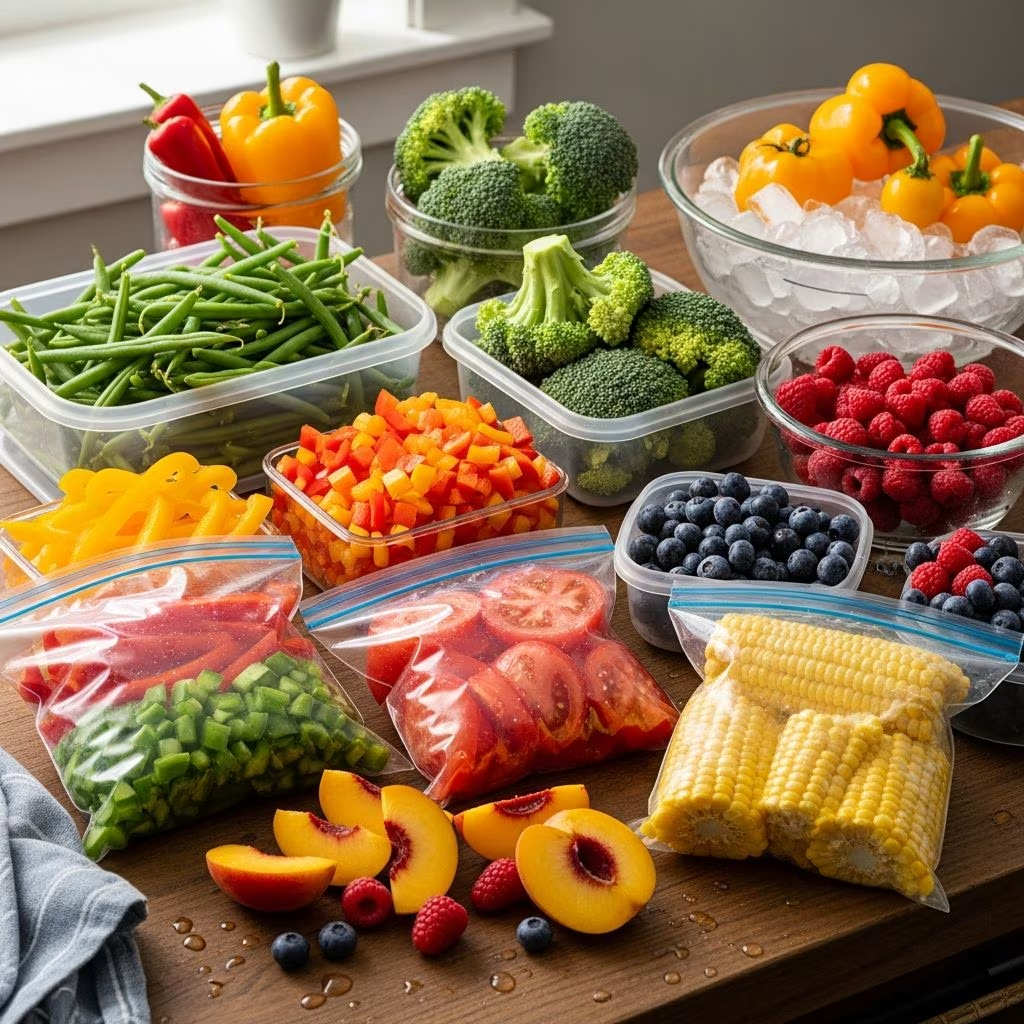
Preserving the bounty of summer through freezing allows you to savor fresh-tasting fruits and vegetables long after the season ends. This method locks in nutrients and flavors when done correctly, making it a practical choice for home preservation without the need for specialized canning equipment. By selecting peak-quality items and following precise preparation steps, you can maintain quality for up to a year in your freezer.
Why Freezing Beats Other Preservation Methods
Freezing stands out for its simplicity and superior retention of taste and vitamins compared to canning or drying. Unlike canning, which requires heat processing that can alter textures, freezing halts enzyme activity that leads to spoilage while preserving crispness in vegetables and juiciness in fruits. It’s ideal for those with limited space or time, as the process typically takes under an hour per batch.
Essential Equipment for Successful Freezing
Gather these basics before starting: heavy-duty freezer bags or containers, baking sheets for flash-freezing, a large pot for blanching, ice bath bowls, and a slotted spoon. Maintain your freezer at 0°F (-18°C) or below for best results. Label everything with contents and dates to track storage times.
Selecting the Best Produce for Freezing
Choose items at their ripest, avoiding overripe or bruised pieces. Harvest or buy in the morning when produce is coolest and most flavorful. For vegetables, opt for young, tender specimens; for fruits, select firm-ripe ones that yield slightly to pressure. This ensures optimal texture post-thaw.
General Preparation Steps
Begin by washing all produce thoroughly under cool running water, then pat dry to prevent ice crystals. Cut into uniform sizes for even freezing—bite-sized pieces work well. For fruits prone to browning like apples or peaches, treat with a solution of 1 tablespoon ascorbic acid or lemon juice per cup of water.
Freezing Vegetables: The Blanching Process
Most vegetables require blanching to deactivate enzymes that cause color loss, flavor degradation, and nutrient breakdown. Use 1 gallon of boiling water per pound of vegetables. Submerge prepped veggies, cover, and boil for the specified time, then plunge into an ice water bath to halt cooking. Drain and dry thoroughly before packing.
- Asparagus: Trim woody ends; blanch spears 2-4 minutes based on thickness.
- Broccoli and Cauliflower: Cut into florets; blanch 3 minutes.
- Green Beans: Trim ends, leave whole or snap into pieces; blanch 3 minutes.
- Corn: For kernels, blanch 4 minutes; small ears need 7 minutes.
- Summer Squash: Slice or cube; blanch 3 minutes.
- Okra: Trim pods; blanch 3-4 minutes.
- Leafy Greens: Blanch 2 minutes (3 for collards).
Exceptions include peppers, onions, and herbs, which freeze well raw after washing and chopping.
Packing Methods for Vegetables
Employ tray packing or dry packing for best results. For tray packing, spread blanched, dry pieces in a single layer on parchment-lined sheets and freeze for 2-4 hours until solid. Transfer to airtight bags, squeezing out air. Dry pack tightly into containers, leaving ½-inch headspace for most veggies except loose ones like broccoli.
Freezing Fruits Without Losing Appeal
Fruits freeze simpler than vegetables—no blanching needed. Wash, dry, and prep: remove pits, cores, or hulls. Flash-freeze small items like berries on trays to prevent clumping. For larger fruits, consider sugar packs or syrup for better texture.
| Fruit | Preparation | Packing Tip |
|---|---|---|
| Berries (Blueberries, Blackberries, Strawberries) | Leave whole or halve; hull strawberries | Flash-freeze, then bag; unsweetened or light syrup |
| Peaches, Nectarines | Blanch to peel, slice, treat anti-browning | Pack in syrup (3 cups sugar/1 qt water); ½-inch headspace |
| Apples, Pears | Peel, core, slice; lemon juice dip | Dry sugar pack or syrup; keep submerged |
| Melons | Remove rind, cube or ball | Unsweetened tray pack |
| Bananas | Peel, slice | Flash-freeze on tray |
Syrup recipes: Light (2 cups sugar/1 qt water), medium (2¾ cups sugar/1 qt water). Dissolve sugar in hot water, cool before use.
Advanced Packing Techniques
Minimize air exposure to avoid freezer burn: use vacuum sealers if available, or press bags flat before sealing. For syrup-packed fruits, add crumpled parchment under the lid to keep pieces submerged. Portion into meal-sized amounts for convenience.
Storage Guidelines and Shelf Life
Store at 0°F; most items last 8-12 months with quality retention. Fruits like berries hold up to 10-12 months; vegetables like beans or corn 8-12 months. Check for freezer burn (dry, discolored spots) and discard if present. Rotate stock using FIFO (first in, first out).
Thawing and Using Frozen Produce
Thaw fruits in the fridge for smoothies or baking—no refreezing. Vegetables thaw best in cooking; add directly to soups or stir-fries from frozen. For even cooking, microwave in short bursts or use cold water submersion for quick needs.
Common Mistakes and How to Avoid Them
Avoid these pitfalls: skipping blanching (leads to mushy veggies), poor sealing (causes burn), overcrowding blanch water (uneven cooking), or freezing unripe produce (poor flavor). Overloading the freezer raises temperature—freeze in small batches.
Seasonal Freezing Calendar
Maximize savings by freezing peak-season items:
- June-July: Strawberries, blueberries, green beans, zucchini.
- July-August: Peaches, corn, okra, summer squash.
- August-September: Blackberries, apples, pears, broccoli.
Recipes Showcasing Frozen Produce
Summer Berry Smoothie: Blend 2 cups mixed frozen berries, 1 banana, yogurt, and milk.
Vegetable Stir-Fry: Sauté thawed green beans, peppers, and corn with soy sauce.
Peach Crisp: Mix frozen peach slices with oats, brown sugar, and bake.
Frequently Asked Questions
Can I freeze produce without blanching?
Yes, for peppers, onions, herbs, and most fruits. Blanching is crucial for enzyme-rich vegetables to preserve quality.
How long does frozen produce last?
Up to 12 months at 0°F, though best used within 8-10 for peak flavor.
Does freezing destroy nutrients?
Minimal loss if blanched properly; freezing retains more vitamins than canning.
Can I reuse freezer bags?
Wash thoroughly, but new bags prevent contamination.
What if my freezer isn’t frost-free?
Defrost regularly to maintain temperature; package air-tight.
References
- How to Freeze Fresh Fruits and Vegetables — HappyHealthy.MS State University Extension. 2023. https://happyhealthy.extension.msstate.edu/tips-videos/how-freeze-fresh-fruits-and-vegetables
- Freezing Fruits & Vegetables — Clemson University HGIC. 2022-10-12. https://hgic.clemson.edu/factsheet/freezing-fruits-vegetables/
- Save Summer Flavor: Freeze Fruits and Vegetables — University of Connecticut Extension. 2014-09-24. https://extension.uconn.edu/2014/09/24/save-summer-flavor-freeze-fruits-and-vegetables/
- How to Store and Freeze Fresh Produce — McCormick (adapted from extension guidelines). 2023. https://www.mccormick.com/blogs/how-to/how-to-store-and-freeze-fresh-produce