Onions form the foundation of countless dishes, adding depth and flavor to everything from soups to sautés. Yet, many home cooks dread the task due to tears, uneven cuts, or safety risks. This guide equips you with professional methods to handle onions confidently, ensuring uniform pieces that cook evenly and elevate your meals.
Essential Tools for Precise Onion Prep
Success starts with the right equipment. A sharp chef’s knife is non-negotiable—dull blades slip and cause accidents. Opt for an 8-inch blade for control. A sturdy cutting board with a non-slip surface prevents shifting. Paring knife for trimming, peeler for skins, and a bowl for scraps complete the setup.
- Chef’s knife: Sharp, 8-inch for main cuts.
- Paring knife: For root and top removal.
- Vegetable peeler: Removes tough outer layers cleanly.
- Cutting board: Wood or plastic with damp towel underneath for stability.
- Bowl: Catches peels and scraps to keep workspace tidy.
Invest in quality; a honed knife glides through onions, reducing effort and risk.
Understanding Onion Anatomy
Grasp the structure: the root end anchors layers, the top (stem) is fibrous, and papery skin protects the flesh. Layers are concentric, ideal for slicing into rings or dicing into cubes. Leave the root intact during initial cuts to hold pieces together.
| Part | Function in Cutting |
|---|---|
| Root end | Keeps onion stable; cut last to minimize tears. |
| Top/stem | Trim first; discard as it’s tough. |
| Papery skin | Peel away; compost or discard. |
| Fleshy layers | Main cutting area for slices or dices. |
Step-by-Step Guide to Basic Onion Slicing
Slicing yields even strips for salads, stir-fries, or caramelizing. Follow these steps for uniformity.
- Trim ends: Place onion on board. Use paring knife to slice off top ½ inch and root tip, just enough to expose flesh without detaching layers.
- Peel: Remove outer skin and any discolored layers. Rinse if needed.
- Halve: Stand onion on flat cut side. Slice vertically through center, from top to root.
- Position half: Cut-side down for stability. Root away from you.
- Slice vertically: Hold onion with claw grip (fingers tucked). Make parallel cuts from end to root, spacing ¼-inch for thin slices or ½-inch for thicker. Stop short of root.
- Finish: Rock knife horizontally through slices, separating into strips. Discard root nub.
Repeat with second half. This method ensures slices stay intact until the end.
Perfect Dicing for Fine Chops
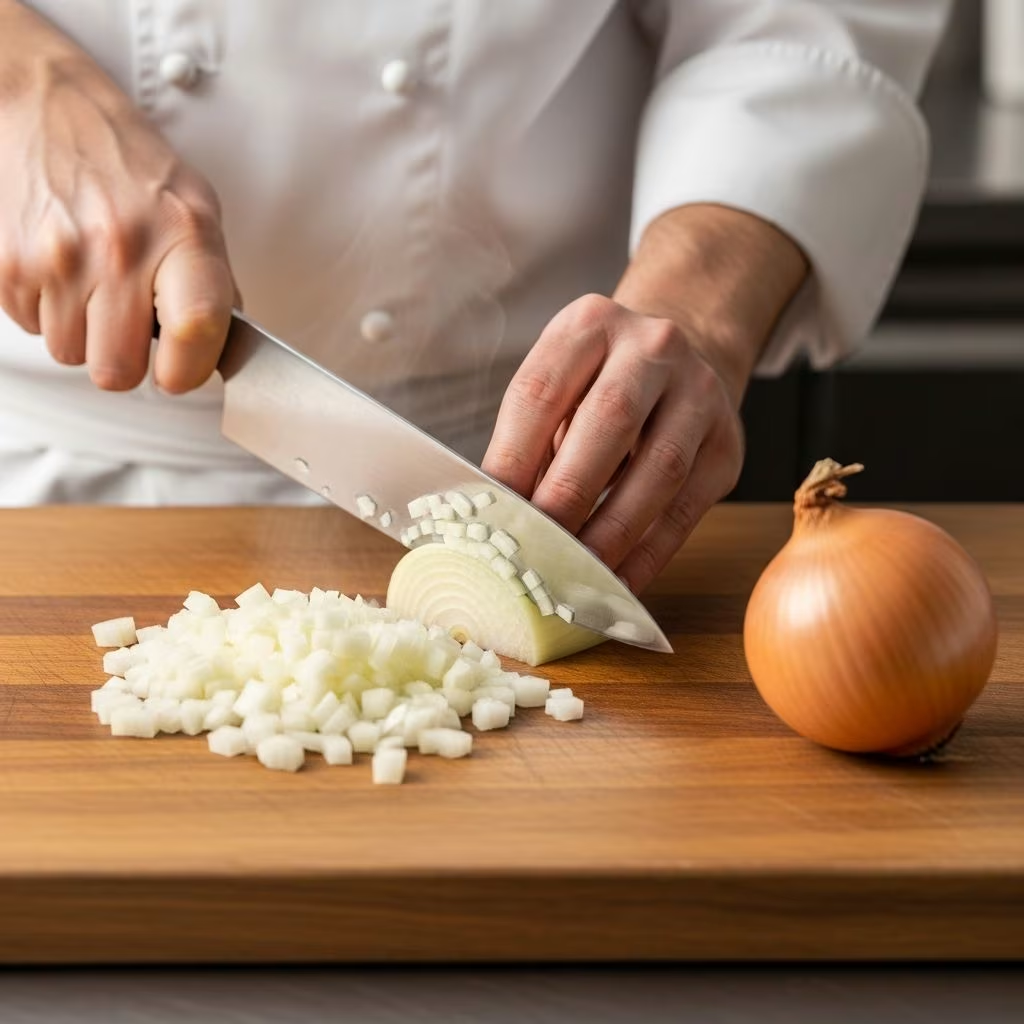
Dicing produces small, uniform cubes ideal for sauces, mirepoix, or fillings. Precision here prevents mushy results.
- Follow trimming, peeling, and halving as above.
- Place half cut-side down, root intact.
- First cuts: Vertical slices parallel to board edge, ¼-inch apart for fine dice. Keep onion cohesive by not cutting through root.
- Rotate 90 degrees: Now perpendicular cuts, same spacing, forming grid.
- Horizontal pass: Tilt onion slightly; rock knife halfway through for third dimension. Avoid full cut to root.
- Release cubes: Turn onion; slice remaining toward root base. Minimal waste.
Gordon Ramsay emphasizes leaving the root to control “bleeding” and tears. Adjust spacing: closer for mince, wider for chop.
No-Tears Strategies That Actually Work
Onion tears stem from syn-propanethial-S-oxide gas released when cells break. Neutralize it effectively.
- Chill first: Freeze onion 15 minutes. Cold slows enzyme reaction.
- Water soak: Post-peel, submerge 5 minutes. Dilutes irritants.
- Ventilation: Use hood fan or cut near running water to disperse gas.
- Goggles: Sealed swim goggles block vapors.
- Sharp knife: Quick, clean cuts release less gas.
Combine methods: chill + goggles + vent for tear-free sessions.
Safety Priorities in Onion Handling
Kitchen cuts are common; prevent them with technique. Claw grip tucks fingertips. Guide knife with knuckles, not tips. Stable board via damp towel. Never rush—intentional cuts beat speed.
- Board on countertop, not stove.
- Knife towards root, away from hand.
- Rock blade for control, don’t chop.
- Flip end pieces for safe final cuts.
Pro tip: Frank Proto advocates non-traditional holds for better leverage.
Advanced Variations for Every Recipe
Half-Moon Slices
Great for salads. Halve onion equatorially (across middle), peel, lay flat, slice thinly into crescents.
Coarse Chop
Wider spacing in dicing steps (½-inch). Ideal for stocks or roasts.
Pole-to-Pole Dice
Trim minimally. Slice from stem to root lengthwise for long strips, then cross-cut. Yields needle-like dice.
Julienne for Asian Dishes
Thin vertical slices only, no cross-cuts. Matches technique in pro kitchens.
Common Mistakes and Fixes
| Mistake | Why It Happens | Fix |
|---|---|---|
| Uneven pieces | Dull knife or rushing | Hone blade; measure spacing. |
| Tears galore | No prep or poor ventilation | Chill + soak + goggles. |
| Finger cuts | Bad grip | Claw hand always. |
| Onion falls apart | Cut root early | Leave root till end. |
| Wasteful | Over-trimming | Minimal end cuts. |
Storage Tips for Cut Onions
Refrigerate in airtight container up to 7 days. Freeze diced in bags for 3 months. Avoid plastic bags—absorbs odors. Rinse before use if stored.
Pairing Cuts with Cooking Methods
- Slices: Caramelize low-and-slow.
- Dice: Sauté high-heat quickly.
- Chop: Soups, braises.
- Julienne: Quick stir-fries.
Uniformity ensures even cooking; large pieces stay crisp, small ones melt in.
Frequently Asked Questions
How do I cut onions without crying?
Chill for 15 minutes, soak peeled halves in water, use goggles, and ventilate well.
What’s the best knife for onions?
Sharp 8-inch chef’s knife for control and safety.
Can I cut onions in advance?
Yes, store airtight in fridge up to a week or freeze for months.
Why leave the root on?
Holds layers together, reduces tears by containing juices.
Red vs. yellow onions—different techniques?
Same methods; reds are milder, better raw sliced.
Practice Drills for Mastery
Start with one onion daily. Time yourself for speed without sacrificing precision. Video your technique against pros like Ramsay. Progress to multiple onions for meal prep.
With these skills, onions transform from foe to ally. Practice yields perfection—your dishes will thank you.
References
- How to Cut an Onion (The Easy Way!) — Evolving Table. 2023. https://www.evolvingtable.com/how-to-cut-onion/
- How to Chop an Onion — Instructables. 2023. https://www.instructables.com/How-to-Chop-an-Onion/
- The Proper Way to Slice an Onion — YouTube (Philabundance Community Kitchen). 2023. https://www.youtube.com/watch?v=0oCAekNrLCc
- Dicing An Onion | Gordon Ramsay — YouTube. 2023. https://www.youtube.com/watch?v=dCGS067s0zo
- The Best Way to Cut an Onion — YouTube (Frank Proto). 2023. https://www.youtube.com/shorts/nMzD1EP88_g