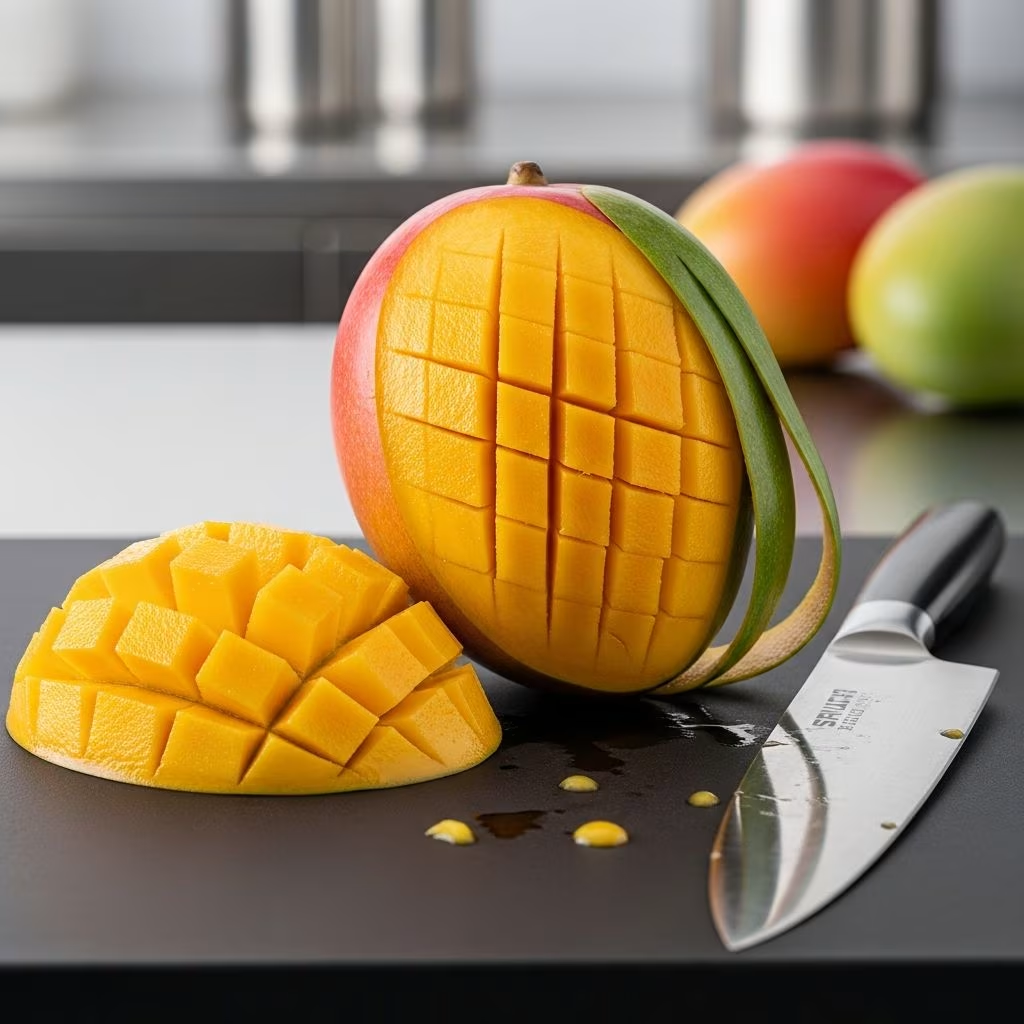
Mangos offer a burst of tropical sweetness, but their large central pit and tough skin often make preparation intimidating for home cooks. With the right approach, you can transform this fruit into neat slices, uniform cubes, or creative presentations suitable for any dish. This guide explores multiple reliable methods drawn from established culinary practices, ensuring you extract every bit of flesh while keeping your workspace clean and safe.
Understanding Mango Anatomy for Better Cuts
Before diving into techniques, grasp the mango’s structure. The fruit features a broad, flat oval pit that runs lengthwise through the center, anchoring most of the fibrous flesh. The skin is leathery and inedible, while the ripe flesh yields easily to pressure. Ripe mangos feel slightly soft at the stem end and emit a fruity aroma. Varieties like Ataulfo or Tommy Atkins differ in size and pit thickness, but the core principles apply universally.
Selecting quality mangos enhances success: choose ones with smooth, unblemished skin free from soft spots or shriveling. This preparation knowledge sets the foundation for efficient cutting, reducing frustration and waste.
Essential Tools for Precise Mango Slicing
A sharp chef’s knife handles initial cuts through the tough exterior, while a smaller paring knife excels at scoring and trimming. A sturdy cutting board with a non-slip surface prevents accidents. Optional aids include a large spoon for scooping, a pint glass for peeling, or a dedicated mango splitter for speed. Always prioritize sharp blades to avoid slipping, which could lead to injury.
- Chef’s knife: 8-inch blade for cheeks.
- Paring knife: For detailed scoring and peeling.
- Spoon: Rounded edge to lift flesh cleanly.
- Pint glass: Innovative peel remover.
These tools, used correctly, make the process intuitive and quick.
Basic Method: Removing the Cheeks Safely
The foundation of all techniques starts with isolating the two largest flesh sections, known as cheeks. Position the mango stem-up on your board. Visualize the pit’s flat plane running vertically. With your non-dominant hand stabilizing the fruit, use the chef’s knife to slice straight down about 1/4 to 1/2 inch from the center, curving slightly if you hit resistance from the pit. Repeat on the opposite side, yielding two plump cheeks and a central husk with attached strips.
This step maximizes yield, as cheeks comprise 70-80% of edible fruit. Discard or save the pit husk for later trimming.
Technique 1: Slicing Mangos into Elegant Wedges
For salads, garnishes, or simple snacking, thin wedges showcase the fruit’s vibrant color and texture. After securing cheeks skin-side down, make parallel lengthwise cuts from the wide end toward the narrow tip, stopping at the skin. Space cuts 1/2 inch apart for uniform pieces.
Slide a spoon between flesh and skin, gliding along the curve to lift slices free. This preserves shape and prevents mushiness. Repeat on remaining cheeks and trim any flesh from the husk similarly. Results: clean, fanning slices ready for platters.
Technique 2: Dicing into Perfect Cubes with Scoring
Cubes ideal for salsas, smoothies, or desserts require grid scoring. Place a cheek skin-down. Use a paring knife to create 1/2-inch spaced vertical cuts through the flesh to—but not piercing—the skin. Rotate 90 degrees and add horizontal cuts, forming a checkerboard pattern.
Gently press the skin side to invert the cheek; cubes pop outward like hedgehog quills. Trim them off close to the skin with the knife. This hedgehog method yields precise 1/2-inch dices with minimal effort.
| Method | Best For | Yield | Skill Level |
|---|---|---|---|
| Slices | Garnishes | High volume | Beginner |
| Cubes (Scoring) | Salsas | Uniform pieces | Intermediate |
| Pint Glass Peel | Smoothies | Large chunks | Beginner |
Technique 3: Quick Peeling with a Pint Glass Hack
For bulk prep or blended recipes, bypass scoring. Hold a cheek flesh-side against the rim of a pint glass, aligning the peel-flesh edge. Slide downward firmly; the skin catches on the rim, stripping away cleanly as flesh drops into the glass. Dice the peeled halves on the board into chunks.
This clever trick minimizes knife work and catches drips in the glass for easy cleanup. Ideal for unripe firmer mangos.
Handling the Remaining Husk and Strips
Don’t discard the central pit section—it holds valuable flesh. Lay it flat skin-down. Use a paring knife to carve off long strips around the pit, following its contours. Peel these strips by laying flat and slicing skin from flesh, then chop into dices.
For two narrower sides left after cheeks, repeat: trim flesh, peel, and cube. This salvages 10-20% more fruit, perfect for thorough preppers.
Advanced Variations for Creative Presentations
Elevate cuts for visual appeal. For a “mango rose,” thinly slice cheeks lengthwise, roll tightly, and fan out. Cube the center for filling. Alternatively, use a channel knife for twists or a melon baller for spheres from ripe flesh.
A C-shaped cut around the entire pit yields four sides without waste: start at the top, curve down one side, rotate 180 degrees, and repeat. Score and invert each.
Using Tools: Mango Splitter for Speed
For high-volume tasks, a stainless splitter positions over the stem end and presses down, splitting cheeks from the pit in one motion. Follow with standard scoring or scooping. While handy, practice confirms knife methods match efficiency with no extra gear.
Safety Tips and Common Mistakes to Avoid
Sharp knives reduce slip risk—hone blades regularly. Stabilize mangos by trimming a thin base slice first. Avoid overripe fruit that mashes easily; opt for firm-ripe. Common pitfalls: cutting through skin during scoring (slow down), ignoring the pit (curve blade), or wasting strips (trim meticulously).
Wash hands and tools post-prep to manage sticky sap. Store cut mangos airtight in the fridge up to 3 days.
Recipe Ideas Featuring Cut Mangos
Mango Salsa: Dice 2 mangos, mix with red onion, cilantro, lime, chili. Serve with chips.
Smoothie Cubes: Freeze pint-glass chunks for thick blends with yogurt and banana.
Tropical Salad: Wedge slices over greens with avocado, nuts, vinaigrette.
These prep skills unlock endless uses, from savory to sweet.
Frequently Asked Questions
Can I eat mango skin?
No, it’s tough and often treated with pesticides; always peel.
How do I know if a mango is ripe?
Gentle squeeze yields slightly, strong aroma, color change from green.
What’s the best knife for mangos?
Sharp chef’s for cheeks, paring for details.
Can I cut unripe mangos the same way?
Yes, but use pint glass method as scoring may tear firmer flesh.
How long do cut mangos last?
Refrigerated in airtight container: 3-5 days; freeze up to 6 months.
Nutritional Benefits of Mangos
Beyond taste, mangos pack vitamin C (67% DV per cup), vitamin A, fiber, and antioxidants like mangiferin supporting immunity and digestion. Low calorie at 99 per cup diced, they fit any diet.
Mastering these techniques empowers confident prep, turning mangos from tricky to triumphant in your culinary repertoire.
References
- How to Cut a Mango — National Mango Board. Accessed 2026. https://www.mango.org/how-to-cut-a-mango/
- How to Cut a Mango (two easy ways!) — Bowl of Delicious. Accessed 2026. https://www.bowlofdelicious.com/how-to-cut-a-mango/
- Nourish PA: How to Cut a Mango — PA Eats. Accessed 2026. https://www.paeats.org/recipe/nourish-pa-how-to-cut-a-mango/
- A Step-By-Step Guide to Proper Mango-Slicing Technique — Schmidt Brothers. Accessed 2026. https://schmidtbrothers.com/blogs/knives-and-stuff/a-step-by-step-guide-to-proper-mango-slicing-technique
- How to Cut a Mango — Cookie and Kate. Accessed 2026. https://cookieandkate.com/how-to-cut-a-mango/