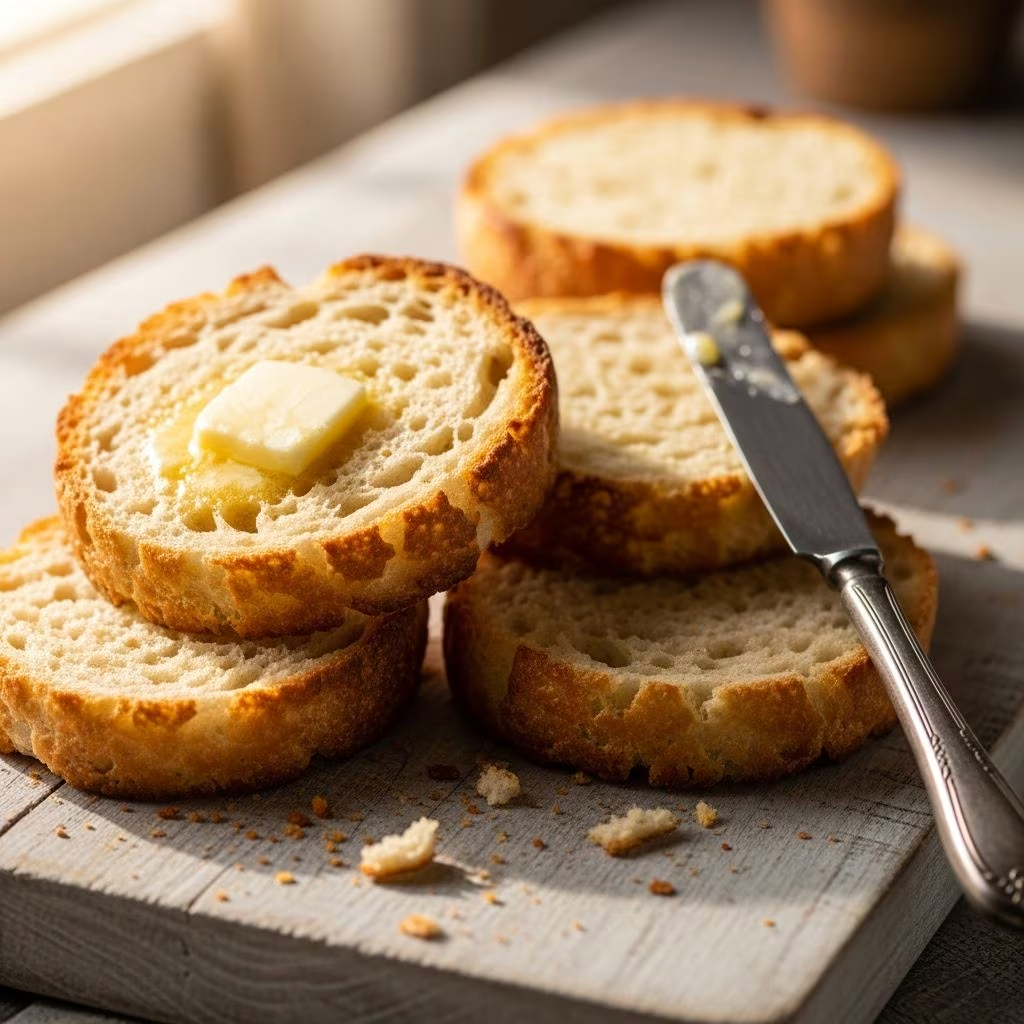
Craving the irresistible chew and uneven holes of English muffins but tired of shaping individual rounds? English Muffin Toasting Bread offers all that signature character in a single, sliceable loaf. This batter-style bread requires no kneading, just a quick mix, rise, and bake. The result is a golden, cornmeal-crusted exterior that yields to a tender, hole-filled crumb ideal for butter, jam, or eggs Benedict. Popularized by trusted bakers, this recipe transforms everyday pantry staples into bakery-quality toast.
Why Choose Toasting Bread Over Traditional English Muffins?
Traditional English muffins demand ring molds, griddle cooking, and careful flipping, which can intimidate beginners. Toasting bread simplifies the process into one pan and oven time, saving hours while preserving the yeasty flavor and craggy interior. The addition of baking soda creates irregular air pockets during rising, mimicking the steam-leavened structure of muffins. Home bakers appreciate its reliability across skill levels, with consistent results even in drafty kitchens.
Beyond convenience, this bread toasts evenly under the broiler, absorbing toppings without sogginess. Its mild tang from yeast and milk pairs with sweet or savory spreads, making it versatile for breakfast, brunch, or snacks. Families love slicing it thick for French toast, where the holes trap custard beautifully.
Gathering Your Ingredients
Precision matters in batter breads, as ratios affect rise and texture. Use a digital scale for accuracy, especially with flour, to avoid dense loaves.
| Ingredient | Volume | Weight (g) | Purpose |
|---|---|---|---|
| All-Purpose Flour | 3 cups | 360-361 | Base structure, gluten development via mixing |
| Granulated Sugar | 1 tbsp | 14 | Yeast food, subtle sweetness |
| Salt | 1 1/2 tsp | 9 | Flavor enhancer, dough strength |
| Baking Soda | 1/4 tsp | – | Creates nooks via CO2 bubbles |
| Instant Yeast | 1 tbsp | – | Rapid rise, flavor |
| Milk | 1 cup | 227 | Moisture, tenderness |
| Water | 1/4 cup | 57 | Adjusts hydration |
| Vegetable Oil or Olive Oil | 2 tbsp | 25 | Richness, soft crumb |
| Cornmeal | As needed | – | Crunchy crust, easy release |
Opt for unbleached all-purpose flour like King Arthur for optimal protein content (11.7%), which supports the batter’s structure without kneading. Whole milk adds creaminess; plant-based alternatives work if heated properly. Instant yeast ensures quick activation—no proofing required.
Step-by-Step Baking Guide
Prep takes under 10 minutes, with rising as the main wait. Total time: about 1 hour 15 minutes for one 8.5×4.5-inch loaf.
- Combine Dry Ingredients: In a large bowl or stand mixer, whisk flour, sugar, salt, baking soda, and yeast. This even distribution prevents yeast clumps and activates baking soda gradually.
- Heat Liquids: Mix milk, water, and oil. Microwave or stovetop heat to 120-130°F—hot but not scalding (finger test: uncomfortably warm). Over 140°F kills yeast; under 120°F slows rise.
- Mix Batter: Pour liquids over dries. Stir until combined (no dry spots), then beat on high (mixer) for 1 minute or by hand 2-3 minutes. Dough resembles thick pancake batter: smooth, sticky, elastic.
- Prepare Pan: Grease an 8.5×4.5-inch loaf pan; coat with cornmeal. This prevents sticking and adds crunch.
- Fill and Rise: Scoop batter in, smooth top. Cover loosely; rise 45-60 minutes until dough crowns 1/4-inch above pan rim (eye-level check). Preheat oven to 400°F midway.
- Bake: Uncover; bake 22-27 minutes until golden and internal temp hits 190°F. Cool in pan 5 minutes, then rack fully before slicing.
Yield: 1 loaf, 12-16 slices. Store at room temp 3-4 days in plastic; freeze up to 3 months.
Mastering the Rise and Texture
The magic lies in the batter’s high hydration (over 70%) and dual leaveners. Yeast ferments for flavor and lift; baking soda reacts with milk’s acidity for steam pockets, forming nooks. Ideal rise shows gentle dome—no overflow, or loaf flattens.
- Troubleshooting Low Rise: Check liquid temp; cold kitchen? Place pan in off oven with light on.
- Gummy Crumb: Underbaked—use thermometer.
- Dense Loaf: Overmixed (toughens gluten) or inaccurate flour.
For pull-apart texture, slice 1/2-inch thick and toast medium-high.
Flavor Variations to Elevate Your Loaf
Customize without altering ratios much. Add-ins go in post-mixing.
- Herb-Infused: 2 tsp dried herbs (thyme, rosemary) in dry mix. Great for savory toast.
- Cheese Lover’s: Fold in 1/2 cup shredded cheddar after beating.
- Whole Wheat: Sub 1 cup flour with whole wheat for nutty depth; add 1 tbsp extra liquid.
- Sourdough Twist: Replace 3/4 cup liquid with unfed discard, reduce flour to 2 1/4 cups, yeast to 2 tsp. Enhances tang.
- Sweet Cinnamon: Add 1 tsp cinnamon, 1/4 cup raisins to batter.
Larger 9×5 pan? Rise to 1-inch below rim; bake 25-30 minutes.
Nutrition and Serving Ideas
Per slice (1/16 loaf): ~120 calories, 20g carbs, 4g protein, 2g fat. Low sugar, no preservatives—healthier than store-bought.
- Classic: Butter + jam.
- Avocado toast with chili flakes.
- Melted cheese + tomato for quick grilled cheese.
- French toast soaked in egg-milk-vanilla.
Storage, Freezing, and Revival Tips
Room temp: Plastic bag, 3 days. Fridge dries it out. Freeze slices in zip bags; thaw and toast directly. Revive day-olds by spritzing water, toasting.
Frequently Asked Questions
Can I use active dry yeast?
Yes, but proof in warm liquids first. Instant is preferred for speed.
What if I lack a stand mixer?
Hand-beat vigorously 2-3 minutes until smooth and stretchy.
Bread didn’t have holes—why?
Baking soda too old or liquid not hot enough. Fresh ingredients key.
Gluten-free version?
Substitute 1:1 GF flour blend + 1 tsp xanthan gum; results approximate.
Scale for two loaves?
Double all; use two pans or one 9×5. Rise/bake times similar.
Expert Tips from Seasoned Bakers
Weight ingredients for consistency. Cornmeal on top boosts crunch. High-fat milk or butter (sub oil) enriches flavor. Experiment with olive oil for fruity notes. This bread shines in bread pudding, where holes soak up custard.
References
- English Muffin Toasting Bread Recipe — King Arthur Baking. 2023. https://www.kingarthurbaking.com/recipes/english-muffin-toasting-bread-recipe
- A Toast for the New Year (English Muffin Toasting Bread) — King Arthur Baking. 2008-12-26. https://www.kingarthurbaking.com/blog/2008/12/26/a-toast-for-the-new-year
- English Muffin Toasting Bread – YouTube — Geoff Cooper. 2023. https://www.youtube.com/watch?v=WtwHapZQgLo
- English Muffin Toasting Bread – Back of the Pack (episode 16) — YouTube. 2023. https://www.youtube.com/watch?v=vxGxRSR9Kew
- English Muffin Toasting Bread — Zmab.net. 2021-07-14. https://zmab.net/2021/07/14/english-muffin-toasting-bread/