Creating the iconic flakiness of croissants traditionally demands hours of precise work with a separate butter block encased in dough. This simplified version streamlines the process by incorporating softened butter directly into the dough through spreading and folding, yielding impressive results in less time. Ideal for home bakers, it produces versatile pastry perfect for classic croissants or creative fillings.
Why Choose a Simplified Laminated Dough?
Laminated doughs rely on thin layers of butter separated by dough, which create steam during baking for that signature lift and shatter. Traditional methods involve encasing a cold butter slab (beurrage) in yeast dough (détrempe), then rolling and folding repeatedly—a technique prone to tears if temperatures fluctuate. In contrast, simplified recipes mix room-temperature high-fat butter (like European-style at 82% butterfat) onto rolled dough, folding it in layers directly. This cuts preparation time while maintaining tenderness and crunch.
Key advantages include:
- Fewer chilling cycles, speeding up the process to under a day.
- Reduced risk of butter breaking through during rolls.
- Adaptability for various shapes like triangles for croissants or squares for danishes.
Scientific backing from baking science shows that even distribution of butterfat ensures consistent puffing, as vapor pressure from melting butter expands the thin dough sheets uniformly.
Essential Ingredients for Success
The foundation starts with quality components. Use bread or all-purpose flour for structure—stronger protein content (11-13%) holds up to rolling without toughness. Active dry yeast provides lift; instant works too for quicker activation. Granulated sugar feeds yeast and tenderizes, while salt enhances flavor.
| Ingredient | Amount | Purpose |
|---|---|---|
| Warm water (100-110°F) | 1½ cups (360g) | Hydrates flour, activates yeast |
| Active dry yeast | 1 tbsp + 1 tsp | Leavening agent |
| All-purpose flour | 4 cups + 1 tbsp (577g) | Base structure |
| Granulated sugar | ¼ cup + 1 tbsp (65g) | Sweetness, tenderness |
| Salt | 2 tsp | Flavor balance |
| Melted unsalted butter | 2 tbsp | Enriches dough |
| European-style butter (82% fat, room temp) | 1½ cups (339g) | Laminating layers |
Opt for high-butterfat varieties to maximize flakiness, as lower-fat butters leak water, leading to greasy results.
Step-by-Step Dough Preparation
Begin by blooming yeast: Dissolve in warm water with a pinch of sugar for 5-10 minutes until foamy. In a stand mixer with dough hook, combine flour, sugar, and salt. Add yeast mixture and melted butter on low speed for 3-4 minutes until a shaggy dough forms—no need for smooth gluten development yet.
Transfer to an oiled bowl, cover, and let rise at room temperature for 1½-2 hours until doubled. This bulk fermentation develops flavor and structure. Punch down, wrap tightly, and chill overnight (8-12 hours) to relax gluten and firm up for rolling.
Incorporating the Butter Layer
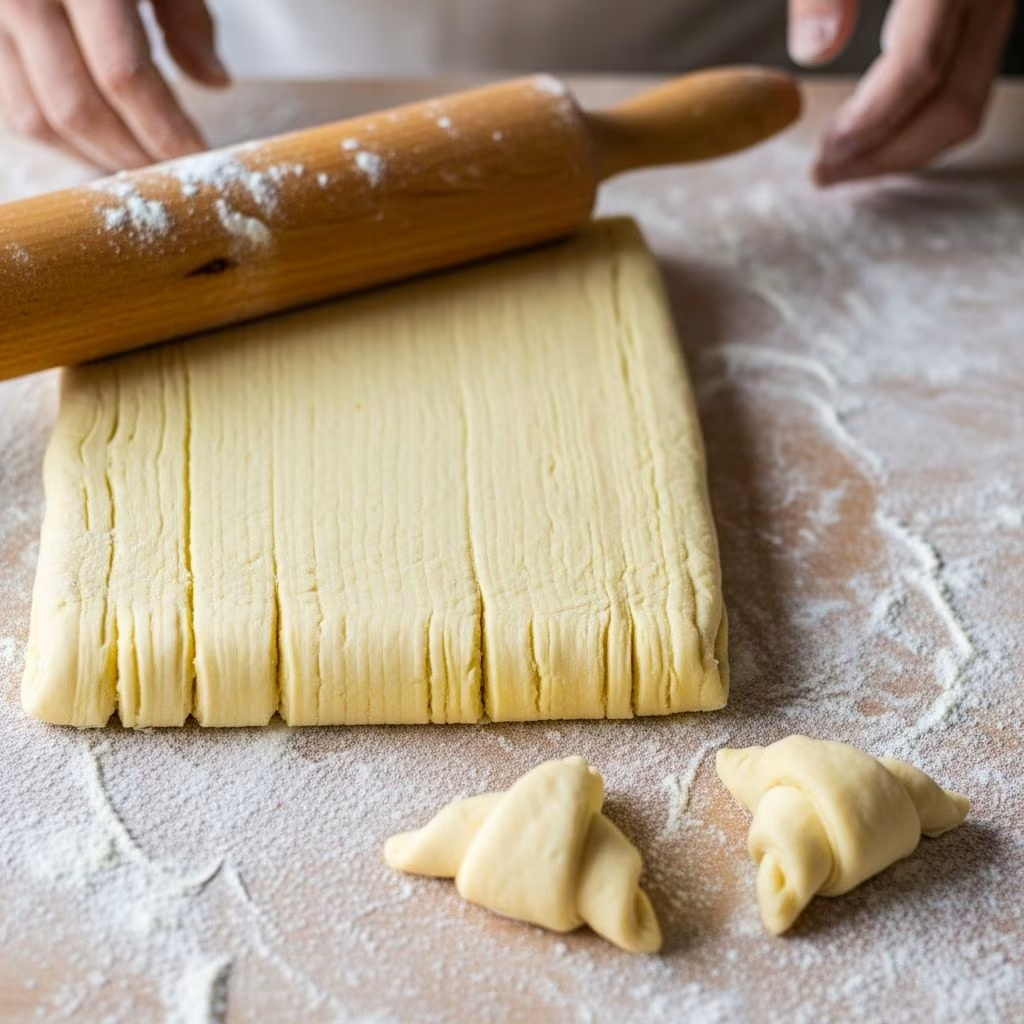
Soften the laminating butter with 1 tbsp flour to a pliable paste (68°F). On a floured surface, roll chilled dough to 12×20 inches. Spread butter evenly, leaving a ½-inch border. Perform a letter fold: Fold one-third over, then the other third on top, like a business envelope. Rotate seam right, roll to 10×18 inches, rewrap, and freeze 20-30 minutes.
Repeat twice more, rolling progressively smaller (8×16 inches final). Each chill prevents butter from softening too much, preserving distinct layers. Compress gently before use or dividing.
Shaping Classic Croissants
Roll rested dough to 10×15 inches on floured parchment-lined sheet. Trim edges straight. Mark 3½-inch intervals along bottom and top, cut into 10-inch triangles (3½-inch base). Stretch base to 12 inches, cut a ½-inch slit at base for better curl.
Roll tightly from base to tip, tucking point underneath. Space 2-3 inches apart on parchment pans. Cover loosely and proof 2-3 hours until puffy (doubled, jiggle test). Brush with egg wash (1 egg + 1 tbsp water + pinch salt). Bake at 400°F for 18-22 minutes until deep golden.
- Tips: Cold oven start optional for even rise.
- Proof in humid spot to prevent drying.
Creative Variations Beyond Croissants
This dough shines in versatility. For pain au chocolat, roll thin rectangles, add chocolate batons, seal, and bake similarly. Danish twists: Cut squares, fill centers with cheese-fruit, fold corners to enclose.
Cruffins (croissant-muffins): Roll into log, slice, muffin-tin bake. Morning buns: Coil slices, sugar-cinnamon dust. Cardamom pastry cream danishes pair with ganache dips for elegance.
Storage and Freezing
Freeze shaped unbaked pastries up to 3 months; proof fully before baking. Baked cool completely, store airtight 1-2 days or freeze. Reheat at 350°F for crisp revival.
Troubleshooting Common Issues
| Problem | Cause | Solution |
|---|---|---|
| Dense, flat croissants | Under-proofed or low butter fat | Extend proof time; use 82% butter |
| Butter leaks | Butter too warm during rolls | Chill longer between folds |
| Tough texture | Overworked dough | Mix minimally; chill adequately |
| Uneven layers | Inconsistent rolling pressure | Use ruler; roll gently even |
Humidity affects proofing—adjust times accordingly.
Advanced Techniques for Perfection
For ultra-flaky results, incorporate reverse lamination: Spread butter on dough underside first. Experiment with flours: 50/50 all-purpose/bread boosts chew. Add vanilla or orange zest to dough for aroma.
Pair with fillings like almond frangipane or ham-cheese for savory. Scale up for crowds, yielding 16-20 croissants per batch.
Frequently Asked Questions
Can I use regular butter instead of European-style?
Yes, but expect less lift—higher water content in standard butter (around 80% fat) causes steaming issues. European 82%+ is optimal.
How long does the full process take?
About 24 hours including overnight chill, but hands-on time is 1-2 hours.
Can this dough be made vegan?
Substitute plant-based butter (high-fat like Miyoko’s) and non-dairy milk; results approximate but less tender.
Why chill between folds?
Keeps butter firm, preventing absorption into dough for clear layers.
Scaling for smaller batches?
Halve ingredients; yields 8-10 pastries. Process identical.
This method democratizes laminated pastries, bringing professional textures to kitchens without patisserie skills. Experiment confidently for bakery triumphs.
References
- Foolproof Cheater Croissant Dough — The Vanilla Bean Blog, Sarah Kieffer. 2023. https://www.thevanillabeanblog.com/foolproof-cheater-croissant-dough/
- Cheater Croissant Dough — Good Eats By Mimi. 2023-11-19. https://goodeatsbymimi.blog/2023/11/19/cheater-croissant-dough/
- Cheater’s Croissants — PureWow. N/A. https://www.purewow.com/recipes/cheaters-croissants
- Cheats Croissant Dough — The Boy Who Bakes, Edd Kimber. N/A. https://eddkimber.substack.com/p/cheats-croissant-dough