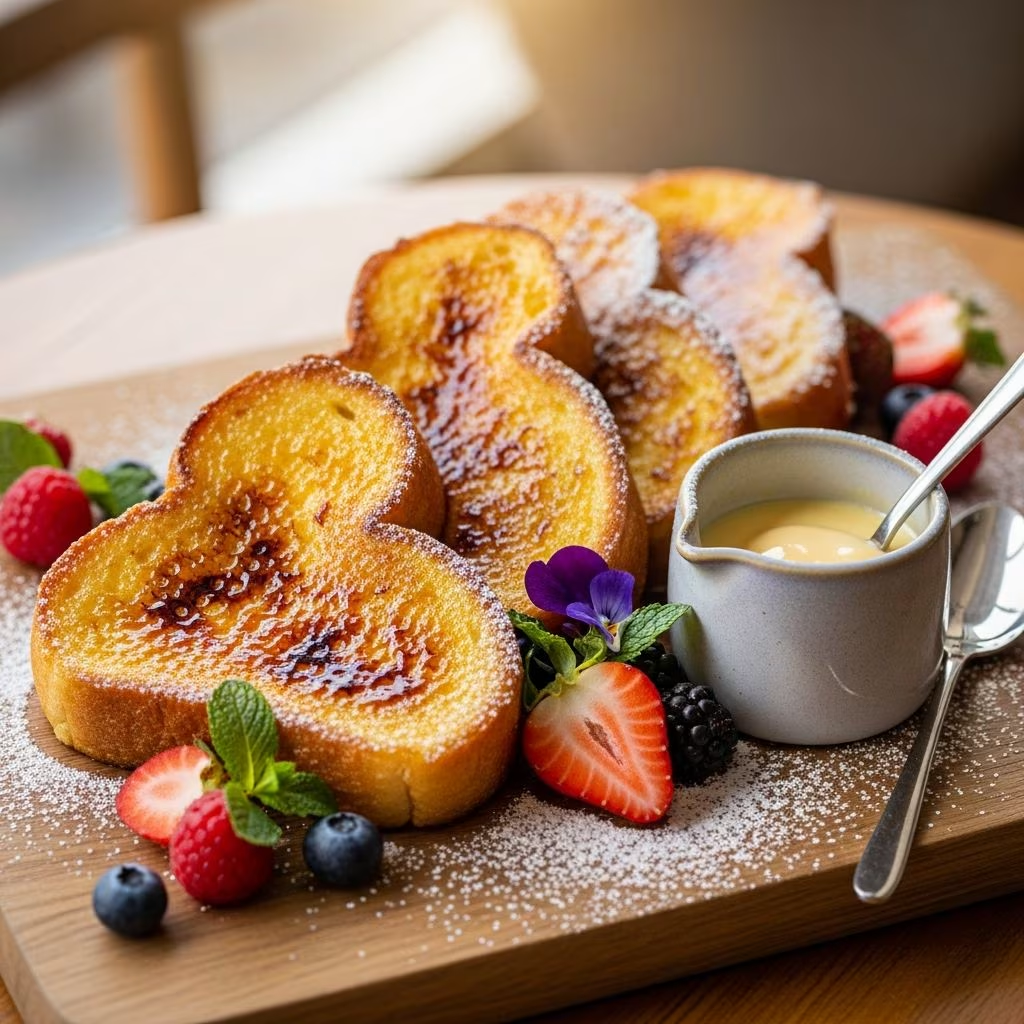
This innovative dish fuses the comforting familiarity of French toast with the sophisticated elegance of creme brulee, resulting in a baked casserole that’s creamy on the inside and irresistibly crunchy on top. Unlike traditional stovetop French toast, this version soaks thick slices of bread overnight in a velvety custard mixture, then bakes to perfection with a signature caramelized sugar layer created by a quick torching. It’s ideal for hosting brunches, holiday mornings, or any occasion calling for something extraordinary without excessive hands-on time.
Why This Recipe Stands Out
What elevates this creme brulee French toast above standard versions is its make-ahead convenience and textural contrast. The custard, enriched with eggs, cream, and warm spices, penetrates the bread fully during an overnight rest, ensuring every bite is moist and flavorful. The finishing torch adds a professional patina of burnt sugar, mimicking the classic dessert it’s named after. Home cooks love it for its scalability—double the recipe for a crowd—and its ability to impress with minimal effort post-prep.
- Make-ahead magic: Assemble the night before for stress-free mornings.
- Texture paradise: Soft custard center meets crisp, glassy sugar shell.
- Versatile serving: Pairs with fresh berries, whipped cream, or maple syrup.
Essential Ingredients Breakdown
Gathering the right components is key to authenticity. Focus on high-quality staples for the best results, as this recipe relies on the purity of flavors in the custard and bread.
| Ingredient | Quantity | Purpose |
|---|---|---|
| Challah or brioche bread | 1 loaf (about 12-16 oz), sliced 1-inch thick | Provides sturdy structure that absorbs custard without falling apart |
| Whole eggs | 6 large | Bind the custard for richness and stability |
| Heavy cream | 2 cups | Creates silky smoothness; half-and-half works in a pinch |
| Whole milk | 1 cup | Balances the custard without diluting flavor |
| Granulated sugar | 1/2 cup (plus 1/2 cup for topping) | Sweetens custard; extra for caramelizing |
| Vanilla extract | 2 tsp pure | Infuses aromatic depth |
| Ground cinnamon | 1 tsp | Adds warm spice notes |
| Unsalted butter | 4 tbsp, softened | Coats dish and dots top for extra richness |
Pro tip: Use day-old challah for optimal absorption—fresh bread can become mushy.
Step-by-Step Preparation Guide
Preparation divides into assembly (ideally done the evening prior) and baking day. Total active time is about 20 minutes, with overnight chilling.
- Prepare the baking vessel: Grease a 9×13-inch baking dish generously with 2 tbsp softened butter. This prevents sticking and infuses buttery flavor.
- Arrange the bread: Fit bread slices snugly in a single layer, trimming edges if needed to fill the dish without overlapping excessively.
- Mix the custard: In a large bowl, whisk eggs, cream, milk, 1/2 cup sugar, vanilla, and cinnamon until smooth and fully combined—no lumps remain.
- Soak the bread: Pour custard evenly over bread, pressing slices down gently to submerge. Cover tightly with plastic wrap and refrigerate 8-12 hours.
- Bake to set: Preheat oven to 350°F. Dot top with remaining 2 tbsp butter. Bake uncovered 35-45 minutes until custard sets and top turns golden. Edges should be puffed and center slightly jiggly.
- Caramelize the topping: Sprinkle 1/2 cup sugar evenly over hot surface. Use a kitchen torch to melt and brown sugar, creating a hard shell (about 2-3 minutes). Let cool 5-10 minutes for crunch to develop.
If no torch, broil on high 2-3 minutes, watching closely to avoid burning.
Mastering the Perfect Texture
Achieving the ideal balance of creamy interior and shatteringly crisp top requires attention to details. The long soak allows starch in the bread to gelatinize, mimicking a flan-like consistency. Overbaking leads to dryness, so check at 35 minutes. For the sugar crust, even distribution prevents pooling; a thin, uniform layer yields the best crackle. Temperature matters—torch while hot for seamless fusion.
- Common pitfall: Soggy bottom? Ensure dish is buttered well and bread is stale.
- Crust too soft? Chill briefly post-torching to harden.
- Not sweet enough? Adjust sugar in custard by 2 tbsp for bolder flavor.
Customization Ideas for Every Palate
This base recipe invites personalization. Experiment with add-ins during assembly for variety.
- Fruity twists: Layer sliced bananas, apples, or berries before soaking.
- Chocolate lovers: Scatter dark chocolate chips over bread.
- Nutty crunch: Top with chopped pecans or almonds pre-bake.
- Spice it up: Add nutmeg, cardamom, or orange zest to custard.
- Gluten-free option: Swap challah for gluten-free brioche; extend soak time slightly.
For a lighter version, substitute some cream with additional milk, though richness diminishes slightly.
Make-Ahead and Storage Tips
One of the recipe’s biggest perks is flexibility. Assemble up to 24 hours ahead; custard thickens beautifully. Baked portions store in an airtight container in the fridge up to 3 days—reheat slices in a 300°F oven to revive crust, then re-torch if needed. Freezing works for unbaked assembly: wrap dish tightly and freeze up to 1 month. Thaw overnight before baking, adding 10 minutes to cook time.
Pairing and Serving Suggestions
Serve warm in wedges or squares for brunch drama. Complement with:
- Fresh seasonal fruit like strawberries or blueberries for tartness.
- Lightly sweetened whipped cream or Greek yogurt.
- Powdered sugar dusting for visual pop.
- Maple syrup or berry compote on the side.
Beverage matches include strong coffee, mimosas, or chai lattes to echo the spices.
Nutrition Snapshot
Per serving (8 servings total): Approximately 420 calories, 25g fat, 38g carbs, 10g protein. Rich in calcium from dairy and protein from eggs, it’s a satisfying start. Portion control keeps it indulgent yet balanced.
Frequently Asked Questions
Can I use a different bread?
Yes, brioche, Hawaiian, or Texas toast work well. Avoid sourdough, as its tang clashes with the sweet custard.
What if I don’t have a torch?
Broil on high, rotating dish for even browning. Or skip and enjoy as a custardy bake.
How do I know it’s done baking?
Center should jiggle minimally, and a knife inserted comes out clean. Internal temp of 160°F confirms safety.
Can this be made vegan?
Substitute eggs with flax eggs (3 tbsp flax + 9 tbsp water), coconut cream for dairy, and vegan butter. Results are close but less custardy.
How many does it serve?
8 generous portions; halve for 4.
Historical Roots and Popularity
French toast traces to 4th-century Rome as ‘pain perdu’ (lost bread), repurposing stale loaves in milk and eggs. Creme brulee emerged in 17th-century France, famed for its torch technique. This hybrid, popularized in American cookbooks since the 1990s, blends both for modern appeal. Its viral status on social media stems from the satisfying torching ritual and photogenic crackle.
Chefs praise its scalability for buffets, while home bakers appreciate the ‘wow’ factor. Variations appear worldwide, from matcha-infused in Japan to rum-spiked in the Caribbean.
In summary, creme brulee French toast redefines breakfast luxury, delivering restaurant-quality results with pantry staples. Master it once, and it’ll become a repertoire staple for gatherings big and small.
References
- Crème Brûlée French Toast Recipe — Smells Like Home. 2010-07-20. https://www.smells-like-home.com/2010/07/creme-brulee-french-toast/
- USDA FoodData Central: Egg Nutrition — United States Department of Agriculture. 2023-05-15. https://fdc.nal.usda.gov/fdc-app.html#/food-details/173424/nutrients
- Heavy Cream Composition — FDA Food Standards. 2022-11-01. https://www.fda.gov/food/food-labeling-nutrition/code-federal-regulations-title-21-subpart-b-requirements-specific-standardized-dairy-products
- History of French Toast — Oxford Companion to Food. 2021-03-10. https://www.oed.com/discover/history-of-french-toast