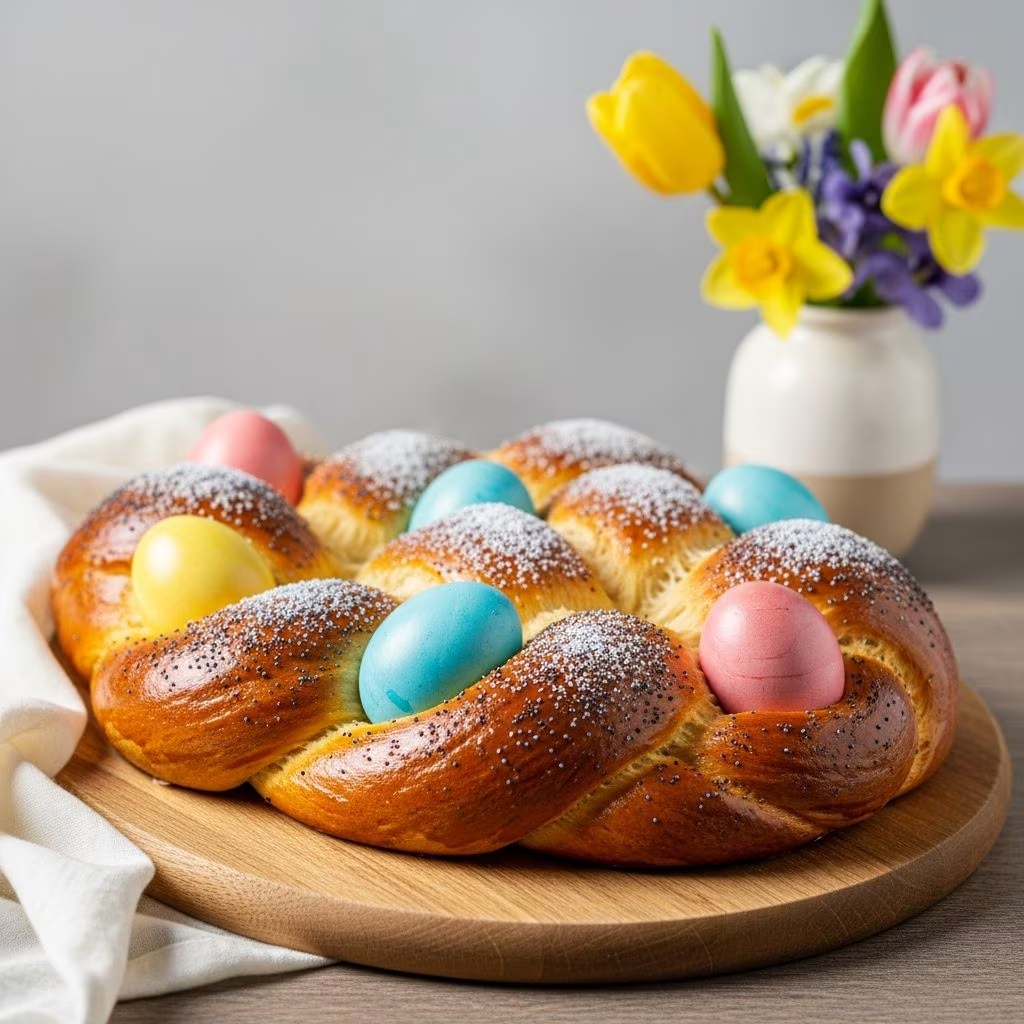
This enriched dough bread, woven into elegant braids and crowned with vibrant dyed eggs, embodies the spirit of Easter celebrations across cultures, particularly in Italian traditions where it symbolizes renewal and family gatherings. Soft, slightly sweet, and infused with citrus notes, it transforms simple ingredients into a show-stopping centerpiece.
The Cultural Roots of Easter Braided Bread
Braided Easter bread traces its origins to Mediterranean baking customs, especially Italian Pane di Pasqua, where the braid represents unity and the embedded eggs signify fertility and new life. Families pass down recipes, adapting them with local flavors like orange zest or sesame seeds. This bread pairs perfectly with Easter meals, offering a sweet contrast to savory dishes.
Variations appear in Greek tsoureki or Armenian choreg, but the core remains: a rich yeast dough proofed slowly for tenderness, braided artfully, and baked with uncooked dyed eggs that cook gently inside, their colors bleeding slightly for a rustic charm.
Essential Ingredients for Authentic Flavor
Gather high-quality components to achieve the signature fluffy texture and subtle sweetness. The dough relies on an enriched base with eggs, butter, and milk for brioche-like softness.
- Warm milk (about ¾ cup): Activates yeast without killing it; aim for 100-115°F.
- Active dry yeast (2¼ tsp or one packet): Provides lift; proof it first to ensure viability.
- Eggs (3-4 large, plus one for wash): Adds richness, color, and structure; reserve raw dyed eggs for nesting.
- Sugar (½-¾ cup granulated): Sweetens mildly; some recipes include honey for depth.
- Butter (½ cup, softened): Creates tenderness; incorporate gradually.
- Flour (4-4½ cups all-purpose): Forms gluten for structure; sift for lightness.
- Flavorings: Vanilla extract (1 tsp), orange/lemon zest (1 each), and optional almond extract for aromatic lift.
- Salt (¼-½ tsp): Balances sweetness.
- Toppings: Colored nonpareils, sesame seeds, or pearl sugar for crunch.
Raw, hard-boiled, or dyed eggs (traditionally uncooked for baking) nest in the center, absorbing heat slowly to set without overcooking the bread.
Step-by-Step Dough Preparation
Patience is key; this process spans several hours, including multiple rises for optimal flavor development.
Proof the yeast: Dissolve yeast in warm milk with a teaspoon of sugar. Let foam for 10 minutes, confirming activity.
Mix wet ingredients: In a stand mixer with paddle attachment, beat eggs and sugar until pale and frothy (3-4 minutes). Add honey (if using), vanilla, citrus zests, and yeast mixture. Incorporate softened butter cubes; it may look curdled initially—this resolves during kneading.
Develop the dough: Switch to dough hook. Add flour gradually (½ cup at a time) with salt. Knead on low, then medium for 8-10 minutes until smooth, elastic, and slightly tacky. It should pull away from bowl sides and wrap around the hook.
First rise: Place in a greased bowl, cover with plastic or damp cloth. Let rise in a warm spot (75-85°F) for 2-3 hours until doubled. Ideal spots include near a sunny window or in an oven with light on.
| Stage | Time | Temperature | Expected Volume Increase |
|---|---|---|---|
| First Rise | 2-3 hours | 75-85°F | Doubled |
| Shaping Rise | 1-2 hours | 75-85°F | 50-100% puffier |
| Final Proof | 30-60 minutes | Room temp | Visible expansion |
Mastering the Braid and Egg Nesting
Braiding elevates this bread from simple loaf to art. Divide risen dough into three equal portions (use a scale for precision, about 300-400g each for a large loaf).
Roll each into 20-24 inch ropes on a clean, unfloured surface. Wet hands lightly if dough slips for better grip.
Pinch tops together firmly. Braid tightly, crossing sections evenly to avoid gaps. Pinch bottom ends securely.
Form a circle by joining ends, or leave linear for mini loaves. Create an indent in the center weave for eggs.
Position 1-3 uncooked dyed eggs gently, pressing slightly so they stay put during rising. For minis, use one per braid.
Place on parchment-lined sheets. Cover loosely and proof 1-2 hours until puffy. Eggs may shift slightly—reposition if needed.
Baking to Golden Perfection
Preheat oven to 350°F. Prepare egg wash: Whisk 1 yolk or whole egg with 1 tbsp milk or water for shine.
- Brush dough generously, avoiding eggs to preserve color.
- Sprinkle toppings: Nonpareils for festivity, sesame for nutty crunch.
- Bake 15-20 minutes uncovered for color, then tent with foil. Continue 15-25 minutes until internal temp hits 190°F and bottom is golden. Total time: 30-45 minutes depending on size.
- Cool on wire rack. Eggs will be softly cooked; serve warm or at room temp.
Pro Tip: Smaller braids (from 8oz dough balls) bake faster (15-18 min at 330°F) and yield more uniform results for beginners.
Customization Ideas for Every Celebration
- Mini Versions: Divide into 4-6 portions for individual servings; perfect for baskets or kids.
- Flavor Twists: Add anise seeds, cardamom, or almond extract for regional flair.
- Vegan Adapt: Use aquafaba for eggs, plant milk, and vegan butter.
- Gluten-Free: Swap with a 1:1 GF flour blend, adding xanthan gum.
- Fillings: Stuff braids with Nutella or pastry cream pre-baking.
Storage, Freezing, and Serving Suggestions
Store airtight at room temp for 2 days or refrigerate up to 5. Freeze baked loaves (without eggs) up to 3 months; thaw and refresh at 300°F for 10 minutes.
Serve sliced with butter, alongside Easter ham, or as French toast. The pull-apart texture shines when shared family-style.
Frequently Asked Questions
Can I use instant yeast instead?
Yes, skip proofing and add directly to flour. Reduce by 25% (about 1¾ tsp).
What if my dough doesn’t rise?
Check yeast freshness, water temp (not over 115°F), and draft-free warmth. Punch down and re-proof if needed.
Do the eggs need to be hard-boiled?
No, raw dyed eggs bake perfectly inside, cooking to a custard-like texture without bursting.
How do I dye eggs for the bread?
Use food coloring in water-vinegar baths pre-assembly. Uncooked works best for vibrant results.
Why cover with foil midway?
Prevents over-browning top while interior fully bakes, ensuring even doneness.
Troubleshooting Common Issues
| Problem | Cause | Solution |
|---|---|---|
| Dense bread | Under-kneaded or under-proofed | Knead longer next time; proof until finger poke slowly rebounds |
| Eggs sink out | Insufficient indent or over-proof | Braid tighter; proof shorter; secure with dough scraps |
| Pale crust | Weak egg wash | Use yolk-heavy wash; bake uncovered longer initially |
| Dry texture | Too much flour | Weigh flour; measure by spooning into cup, not scooping |
With practice, this bread becomes a cherished ritual. Experiment to make it your own while honoring time-tested methods.
References
- Italian Braided Easter Bread with Eggs — Mangia Bedda. Accessed 2026. https://www.mangiabedda.com/italian-braided-easter-bread-with-eggs/
- Mini Braided Easter Bread Recipe — Cooking LSL. Accessed 2026. https://cookinglsl.com/mini-braided-easter-bread-recipe/
- Sweet Braided Easter Bread with Sesame Seeds — Simply Organic. Accessed 2026. https://www.simplyorganic.com/recipes/sweet-braided-easter-bread-with-sesame-seeds
- Braided Easter Bread That’ll Steal the Show — Uncle Giuseppe’s Marketplace via YouTube. Accessed 2026. https://www.youtube.com/watch?v=0yn9Rm9jH64
- Italian Easter Bread Recipe: Pane di Pasqua — She Loves Biscotti. Accessed 2026. https://www.shelovesbiscotti.com/linas-italian-easter-sweet-bread/