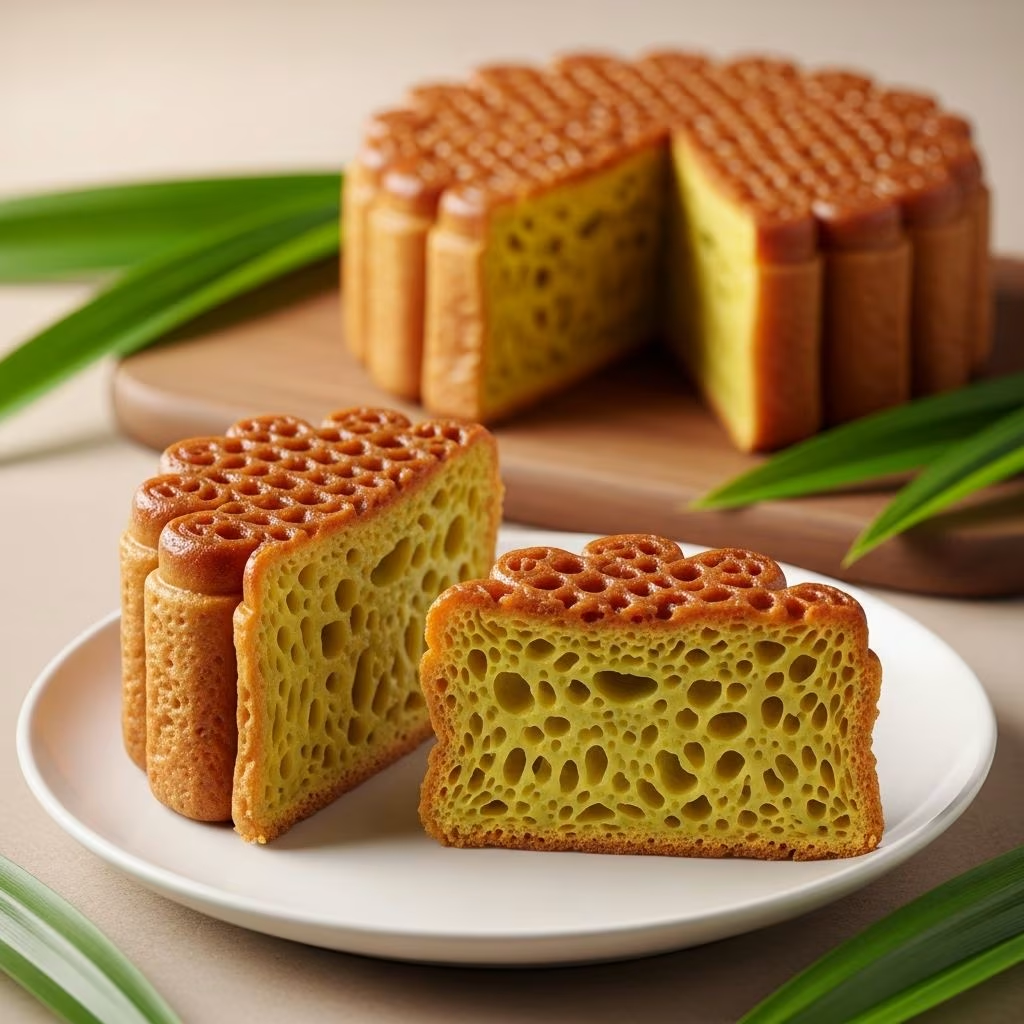
Vietnamese honeycomb cake, known as Banh Bo Nuong, captivates with its vibrant green hue, springy texture, and distinctive bubble-filled interior resembling a beehive. This gluten-free delight, rooted in Vietnamese street food culture, relies on tapioca starch for chewiness and precise leavening for those signature pockets. Originating from simple home baking traditions, it has evolved into a beloved dessert across Asia, often enjoyed fresh from markets or ovens.
The Allure of Banh Bo Nuong’s Unique Texture
The magic of this cake lies in its transformation during baking. Tapioca starch, the backbone of the recipe, gelatinizes under heat to create a chewy, moist crumb unlike wheat-based cakes. When combined with single-acting baking powder or baking soda and cream of tartar, it produces rapid gas expansion, forming large, irregular air pockets that give the cross-section its honeycomb appearance.
Achieving this requires a light, aerated batter. Overmixing deflates it, while under-whisking leaves lumps. The batter pours thin and foamy, expanding dramatically in a hot pan to prevent sinking. Cooling techniques, like leaving it in the oven post-bake, stabilize the structure, ensuring it doesn’t collapse.
Essential Ingredients for Authentic Flavor
Core components define Banh Bo Nuong’s tropical profile. Coconut milk or cream imparts richness and subtle sweetness, pairing seamlessly with pandan for an aromatic lift. Pandan, from screwpine leaves, delivers a nutty, vanilla-like essence and natural green color—fresh juice blended with extract yields the boldest taste.
- Tapioca starch (160g-2 cups): No substitutes; provides chew and structure.
- Eggs (5-8 large): Room temperature for better emulsion; whisked extensively for aeration.
- Sugar (1-1.5 cups): White for pandan version, brown for caramel notes.
- Leavening agents: Single-acting baking powder (essential for one-time rise) or bicarb soda + cream of tartar.
- Flavorings: Pandan extract (0.5-1 tsp), vanilla (0.5 tsp optional).
Variations include butter instead of oil for tenderness or rice flour for added chew. Full-fat coconut products ensure moisture without separation.
Step-by-Step Baking Guide
Success hinges on temperature control, pan prep, and timing. Preheat your oven to 350°F (175-180°C) with the pan inside—this shocks the batter for maximum rise.
- Prepare coconut base: Warm 1 cup coconut milk/cream with sugar, salt, pandan extract/juice, and oil/butter until dissolved (no boil). Cool to room temp.
- Whisk eggs: Beat 5-8 eggs for 5 minutes until pale and frothy, then incorporate coconut mixture slowly.
- Add dries: Sift in tapioca starch (and rice flour if using), whisk 5 minutes for smoothness. Finish with leavening; mix 30 seconds max.
- Strain batter: Pour through a fine sieve into hot, greased bundt/round pan (8-inch). Bang pan to burst large bubbles.
- Bake: 40-60 minutes until golden. Turn off oven, rest 10-20 minutes inside with door cracked.
- Cool and unmold: Invert immediately onto rack; flip upright to cool fully.
For bundt pans, cover the center hole with foil during preheat to even heat distribution.
Pan Selection and Preparation Tips
Metal bundt or round pans (8-9 inch) conduct heat best for crisp edges and even rising. Nonstick spray or oil is crucial; dust with tapioca for release. Preheating the pan (325-350°F) creates steam for lift, but handle with mitts. Avoid glass—poor heat conduction leads to uneven baking.
| Pan Type | Pros | Cons | Best For |
|---|---|---|---|
| Bundt | Dramatic shape, even cooking | Foil needed for hole | Pandan versions |
| Round | Simple slices | May need lining | Beginners |
| Loaf | Portion control | Less rise | Variations |
Flavor Variations to Explore
While pandan reigns supreme, experiment mindfully to preserve texture.
- Chocolate: Add 2 tbsp cocoa powder; reduce sugar slightly.
- Matcha: Swap pandan for 1 tsp matcha powder in coconut base.
- Plain Vanilla: Omit pandan; double vanilla extract.
- Gluten-Free Original: Stick to recipe; already GF.
- Brown Sugar: For molasses depth, use dark sugar.
Pandan-coconut remains classic, evoking Vietnamese bakeries.
Troubleshooting Common Issues
Flat cake? Heavy batter or wrong leavener—use single-acting powder only. Sunken center: Open oven too soon or underbake. Pale color: Insufficient pandan or low heat. Sticky sides: Insufficient greasing or premature unmolding.
Pro Tips:
- Whisk eggs in one direction to minimize bubbles.
- Test doneness with toothpick—crumbly, not wet.
- Store airtight; best day-of, but freezes well sliced.
Nutritional Profile and Storage
Per slice (1/12 cake): ~250 calories, high carbs from tapioca, moderate fat from coconut. Gluten-free, but egg-heavy. Refrigerate up to 3 days; refresh in microwave 10 seconds. Freeze slices wrapped for 1 month.
Frequently Asked Questions
What if I can’t find pandan?
Use 1 tsp extract alone, or substitute vanilla/matcha. Fresh leaves blended yield best results.
Why single-acting baking powder?
It activates once upon heat, preventing pre-oven rise and collapse. Double-acting causes deflation.
Can I use all-purpose flour?
No—tapioca is key for chew and bubbles.
How to achieve vibrant green?
Combine fresh pandan juice + extract; avoid boiling coconut mix.
Bundt vs. round pan?
Bundt for visuals; round for ease.
Pairing and Serving Ideas
Serve plain, with coconut whipped cream, or fresh fruit like mango. Pairs with Vietnamese coffee for contrast. At parties, slice thin for bite-sized treats.
Mastering Banh Bo Nuong rewards patience with stunning results. Practice leavening precision and batter lightness for that perfect honeycomb reveal.
References
- Vietnamese Honeycomb Cake (Banh Bo Nuong) — Scruff & Steph. 2018-07-17. https://scruffandsteph.com/2018/07/17/vietnamese-honeycomb-cake-banh-bo-nuong/
- How To Make Bánh Bò Nướng (Vietnamese Honeycomb Cake) — Jen H. Dao. N/A. https://jenhdao.com/banh-bo-nuong/
- Easy Banh Bo Nuong (Vietnamese Honeycomb Cake) — Cooking Therapy. N/A. https://www.cooking-therapy.com/banh-bo-nuong/
- Gluten Free Pandan Vietnamese Honeycomb Cake — Hummingbird High. 2024-05. https://www.hummingbirdhigh.com/2024/05/gluten-free-pandan-vietnamese-honeycomb-cake.html
- Easy Vietnamese Pandan and Coconut Honeycomb Cake — Amy Le Kitchen. N/A. https://amylekitchen.com/easy-vietnamese-pandan-and-coconut-honeycomb-cake/