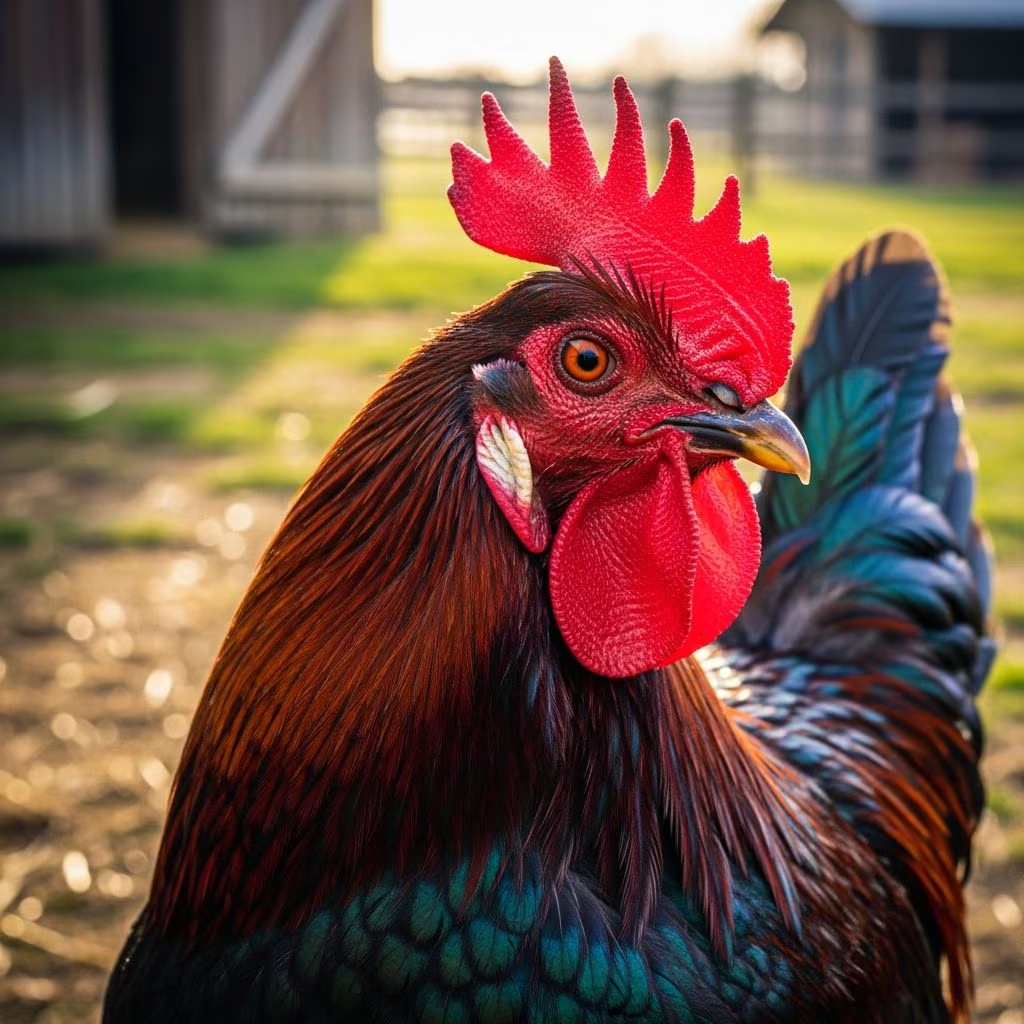
Chickens rank among the most widespread domesticated animals globally, yet their capabilities often go unnoticed amid everyday familiarity. These birds exhibit remarkable intelligence, sensory acuity, and biological adaptations that rival many higher animals. This article delves into their cognitive prowess, visual superiority, reproductive feats, and social intricacies, drawing from verified observations to reveal why chickens deserve greater appreciation.
The Extraordinary World of Chicken Senses
Chickens possess sensory systems far more advanced than typically assumed, starting with their vision. Unlike humans with three color receptors, chickens enjoy tetrachromatic vision, detecting ultraviolet light alongside red, green, and blue spectra. This allows them to perceive wavelengths from 350-780 nm, enabling hens to select mates with vibrant UV-reflective plumage and spot nutrient-rich foods invisible to us.
Their eyes process images at 150-200 frames per second, compared to human limits of 25-30, making flickering lights stressful for them while appearing steady to people. This heightened processing aids predator detection and foraging efficiency. Chickens also taste salt but lack sweetness perception, influencing feed preferences.
Key Sensory Comparisons
| Feature | Chickens | Humans |
|---|---|---|
| Color Receptors | 4 (incl. UV) | 3 |
| Image Processing Speed | 150-200 fps | 25-30 fps |
| Wavelength Range | 350-780 nm | 380-740 nm |
| Taste Sweetness | No | Yes |
These traits underscore chickens’ evolutionary adaptations for survival in diverse environments.
Cognitive Abilities That Rival Primates
Dismissing chickens as dim-witted overlooks substantial evidence of their smarts. They recognize and remember over 100 faces—human or avian—for years, associating them with positive or negative experiences and sharing insights with flock mates. This episodic memory lets them recall event specifics, like food cache locations.
Chickens demonstrate self-control akin to young children, delaying gratification for bigger rewards in experiments. They solve puzzles by pecking correct pieces and navigate mazes adeptly, showcasing spatial intelligence comparable to dogs or cats. Far from ‘bird-brained,’ their brains handle complex object permanence and empathy, with hens buffering stressed chicks socially.
- Face Recognition: Up to 100 individuals, long-term retention.
- Problem-Solving: Puzzle-solving and treat-finding under cups.
- Empathy: Hens comfort distressed chicks.
- Self-Control: Opt for larger future rewards.
Complex Communication and Social Bonds
Chickens vocalize around 30 distinct calls, conveying food discoveries, warnings, or gratitude. Hens uniquely ‘talk’ to unhatched chicks through eggshells, teaching recognition sounds before birth; embryos chirp responses. This prenatal bonding fosters immediate post-hatch cohesion.
They play enthusiastically—running, flapping, skipping—and sunbathe socially. Flock dynamics involve hierarchies, alliances, and information sharing, with individuals passing face-based threat alerts. Chickens dream during REM sleep, twitching as if reliving pecks or flights, and practice unihemispheric sleep: one brain hemisphere rests while the other stays vigilant, eye open.
Egg-Laying Marvels and Production Records
Hens lay 250-300 eggs yearly under optimal conditions, with outliers like a University of Missouri Leghorn producing 371 in 364 days—over one daily. Eggs vary in size; the largest recorded weighed nearly 12 ounces (or 1 pound per some accounts), dwarfing standard 1.75-ounce mediums. Aging hens produce fewer but larger eggs. Mothers rotate eggs ~50 times daily for even heating.
Myths abound: Turkens aren’t turkey-chicken hybrids, and true gender swaps don’t occur, though rare bilateral gynandromorphs appear half-male, half-female. A hen once laid seven eggs in a day, per reports.
Top Egg Production Benchmarks
| Record | Details | Source |
|---|---|---|
| Annual Eggs | 371 in 364 days | Leghorn strain |
| Single Day | 7 eggs | Reported max |
| Largest Egg | ~12 oz / 1 lb | Historical record |
| Daily Rotations | 50 times | Maternal care |
Physical Resilience and Quirky Traits
Chickens aren’t fully flightless, managing short bursts to perch or evade danger, remnants of red junglefowl ancestry. Their hearts race at 300+ beats per minute. Stress triggers feather loss, and beaks bleed easily. Lifetime manure from one chicken powers a 100-watt bulb for five hours via biogas.
Phobias like alektorophobia target chickens. The oldest, Muffy, reached 22 years. Global KFC consumption could encircle Earth 11 times equatorially. They descend from dinosaurs, retaining flight echoes.
Evolutionary Roots and Modern Implications
Domesticated ~8,000 years ago from red junglefowl, chickens evolved tropical survival skills like tree roosting. Today, understanding their needs—stable lighting, enrichment, social groups—boosts welfare and productivity in farming. Their UV vision informs better feed and housing designs.
Frequently Asked Questions (FAQs)
Do chickens recognize humans?
Yes, they distinguish over 100 faces, recalling interactions long-term.
Can chickens see ultraviolet light?
Absolutely, via tetrachromatic vision, aiding foraging and mate choice.
How many eggs does a chicken lay yearly?
Typically 250-300, with records up to 371.
Do chickens dream?
Yes, they show REM sleep and unihemispheric rest.
Are chickens smart?
They solve problems, empathize, and self-regulate like young children or pets.
Practical Tips for Chicken Keepers
- Provide UV-transmissive lighting to mimic natural vision.
- Use consistent routines leveraging their memory.
- Offer toys and space for play to reduce stress.
- Monitor heart rates and feathers for health cues.
- Ensure perches for short flights and roosting.
References
- Chickens are cool! (50 chicken facts you will love) — Backyard Chickens. 2023. https://www.backyardchickens.com/articles/chickens-are-cool-50-chicken-facts-you-will-love.66963/
- 20 Crazy Chicken Facts for Chicken Trivia — The Pioneer Chicks. 2023. https://www.thepioneerchicks.com/10-crazy-chicken-facts/
- 7 Interesting Facts About Chickens You Might Not Know — Poultry Scales (BAT Scales). 2023. https://poultryscales.com/academy/7-interesting-facts-about-chickens-you-might-not-know
- Fun FACTS About Chickens You Never Knew | Facts for Kids — YouTube (Hey! Guess What?). 2023. https://www.youtube.com/watch?v=uZ1OF7Bh1do
- 10 fun facts about chickens — BC SPCA. 2023. https://spca.bc.ca/news/fun-facts-about-chickens/
- Chicken facts: funny to thought-provoking — World Animal Protection. 2023. https://www.worldanimalprotection.org/latest/blogs/11-facts-about-chickens/
- 10 Facts About Chickens — FOUR PAWS USA. 2023. https://www.fourpawsusa.org/campaigns-topics/topics/farm-animals/10-facts-about-chickens